

Close Menu
    Facebook X (Twitter) Instagram
    SciTechDaily
    • Biology
    • Chemistry
    • Earth
    • Health
    • Physics
    • Science
    • Space
    • Technology
    Facebook X (Twitter) Pinterest YouTube RSS
    SciTechDaily
    Home»Earth»Hong Kong Temperatures to Rise by 2-3 Degrees Celsius in 30 Years
    Earth

    Hong Kong Temperatures to Rise by 2-3 Degrees Celsius in 30 Years

    By SciTechDailyJanuary 2, 2013No Comments2 Mins Read
    Facebook Twitter Pinterest Telegram LinkedIn WhatsApp Email Reddit
    Share
    Facebook Twitter LinkedIn Pinterest Telegram Email Reddit
    hong-kong-bay-temperature
    Hong Kong Bay

    The temperature in the inner urban areas of Honk Kong, China, is predicted to rise by two to three degrees Celsius (5.4 degrees Fahrenheit) in the next 30 years, according to researchers at the Department of Land Surveying and Geo-Informatics (LSGI) of the Hong Kong Polytechnic University (PolyU).

    The scientists used remote sensing technology as well as satellite images to map the distribution of temperatures for daytime and nighttime over Hong Kong. Taking into consideration the temperature change due to greenhouse-induced warming as well as the impact of urbanization, known as the Urban Heat Island (UHI) effect, these maps model the temperature changes for the next 30 years.
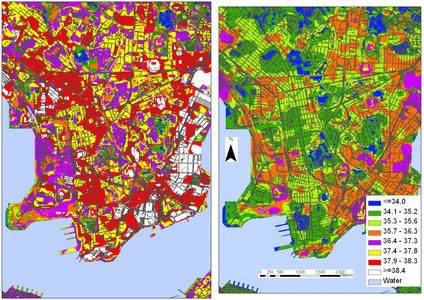
    Projected daytime temperature map of Kowloon
    Left: Projected daytime temperature map of Kowloon in 2039. Right: Daytime temperature map of Kowloon in 2009.

    The urban area of Hong Kong is significantly warmer than its rural surroundings, and the temperature difference is larger at night and in winter. These increases are caused by high-rise buildings that block thermal radiation at night, materials with thermal bulk properties, like asphalt and concrete, and the lack of vegetation.
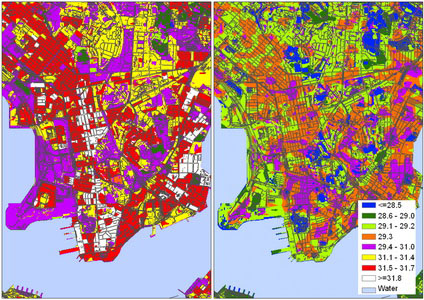
    temperature map of Kowloon
    Left: Projected nighttime temperature map of Kowloon in 2039. Right: Nighttime temperature map of Kowloon in 2008.

    Urbanization is an additional factor in causing the temperature rise, and if current trends continue, temperatures could increase much faster in the future, states Janet Nichol, lead author. The annual temperature in Hong Kong could rise by 3.0 to 6.0 degrees Celsius (5.4 to 10.8 degrees Fahrenheit) by 2100, given that there will be no further urbanization. However, within the same period with a constant urbanization rate as before, the temperature rise is predicted to rise by 3.7 to 6.8 Celsius degrees (6.7 to 12.2 degrees Fahrenheit) within the same period.

    The study also suggests that in the next three decades, nighttime temperatures in the center of Kowloon are expected to rise by at least two degrees Celsius, reaching 31.5˚C (88.7 ˚F)at night, making most urban districts in the city “uncomfortable” at night by 2039.

    Never miss a breakthrough: Join the SciTechDaily newsletter.
    Follow us on Google and Google News.

    Climate Change Global Warming Urbanization
    Share. Facebook Twitter Pinterest LinkedIn Email Reddit

    Related Articles

    The Role of Climate Change in Chemical Weathering of Rocks

    NASA Study Reveals Multi-Year Ice Declining Faster than Perennial Ice that Surrounds It

    New Research Shows Southern Ocean as a Powerful Influence on Climate Change

    Earth’s Clouds are Getting Lower, May be in Response to Global Warming

    New Models Hone Picture of Climate Impact on Earth

    Research Shows Roughly 150 Billion Tons of Ice Lost Annually

    Researchers Study the Link Between Gas Hydrates and Climate Warming

    Criegee Intermediate Reactions Detected and Measured by Sandia Researchers

    Criegee Biradicals May Cool Planet and Offset Global Warming

    Leave A Reply Cancel Reply

    • Facebook
    • Twitter
    • Pinterest
    • YouTube

    Don't Miss a Discovery

    Subscribe for the Latest in Science & Tech!

    Trending News

    Scientists Uncover Potential Brain Risks of Popular Fish Oil Supplements

    Scientists Discover a Surprising Way To Make Bread Healthier and More Nutritious

    After 60 Years, Scientists Uncover Unexpected Brain Effects of Popular Diabetes Drug Metformin

    New Research Uncovers Hidden Side Effects of Popular Weight-Loss Drugs

    Scientists Rethink Extreme Warming After Surprising Ocean Discovery

    Landmark Study Links Never Marrying to Significantly Higher Cancer Risk

    Researchers Discover Unknown Beetle Species Just Steps From Their Lab

    Largest-Ever Study Finds Medicinal Cannabis Ineffective for Anxiety, Depression, PTSD

    Follow SciTechDaily
    • Facebook
    • Twitter
    • YouTube
    • Pinterest
    • Newsletter
    • RSS
    SciTech News
    • Biology News
    • Chemistry News
    • Earth News
    • Health News
    • Physics News
    • Science News
    • Space News
    • Technology News
    Recent Posts
    • Not Just Alzheimer’s: Scientists Uncover Clues to a Second, Overlooked Disorder
    • Scientists Uncover Dangerous Connection Between Serotonin and Heart Valve Disease
    • Scientists Discover a “Protector” Protein That Could Help Reverse Hair Loss
    • Powerful Lasers Reveal How Matter Becomes Plasma in Trillionths of a Second
    • A Simpler Path to Super-Resolution: Scientists Reinvent Microscopy
    Copyright © 1998 - 2026 SciTechDaily. All Rights Reserved.
    • Science News
    • About
    • Contact
    • Editorial Board
    • Privacy Policy
    • Terms of Use

    Type above and press Enter to search. Press Esc to cancel.