
Close Menu
    Facebook X (Twitter) Instagram
    SciTechDaily
    • Biology
    • Chemistry
    • Earth
    • Health
    • Physics
    • Science
    • Space
    • Technology
    Facebook X (Twitter) Pinterest YouTube RSS
    SciTechDaily
    Home»Health»How AI Can Help Create and Optimize Drugs To Treat Opioid Addiction
    Health

    How AI Can Help Create and Optimize Drugs To Treat Opioid Addiction

    By Biophysical SocietyFebruary 20, 2023No Comments3 Mins Read
    Facebook Twitter Pinterest Telegram LinkedIn WhatsApp Email Reddit
    Share
    Facebook Twitter LinkedIn Pinterest Telegram Email Reddit
    How AI Can Help Design Drugs to Treat Opioid Addiction
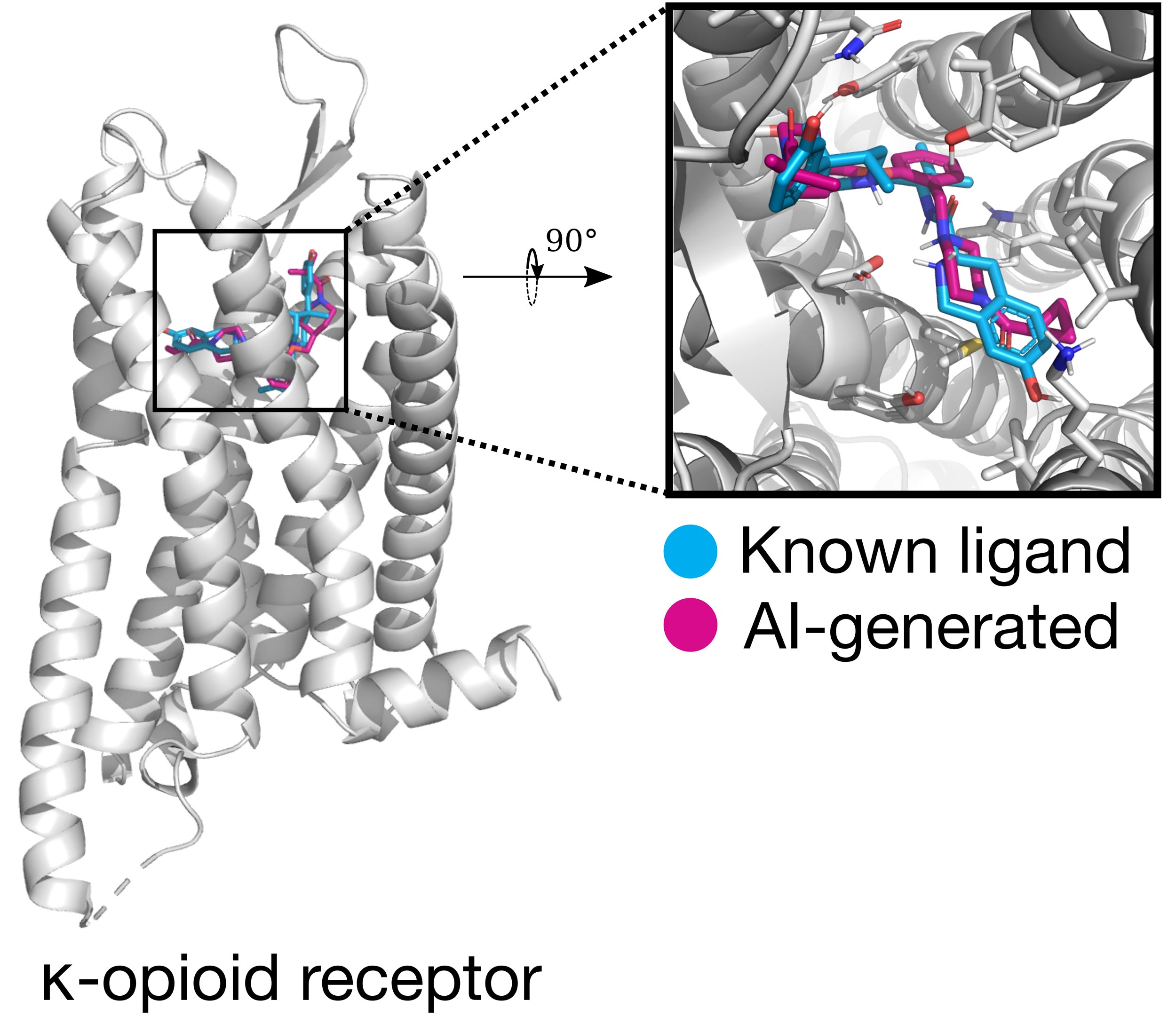
    A compound generated by artificial intelligence-based tools predicted to bind to the kappa-opioid receptor. Credit: Image courtesy of Leslie Salas Estrada

    Researchers are turning to artificial intelligence to create and optimize potential new drugs to help people with opioid addiction.

    It is estimated that about three million Americans suffer from opioid use disorder, and every year more than 80,000 Americans die from overdoses. Opioid drugs, such as heroin, fentanyl, oxycodone, and morphine, activate opioid receptors. Activating mu-opioid receptors leads to pain relief and euphoria, but also physical dependence and decreased breathing. The latter is what leads to death in the case of a drug overdose.

    Preclinical studies have shown that blocking kappa-opioid receptors may offer a promising pharmacological approach to treating opioid dependence. By discovering drugs that inhibit the kappa-opioid receptor, Leslie Salas Estrada, in the lab of Marta Filizola, at the Icahn School of Medicine at Mount Sinai, hopes to alleviate opioid addiction. Salas Estrada, a postdoctoral researcher, will present her work on Monday, February 20 at the 67th Annual Biophysical Society Meeting in San Diego, California.

    Kappa-opioid receptors are known to mediate brain rewards. “If you’re addicted and you’re trying to quit, at some point you will get withdrawal symptoms, and those can be really hard to overcome,” Salas Estrada explained, “after a lot of opioid exposure, your brain gets rewired to need more drugs. Blocking the activity of the kappa opioid receptor has been shown in animal models to reduce this need to use drugs in the withdrawal period.”

    However, discovering drugs that can block the activity of a protein, such as the kappa-opioid receptor, can be a long and expensive process. Using computational tools can make it more efficient, but it can take months to screen billions of chemical compounds. Instead, Salas Estrada is using artificial intelligence (AI) to optimize the process.

    Leveraging AI to Accelerate Drug Discovery

    “Artificial intelligence has the advantage of being able to take huge amounts of information and learn to recognize patterns from it. So, we believe that machine learning can help us to leverage the information that can be derived from large chemical databases to design new drugs from scratch. And in that way, we can potentially reduce the time and costs associated with drug discovery,” she said.

    Using information about the kappa-opioid receptor and known drugs, they trained a computer model to generate compounds that might block the receptor with a reinforcement learning algorithm that rewarded properties that are favorable for drug treatments.

    So far, the team has identified several compounds that have promising properties and they are working with collaborators to synthesize them and eventually test their ability to block the kappa-opioid receptor in cells, before testing them in animal models for safety and effectiveness. Ultimately, Salas Estrada said, “we hope we can help people struggling with addiction.”

    Never miss a breakthrough: Join the SciTechDaily newsletter.
    Follow us on Google and Google News.

    Addiction Artificial Intelligence Biophysical Society Opioids
    Share. Facebook Twitter Pinterest LinkedIn Email Reddit

    Related Articles

    New Study Shows How Cancer Survivors Develop Opioid Addictions

    Study Finds No Evidence to Suggest Cannabis Helps Patients Stop Using Opioids

    Opioid Prescription Doses Are Often Being Tapered More Rapidly Than Recommended

    Study Examines Opioid & Cocaine Use by Profession – Most Likely to Use “Makes Sense”

    A Lethal Dose for $1 – Fentanyl’s Risk on the ‘Darknet’

    Stemming the Opioid Crisis: New Addiction Treatments Hold Promise

    Young, White, Daily Opioid Users More Likely to Prefer Fentanyl

    Medications Can Help As Opioid Treatment for Teens

    Teens Abusing Opioids May Benefit From Medication Treatment

    Leave A Reply Cancel Reply

    • Facebook
    • Twitter
    • Pinterest
    • YouTube

    Don't Miss a Discovery

    Subscribe for the Latest in Science & Tech!

    Trending News

    New Pill Lowers Stubborn Blood Pressure and Protects the Kidneys

    Humans May Have Hidden Regenerative Powers, New Study Suggests

    Scientists Just Solved the Mystery of Why Crabs Walk Sideways

    Doctors Are Surprised by What This Vaccine Is Doing to the Heart

    This Popular Supplement May Boost Your Brain, Not Just Your Muscles

    Scientists Say This Simple Supplement May Actually Reverse Heart Disease

    Warming Oceans Could Trigger a Dangerous Methane Surge

    This Simple Movement Could Be Secretly Cleaning Your Brain

    Follow SciTechDaily
    • Facebook
    • Twitter
    • YouTube
    • Pinterest
    • Newsletter
    • RSS
    SciTech News
    • Biology News
    • Chemistry News
    • Earth News
    • Health News
    • Physics News
    • Science News
    • Space News
    • Technology News
    Recent Posts
    • Hidden Heart Risk Found in 1 in 5 People, Study Warns
    • Scientists Say This Daily Walking Habit May Be the Secret to Keeping Weight Off After Dieting
    • New Therapy Rewires the Brain To Restore Joy in Depression Patients
    • Researchers Discover Efficient New Way To Split Hydrogen From Water for Energy
    • This Korean Skincare Ingredient Could Help Fight Deadly Superbugs
    Copyright © 1998 - 2026 SciTechDaily. All Rights Reserved.
    • Science News
    • About
    • Contact
    • Editorial Board
    • Privacy Policy
    • Terms of Use

    Type above and press Enter to search. Press Esc to cancel.