
Close Menu
    Facebook X (Twitter) Instagram
    SciTechDaily
    • Biology
    • Chemistry
    • Earth
    • Health
    • Physics
    • Science
    • Space
    • Technology
    Facebook X (Twitter) Pinterest YouTube RSS
    SciTechDaily
    Home»Space»Hubble Captures a Massive Celestial Prawn Drifting Through the Cosmic Deep
    Space

    Hubble Captures a Massive Celestial Prawn Drifting Through the Cosmic Deep

    By NASA's Goddard Space Flight CenterNovember 24, 2021No Comments2 Mins Read
    Facebook Twitter Pinterest Telegram LinkedIn WhatsApp Email Reddit
    Share
    Facebook Twitter LinkedIn Pinterest Telegram Email Reddit
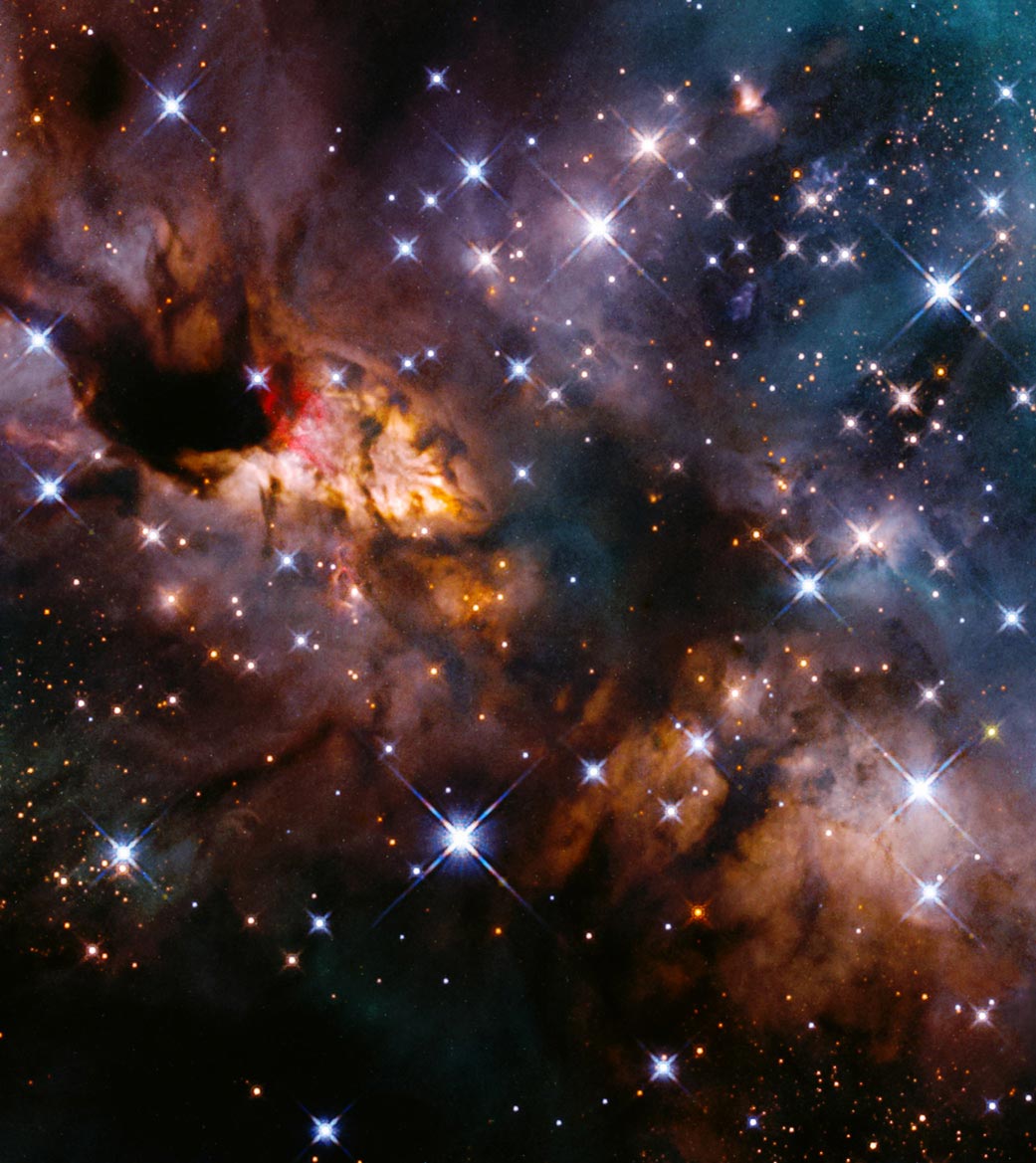
    Prawn Nebula IC 4628
    The Prawn Nebula, or IC 4628, located about 6,000 light-years from Earth, is an emission nebula, ionized by radiation from nearby stars. Credit: NASA, ESA, and J. Tan (Chalmers University of Technology); Processing; Gladys Kober (NASA/Catholic University of America)

    The Prawn Nebula, or IC 4628, is a vast stellar nursery about 6,000 light-years from Earth in the constellation Scorpius.

    The Prawn Nebula is a massive stellar nursery located in the constellation Scorpius, about 6,000 light-years from Earth. Though the nebula stretches 250 light-years and covers a space four times the size of the full moon, it emits light primarily in wavelengths the human eye cannot detect, making it extremely faint to earthbound viewers. Hubble’s gaze, however, shows a small section of the nebula here in both visible and invisible infrared light, capturing dazzling detail of the nebula’s structure, including bright areas of glowing gas.

    The Prawn Nebula, also known as IC 4628, is an emission nebula, which means its gas has been energized, or ionized, by the radiation of nearby stars. The radiation from these massive stars strips electrons from the nebula’s hydrogen atoms. As the energized electrons revert from their higher-energy state to a lower-energy state by recombining with hydrogen nuclei, they emit energy in the form of light, causing the nebula’s gas to glow. In this image, red indicates the presence of ionized iron (Fe II) emission.
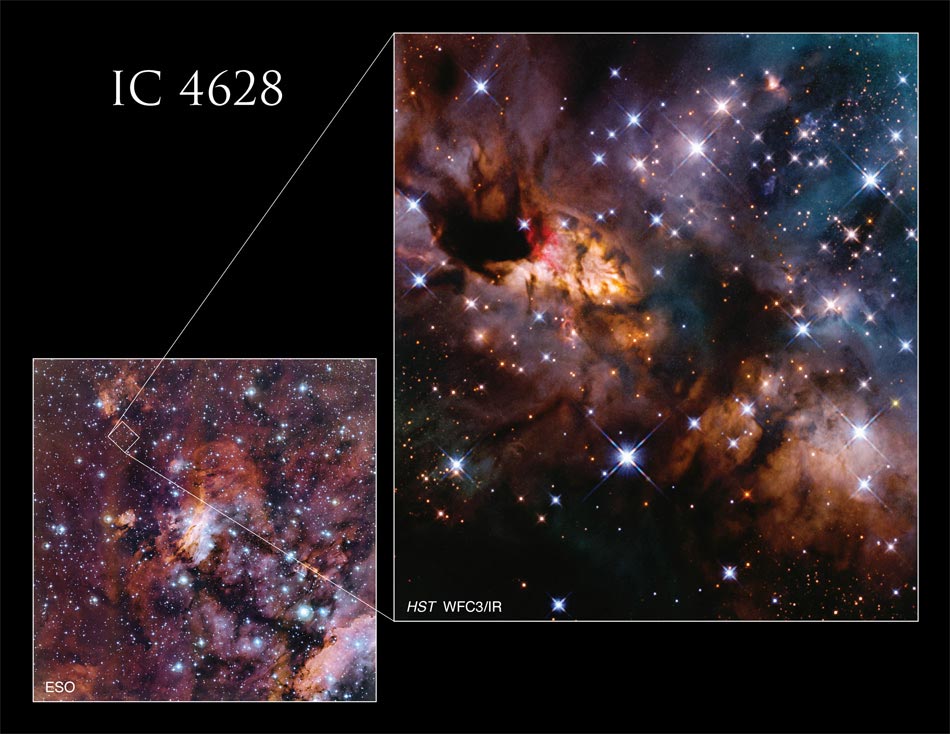
    IC 4628
    The Prawn Nebula lies south of the star Antares in the constellation Scorpius, the Scorpion. Hubble’s focused view captures just a small portion of the vast star-forming region. Credit: NASA, ESA, J. Tan (Chalmers University of Technology), and ESO; Processing; Gladys Kober (NASA/Catholic University of America)

    This Hubble Space Telescope image was captured as part of a survey of massive- and intermediate-size “protostars,” or newly forming stars. Astronomers used the infrared sensitivity of Hubble’s Wide Field Camera 3 to look for hydrogen ionized by ultraviolet light ionized by the protostars, jets from the stars, and other features.

    Never miss a breakthrough: Join the SciTechDaily newsletter.
    Follow us on Google and Google News.

    Astronomy Hubble Space Telescope NASA NASA Goddard Space Flight Center Popular
    Share. Facebook Twitter Pinterest LinkedIn Email Reddit

    Related Articles

    Historic Discovery: Twin Titans Clash As NASA Unveils Closest Supermassive Black Hole Duo

    The Great Escape: NASA’s Hubble and MAVEN Help Solve Mystery of Mars’ Vanishing Water

    Webb and Hubble Unite: A Breathtaking 3D Journey Through the Pillars of Creation

    Stellar Sleuths: Citizen Scientists and AI Uncover Hidden Asteroids With Hubble

    Stellar Fireworks: Hubble Revisits a Strange Star’s 40-Year Nova Mystery

    Cosmic Geode: Hubble Captures the Birth of a Sun-like Star

    Jupiter Unveiled: Hubble Captures the Giant’s Roaring Storms and Volcanic Moon Io

    Cyclones in Space? See How Hubble Uncovered Extreme Weather on a Distant Planet

    Saturn’s Seasonal Spectacle: Hubble’s Ultra-Sharp Vision Unveils Ring Spoke Phenomenon

    Leave A Reply Cancel Reply

    • Facebook
    • Twitter
    • Pinterest
    • YouTube

    Don't Miss a Discovery

    Subscribe for the Latest in Science & Tech!

    Trending News

    The Universe Is Expanding Too Fast and Scientists Can’t Explain Why

    “Like Liquid Metal”: Scientists Create Strange Shape-Shifting Material

    Early Warning Signals of Esophageal Cancer May Be Hiding in Plain Sight

    Common Blood Pressure Drug Shows Surprising Power Against Deadly Antibiotic-Resistant Superbug

    Scientists Uncover Dangerous Connection Between Serotonin and Heart Valve Disease

    Scientists Discover a “Protector” Protein That Could Help Reverse Hair Loss

    Bone-Strengthening Discovery Could Reverse Osteoporosis

    Scientists Uncover Hidden Trigger Behind Stem Cell Aging

    Follow SciTechDaily
    • Facebook
    • Twitter
    • YouTube
    • Pinterest
    • Newsletter
    • RSS
    SciTech News
    • Biology News
    • Chemistry News
    • Earth News
    • Health News
    • Physics News
    • Science News
    • Space News
    • Technology News
    Recent Posts
    • A Common Diabetes Drug May Hold the Key to Stopping HIV From Coming Back
    • Ancient “Syphilis-Like” Disease in Vietnam Challenges Key Scientific Assumptions
    • Drinking Alcohol To Cope in Your 20s Could Damage Your Brain for Life
    • Scientists Crack Alfalfa’s Chromosome Mystery After Decades of Debate
    • Ancient Ant-Plant Alliance Collapses As Predatory Wasps Move In
    Copyright © 1998 - 2026 SciTechDaily. All Rights Reserved.
    • Science News
    • About
    • Contact
    • Editorial Board
    • Privacy Policy
    • Terms of Use

    Type above and press Enter to search. Press Esc to cancel.