
Close Menu
    Facebook X (Twitter) Instagram
    SciTechDaily
    • Biology
    • Chemistry
    • Earth
    • Health
    • Physics
    • Science
    • Space
    • Technology
    Facebook X (Twitter) Pinterest YouTube RSS
    SciTechDaily
    Home»Space»Hubble Captures Sharpest View Ever of the Triangulum Galaxy
    Space

    Hubble Captures Sharpest View Ever of the Triangulum Galaxy

    By Mathias Jäger, ESA/Hubble Space TelescopeJanuary 7, 2019No Comments3 Mins Read
    Facebook Twitter Pinterest Telegram LinkedIn WhatsApp Email Reddit
    Share
    Facebook Twitter LinkedIn Pinterest Telegram Email Reddit
    Sharpest View Ever of the Triangulum Galaxy
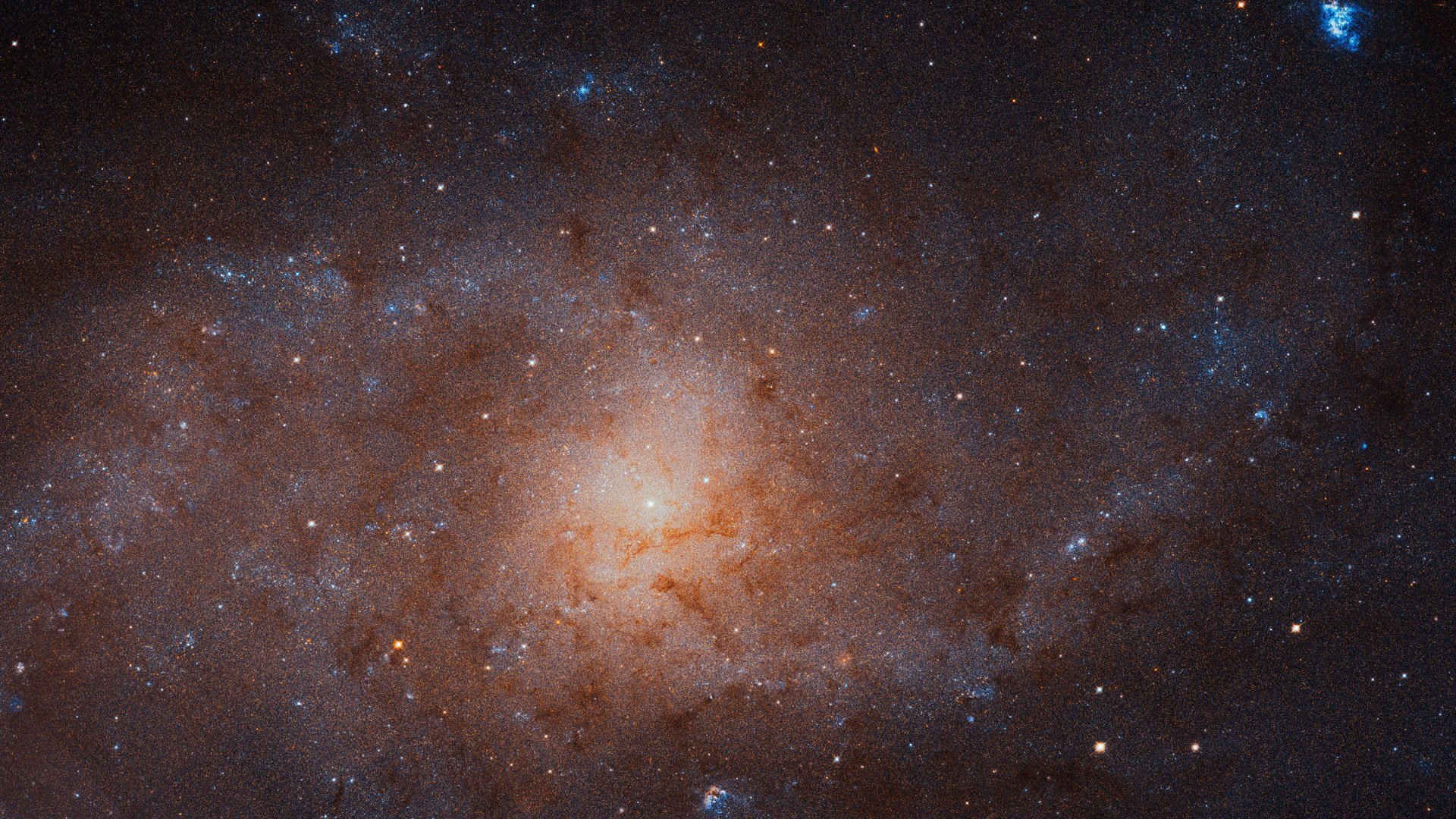
    This gigantic image of the Triangulum Galaxy — also known as Messier 33 — is a composite of about 54 different pointings with Hubble’s Advanced Camera for Surveys. The mosaic of the Triangulum Galaxy showcases the central region of the galaxy and its inner spiral arms. Millions of stars, hundreds of star clusters, and bright nebulae are visible. Credit: NASA, ESA, and M. Durbin, J. Dalcanton, and B. F. Williams (University of Washington) Zoom in Tool

    The NASA/ESA Hubble Space Telescope has captured the most detailed image yet of a close neighbor of the Milky Way — the Triangulum Galaxy, a spiral galaxy located at a distance of only three million light-years. This panoramic survey of the third-largest galaxy in our Local Group of galaxies provides a mesmerizing view of the 40 billion stars that make up one of the most distant objects visible to the naked eye.

    This new image of the Triangulum Galaxy — also known as Messier 33 or NGC 598 — has a staggering 665 million pixels and showcases the central region of the galaxy and its inner spiral arms. To stitch together this gigantic mosaic, Hubble’s Advanced Camera for Surveys needed to create 54 separate images.

    Under excellent dark-sky conditions, the Triangulum Galaxy can be seen with the naked eye as a faint, blurry object in the constellation of Triangulum (the Triangle), where its ethereal glow is an exciting target for amateur astronomers.

    At only three million light-years from Earth, the Triangulum Galaxy is a notable member of the Local Group — it is the group’s third-largest galaxy, but also the smallest spiral galaxy in the group. It measures only about 60,000 light-years across, compared to the 200,000 light-years of the Andromeda Galaxy; the Milky Way lies between these extremes at about 100 000 light-years in diameter.

    The Triangulum Galaxy is not only surpassed in size by the other two spirals, but by the multitude of stars they contain. The Triangulum Galaxy has at least an order of magnitude fewer stars than the Milky Way and two orders of magnitude less than Andromeda. These numbers are hard to grasp when already in this image 10 to 15 million individual stars are visible.

    In contrast to the two larger spirals, the Triangulum Galaxy doesn’t have a bright bulge at its center and it also lacks a bar connecting its spiral arms to the center. It does, however, contain a huge amount of gas and dust, giving rise to rapid star formation. New stars form at a rate of approximately one solar mass every two years.


    This video sequence gives a detailed close-up view of the Triangulum Galaxy, also known as Messier 33.

    The abundance of gas clouds in the Triangulum Galaxy is precisely what drew astronomers to conduct this detailed survey. When stars are born, they use up material in these clouds of gas and dust, leaving less fuel for new stars to emerge. Hubble’s image shows two of the four brightest of these regions in the galaxy: NGC 595 and NGC 604. The latter is the second most luminous region of ionized hydrogen within the Local Group and it is also among the largest known star formation regions in the Local Group.

    These detailed observations of the Triangulum Galaxy have tremendous legacy value — combined with those of the Milky Way, the Andromeda Galaxy, and the irregular Magellanic Cloud galaxies, they will help astronomers to better understand star formation and stellar evolution.

    Never miss a breakthrough: Join the SciTechDaily newsletter.
    Follow us on Google and Google News.

    Astronomy Hubble Space Telescope
    Share. Facebook Twitter Pinterest LinkedIn Email Reddit

    Related Articles

    A Morphing Spiral Galaxy Amongst Friends

    Hubble Views Magnificent Lopsided Galaxy NGC 2276

    Hubble Captures Fantastic Detail of Eponymous Spiral Galaxy NGC 691

    Spectacular Image Captured by Hubble Shows a Strangely Contorted Spiral Galaxy

    A Distant Spiral in Virgo: Extraordinary Detail Seen in a Galaxy 150 Million Light-Years Away From Earth

    Magnetic Monsters: Hubble Tracks Down Location of Mysterious Radio Signals From Intergalactic Space

    A Menagerie of Galaxies: Hubble Captures a Cluster With Galaxies of All Shapes and Sizes

    How Habitable Are Planets That Orbit Red Dwarfs – The Most Common Type of Stars in the Galaxy?

    Cosmic Silver Lining: Hubble Spots V565 Surrounded by Four Prominent Diffraction Spikes

    Leave A Reply Cancel Reply

    • Facebook
    • Twitter
    • Pinterest
    • YouTube

    Don't Miss a Discovery

    Subscribe for the Latest in Science & Tech!

    Trending News

    One of the Universe’s Largest Stars May Be Getting Ready To Explode

    Scientists Discover Enzyme That Could Supercharge Ozempic-Like Weight Loss Drugs

    Popular Sweetener Linked to DNA Damage – “It’s Something You Should Not Be Eating”

    Ancient “Rock” Microbes May Reveal How Complex Life Began

    Researchers Capture Quantum Interference in One of Nature’s Rarest Atoms

    “A Plague Is Upon Us”: The Mass Death That Changed an Ancient City Forever

    Scientists Discover Game-Changing New Way To Treat High Cholesterol

    This Small Change to Your Exercise Routine Could Be the Secret to Living Longer

    Follow SciTechDaily
    • Facebook
    • Twitter
    • YouTube
    • Pinterest
    • Newsletter
    • RSS
    SciTech News
    • Biology News
    • Chemistry News
    • Earth News
    • Health News
    • Physics News
    • Science News
    • Space News
    • Technology News
    Recent Posts
    • Scientists Prove There Are Just Six Degrees of Separation in a Social Network
    • Bee Bacteria Could Fix a Major Flaw in Plant-Based Milk
    • Scientists Discover a Surprising Way To Make Bread Healthier and More Nutritious
    • Natural Compounds Boost Bone Implant Success While Killing Bacteria and Cancer Cells
    • After 60 Years, Scientists Uncover Unexpected Brain Effects of Popular Diabetes Drug Metformin
    Copyright © 1998 - 2026 SciTechDaily. All Rights Reserved.
    • Science News
    • About
    • Contact
    • Editorial Board
    • Privacy Policy
    • Terms of Use

    Type above and press Enter to search. Press Esc to cancel.