
Close Menu
    Facebook X (Twitter) Instagram
    SciTechDaily
    • Biology
    • Chemistry
    • Earth
    • Health
    • Physics
    • Science
    • Space
    • Technology
    Facebook X (Twitter) Pinterest YouTube RSS
    SciTechDaily
    Home»Space»Hubble Captures The Death of a Star
    Space

    Hubble Captures The Death of a Star

    By European Space AgencyAugust 25, 2019No Comments2 Mins Read
    Facebook Twitter Pinterest Telegram LinkedIn WhatsApp Email Reddit
    Share
    Facebook Twitter LinkedIn Pinterest Telegram Email Reddit
    Hubble Captures Dynamic Dying Star
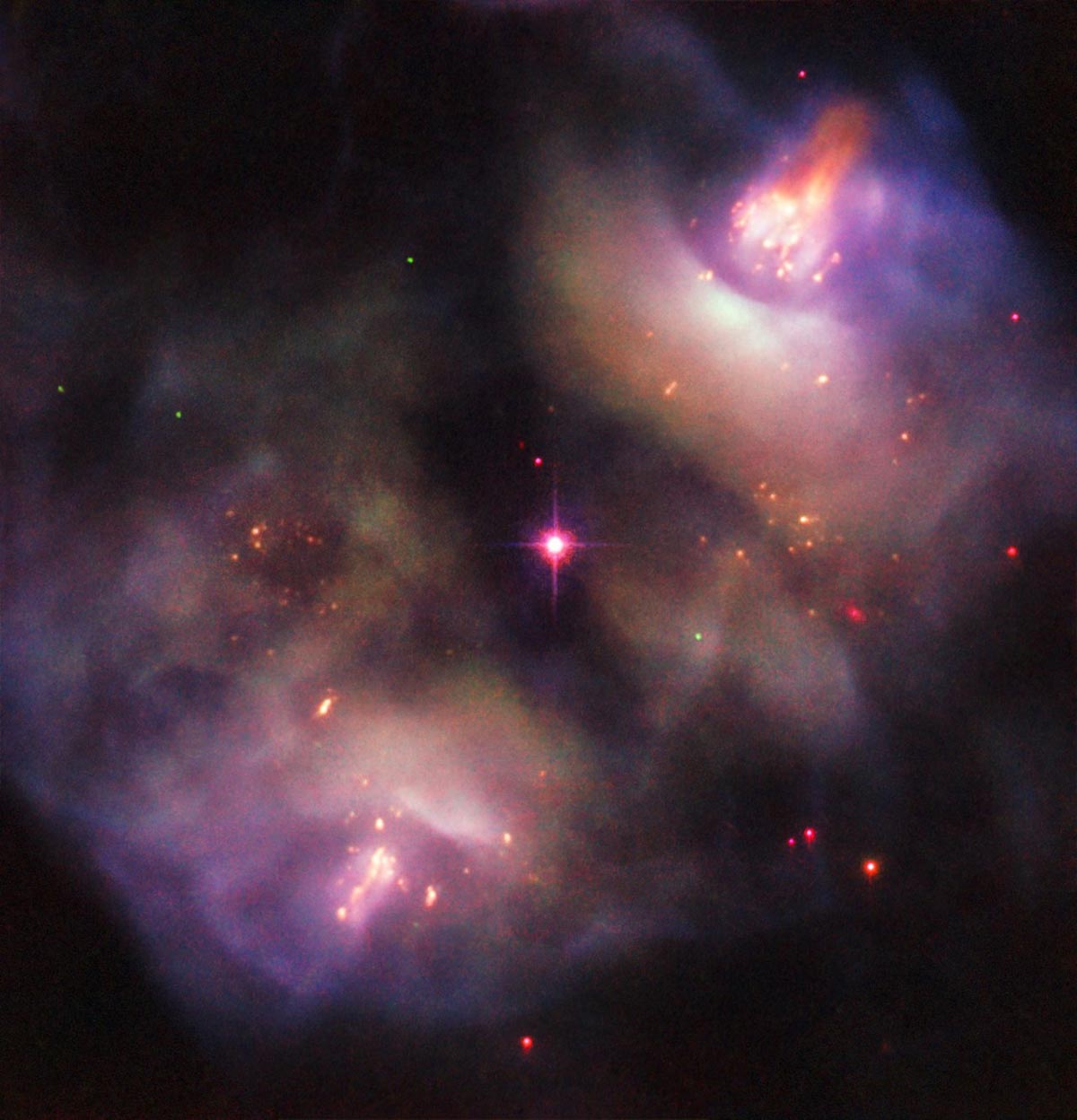
    Two lobes are visible to the upper right and lower left of the frame, and together form something known as a planetary nebula (known as NGC 2371 and NGC 2372, though sometimes referred to together as NGC 2371/2). Credit: ESA/Hubble & NASA, R. Wade et al.

    This atmospheric Picture of the Week, taken with the NASA/ESA Hubble Space Telescope, shows a dark, gloomy scene in the constellation of Gemini (The Twins). The subject of this image confused astronomers when it was first studied — rather than being classified as a single object, it was instead recorded as two objects, owing to its symmetrical lobed structure (known as NGC 2371 and NGC 2372, though sometimes referred to together as NGC 2371/2).

    These two lobes are visible to the upper right and lower left of the frame, and together form something known as a planetary nebula. Despite the name, such nebulae have nothing to do with planets; NGC 2371/2 formed when a Sun-like star reached the end of its life and blasted off its outer layers, shedding the constituent material and pushing it out into space to leave just a superheated stellar remnant behind. This remnant is visible as the orange-tinted star at the center of the frame, sitting neatly between the two lobes.

    The structure of this region is complex. It is filled with dense knots of gas, fast-moving jets that appear to be changing direction over time, and expanding clouds of material streaming outwards on diametrically opposite sides of the remnant star. Patches of this scene glow brightly as the remnant star emits energetic radiation that excites the gas within these regions, causing it to light up. This scene will continue to change over the next few thousand years; eventually the knotty lobes will dissipate completely, and the remnant star will cool and dim to form a white dwarf.

    Never miss a breakthrough: Join the SciTechDaily newsletter.
    Follow us on Google and Google News.

    Hubble Space Telescope NASA Nebula Popular
    Share. Facebook Twitter Pinterest LinkedIn Email Reddit

    Related Articles

    Astronomers Build Incredible 3D Visualization of Exploded Star Using NASA’s Great Observatories [Video]

    NASA Data Reveals Significant Changes in Exoplanet’s Atmosphere

    Hubble Views Planetary Nebula NGC 7026

    Hubble Views Star in Preplanetary Nebula Stage

    Panoramic View of 30 Doradus – The Brightest Star-Forming Region in Our Galactic Neighborhood

    Dark Matter Core of Abell 520 Differs from Bullet Cluster

    Researchers Discover First Intermediate-Mass Black Hole

    ESA’s Hershel Space Telescope Captures Incredible Views of Eagle Nebula

    SOFIA Looking Deep Into the Orion Nebula

    Leave A Reply Cancel Reply

    • Facebook
    • Twitter
    • Pinterest
    • YouTube

    Don't Miss a Discovery

    Subscribe for the Latest in Science & Tech!

    Trending News

    Scientists May Have Found the Key to Jupiter and Saturn’s Moon Mystery

    Scientists Uncover Brain Changes That Link Pain to Depression

    Saunas May Do More Than Raise Body Temperature – They Activate Your Immune System

    Exercise in a Pill? Metformin Shows Surprising Effects in Cancer Patients

    Hidden Oceans of Magma Could Be Protecting Alien Life

    New Study Challenges Alzheimer’s Theories: It’s Not Just About Plaques

    Artificial Sweeteners May Harm Future Generations, Study Suggests

    Splashdown! NASA Artemis II Returns From Record-Breaking Moon Mission

    Follow SciTechDaily
    • Facebook
    • Twitter
    • YouTube
    • Pinterest
    • Newsletter
    • RSS
    SciTech News
    • Biology News
    • Chemistry News
    • Earth News
    • Health News
    • Physics News
    • Science News
    • Space News
    • Technology News
    Recent Posts
    • Ancient DNA Reveals Irish Goats Have a 3,000-Year-Old Lineage Still Alive Today
    • Historians Reveal Secrets of the Strange Hat Wars That Shook Early Modern England
    • “A Plague Is Upon Us”: The Mass Death That Changed an Ancient City Forever
    • This Strange Material Can Turn Superconductivity on and off Like a Switch
    • Scientists Discover Game-Changing New Way To Treat High Cholesterol
    Copyright © 1998 - 2026 SciTechDaily. All Rights Reserved.
    • Science News
    • About
    • Contact
    • Editorial Board
    • Privacy Policy
    • Terms of Use

    Type above and press Enter to search. Press Esc to cancel.