
Close Menu
    Facebook X (Twitter) Instagram
    SciTechDaily
    • Biology
    • Chemistry
    • Earth
    • Health
    • Physics
    • Science
    • Space
    • Technology
    Facebook X (Twitter) Pinterest YouTube RSS
    SciTechDaily
    Home»Space»Hubble Image of Galaxy NGC 3079
    Space

    Hubble Image of Galaxy NGC 3079

    By Jet Propulsion LaboratoryDecember 27, 2013No Comments2 Mins Read
    Facebook Twitter Pinterest Telegram LinkedIn WhatsApp Email Reddit
    Share
    Facebook Twitter LinkedIn Pinterest Telegram Email Reddit
    Hubble Image of Galaxy NGC 3079
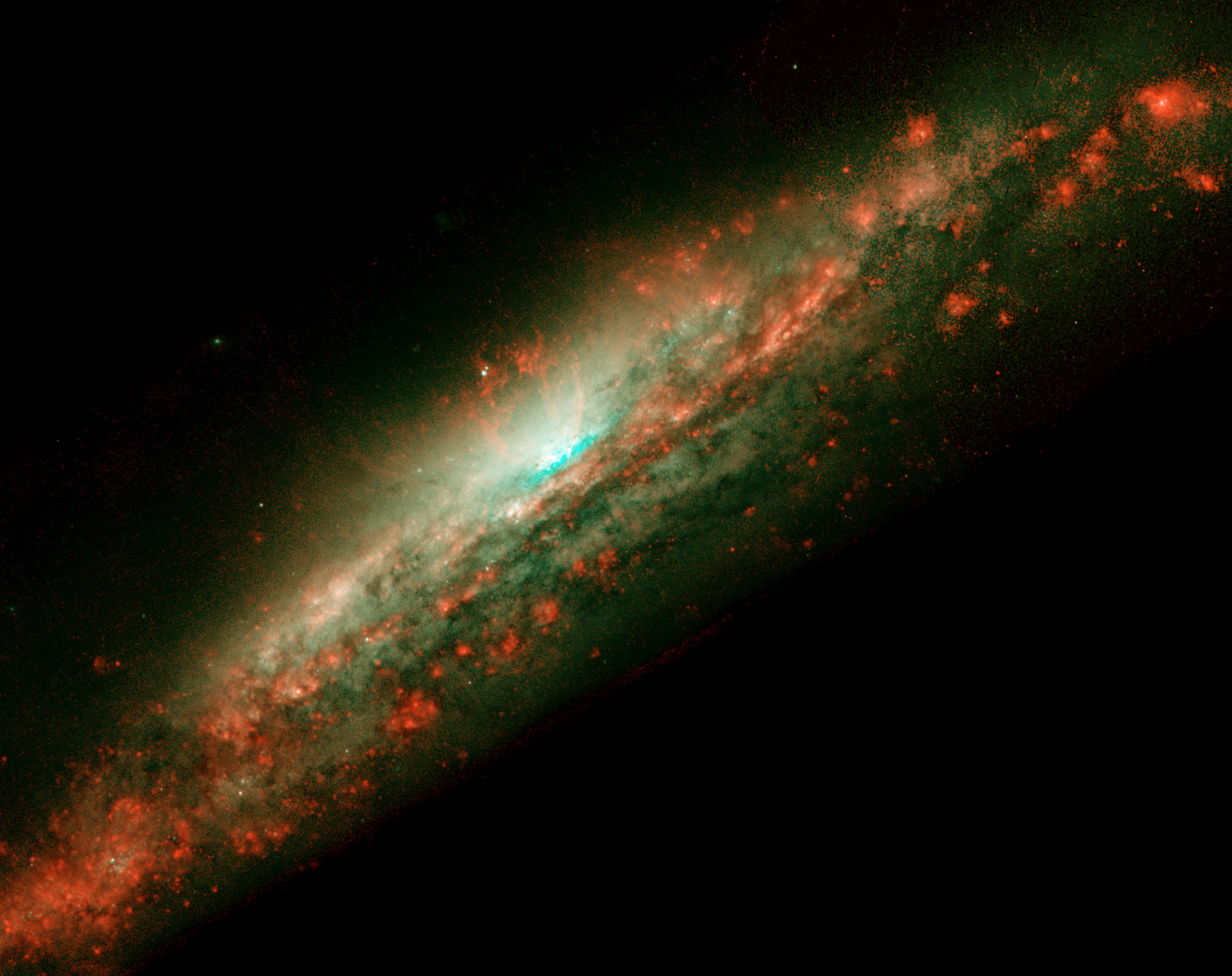
    Hubble image of Galaxy NGC 3079 is located 50 million light-years from Earth in the constellation Ursa Major. Credit: NASA/Space Telescope Science Institute

    First released in 1999, this Hubble image of the day shows Galaxy NGC 3079, which is located 50 million light-years from Earth.

    A lumpy bubble of hot gas rises from a cauldron of glowing matter in a distant galaxy, as seen by NASA’s Hubble Space Telescope.

    The images, taken by Hubble’s Wide Field and Planetary Camera 2, are online at http://hubblesite.org/newscenter/archive/releases/2001/28/image/a/. The camera was designed and built by NASA’s Jet Propulsion Laboratory, Pasadena, California.

    Galaxy NGC 3079, located 50 million light-years from Earth in the constellation Ursa Major, has a huge bubble in the center of its disc, as seen in the image on the left. The smaller photo at right shows a close-up of the bubble. The two white dots are stars.

    Astronomers suspect the bubble is being blown by “winds,” or high-speed streams of particles, released during a burst of star formation. The bubble’s lumpy surface has four columns of gaseous filaments towering above the galaxy’s disc. The filaments whirl around in a vortex and are expelled into space. Eventually, this gas will rain down on the disc and may collide with gas clouds, compress them and form a new generation of stars.

    Theoretical models indicate the bubble formed when winds from hot stars mixed with small bubbles of hot gas from supernova explosions. Radio telescope observations indicate those processes are still active. Eventually, the hot stars will die, and the bubble’s energy source will fade away.

    The images, taken in 1998, show glowing gas as red and starlight as blue/green.

    The Space Telescope Science Institute, Baltimore, Maryland, manages space operations for Hubble for NASA’s Office of Space Science, Washington, D.C. The institute is operated by the Association of Universities for Research in Astronomy, Inc., for NASA, under contract with the Goddard Space Flight Center, Greenbelt, Maryland. The Hubble Space Telescope is a project of international cooperation between NASA and the European Space Agency. JPL is a division of the California Institute of Technology in Pasadena.


    Never miss a breakthrough: Join the SciTechDaily newsletter.
    Follow us on Google and Google News.

    Astronomy Hubble Space Telescope JPL NASA Popular
    Share. Facebook Twitter Pinterest LinkedIn Email Reddit

    Related Articles

    Cosmic Horror Unveiled: NASA Reveals “Blood-Soaked Eyes” Staring From Deep Space [Video]

    NASA Discovers Pair of Super-Earths With 1,000-Mile-Deep Oceans

    Gorgeous Ring of Stellar Wildfire Captured by Hubble Space Telescope

    Hubble Uses Moon As “Mirror” to Study Earth’s Atmosphere – Proxy in Search of Potentially Habitable Planets Around Other Stars

    NASA ASTHROS: Stratospheric Balloon the Size of a Football Stadium Will Carry a Cutting-Edge Telescope

    Summertime on Saturn Captured in Stunning New Hubble Image

    New NASA Video Shows a 360-Degree View of Saturn’s Auroras

    Hubble Detects Water Vapor Over Jupiter’s Moon Europa

    Hubble & Spitzer See Weather Patterns in a Brown Dwarf

    Leave A Reply Cancel Reply

    • Facebook
    • Twitter
    • Pinterest
    • YouTube

    Don't Miss a Discovery

    Subscribe for the Latest in Science & Tech!

    Trending News

    289-Million-Year-Old Reptile Mummy Reveals Origin of Human Breathing System

    New Brain Discovery Challenges Long-Held Theory of Teenage Brain Development

    Scientists Discover Plants “Scream” – We Just Couldn’t Hear Them Until Now

    Scientists Discover a Surprising Reason Intermittent Fasting Extends Life

    This Simple Fruit Wash Could Make Produce Safer and Last Days Longer

    Scientists Say Adding This Unusual Seafood to Your Diet Could Reverse Signs of Aging

    Scientists Say a Hidden Structure May Exist Inside Earth’s Core

    Doctors Surprised by the Power of a Simple Drug Against Colon Cancer

    Follow SciTechDaily
    • Facebook
    • Twitter
    • YouTube
    • Pinterest
    • Newsletter
    • RSS
    SciTech News
    • Biology News
    • Chemistry News
    • Earth News
    • Health News
    • Physics News
    • Science News
    • Space News
    • Technology News
    Recent Posts
    • Scientists Finally Solved One of Water’s Biggest Mysteries
    • 7,000-Year-Old DNA Rewrites the Story of the “Neolithic Revolution”
    • Missing Medieval Relic of Legendary English King Found After Being Missing for 40 Years
    • New Study Challenges Long-Held Assumptions About Cancer and Aging
    • Major Review Finds Alzheimer’s Amyloid Drugs Offer No Real Benefit
    Copyright © 1998 - 2026 SciTechDaily. All Rights Reserved.
    • Science News
    • About
    • Contact
    • Editorial Board
    • Privacy Policy
    • Terms of Use

    Type above and press Enter to search. Press Esc to cancel.