
Close Menu
    Facebook X (Twitter) Instagram
    SciTechDaily
    • Biology
    • Chemistry
    • Earth
    • Health
    • Physics
    • Science
    • Space
    • Technology
    Facebook X (Twitter) Pinterest YouTube RSS
    SciTechDaily
    Home»Space»Hubble Image of the Week – LMC and the Honeycomb Nebula
    Space

    Hubble Image of the Week – LMC and the Honeycomb Nebula

    By SciTechDailyOctober 2, 2017No Comments2 Mins Read
    Facebook Twitter Pinterest Telegram LinkedIn WhatsApp Email Reddit
    Share
    Facebook Twitter LinkedIn Pinterest Telegram Email Reddit
    Hubble Image of the Honeycomb Nebula
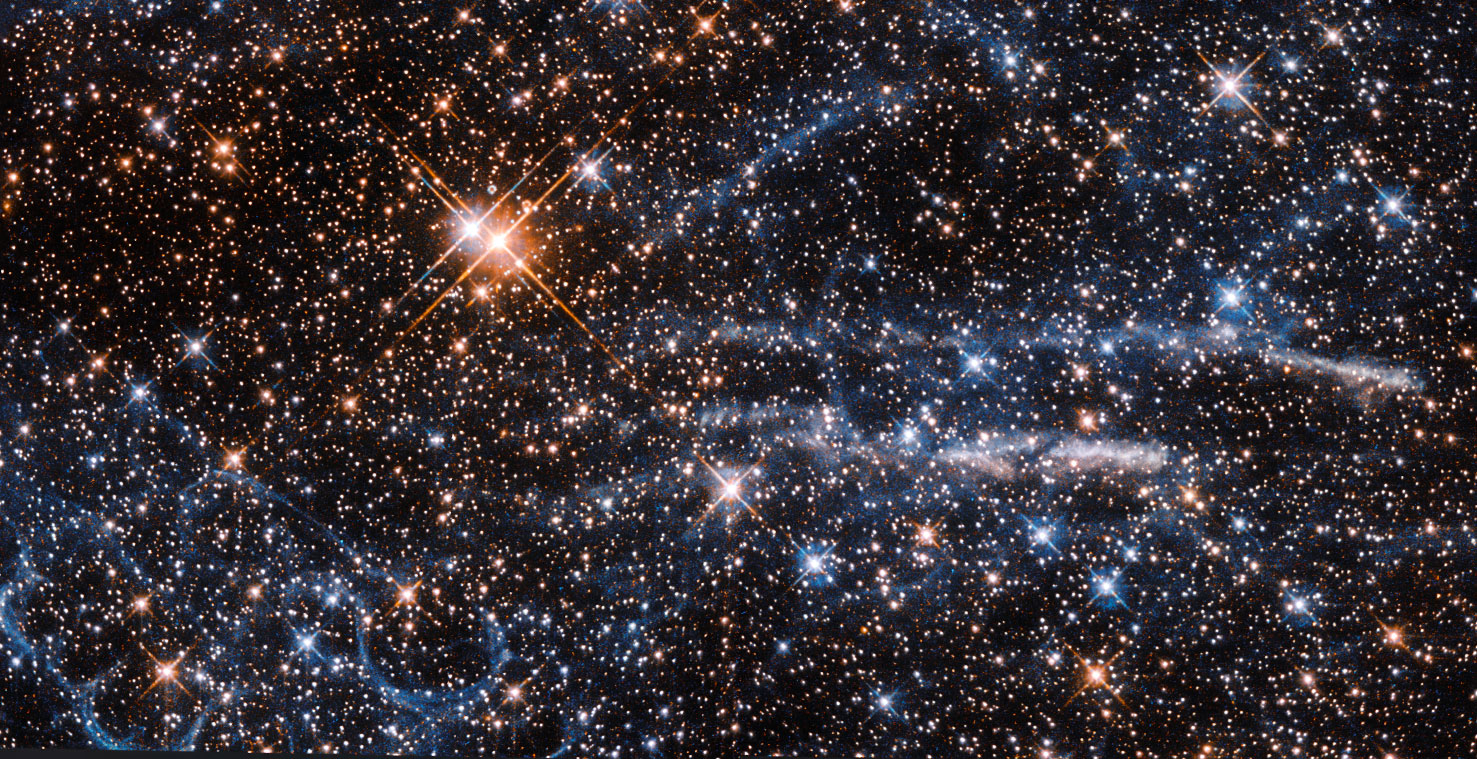
    In this image taken by the NASA/ESA Hubble Space Telescope, the Tarantula Nebula’s spindly filaments of gas, which gave the region its name, are visible, along with the Honeycomb Nebula’s stacked “bubbles” structure on the lower left. Credit: ESA/Hubble & NASA. Acknowledgments: Judy Schmidt (Geckzilla)

    This Hubble image of the week shows one of the largest and most intense regions of active star formation and the intriguing structure of stacked “bubbles” that forms the so-called Honeycomb Nebula.

    At a distance of just 160,000 light-years, the Large Magellanic Cloud (LMC) is one of the Milky Way’s closest companions. It is also home to one of the largest and most intense regions of active star formation known to exist anywhere in our galactic neighborhood — the Tarantula Nebula. This NASA/ESA Hubble Space Telescope image shows both the spindly, spidery filaments of gas that inspired the region’s name, and the intriguing structure of stacked “bubbles” that forms the so-called Honeycomb Nebula (to the lower left).

    The Honeycomb Nebula was found serendipitously by astronomers using ESO’s New Technology Telescope to image the nearby SN1987A, the closest observed supernova to Earth for over 400 years. The nebula’s strange bubble-like shape has baffled astronomers since its discovery in the early 1990s. Various theories have been proposed to explain its unique structure, some more exotic than others.

    In 2010, a group of astronomers studied the nebula and, using advanced data analysis and computer modeling, came to the conclusion that its unique appearance is likely due to the combined effect of two supernovae — a more recent explosion has pierced the expanding shell of material created by an older explosion. The nebula’s especially striking appearance is suspected to be due to a fortuitous viewing angle; the honeycomb effect of the circular shells may not be visible from another viewpoint.

    Never miss a breakthrough: Join the SciTechDaily newsletter.
    Follow us on Google and Google News.

    Astronomy Hubble Space Telescope Large Magellanic Cloud
    Share. Facebook Twitter Pinterest LinkedIn Email Reddit

    Related Articles

    Cotton Candy Clouds: Hubble Captures a Dwarf Galaxy in Stunning Detail

    Hubble Unveils the Brilliant Chaos of Star Birth in the Tarantula Nebula

    Hubble Spots a Dazzling Cluster in the Cloud

    Hubble Image of the Week – Glowing Gas and Dark Dust in the LMC

    Hubble Image of the Week – The Stars of the Large Magellanic Cloud

    New Hubble Image of the Large Magellanic Cloud

    Distance to the Large Magellanic Cloud Recalculated, Improves Hubble Constant

    Hubble Views the Large Magellanic Cloud and Its Star Forming Regions

    Hubble’s Close-Up View of the Tarantula Nebula

    Leave A Reply Cancel Reply

    • Facebook
    • Twitter
    • Pinterest
    • YouTube

    Don't Miss a Discovery

    Subscribe for the Latest in Science & Tech!

    Trending News

    Scientists Uncover Potential Brain Risks of Popular Fish Oil Supplements

    Scientists Discover a Surprising Way To Make Bread Healthier and More Nutritious

    After 60 Years, Scientists Uncover Unexpected Brain Effects of Popular Diabetes Drug Metformin

    New Research Uncovers Hidden Side Effects of Popular Weight-Loss Drugs

    Scientists Rethink Extreme Warming After Surprising Ocean Discovery

    Landmark Study Links Never Marrying to Significantly Higher Cancer Risk

    Researchers Discover Unknown Beetle Species Just Steps From Their Lab

    Largest-Ever Study Finds Medicinal Cannabis Ineffective for Anxiety, Depression, PTSD

    Follow SciTechDaily
    • Facebook
    • Twitter
    • YouTube
    • Pinterest
    • Newsletter
    • RSS
    SciTech News
    • Biology News
    • Chemistry News
    • Earth News
    • Health News
    • Physics News
    • Science News
    • Space News
    • Technology News
    Recent Posts
    • Powerful Lasers Reveal How Matter Becomes Plasma in Trillionths of a Second
    • A Simpler Path to Super-Resolution: Scientists Reinvent Microscopy
    • Scientists Uncover Hidden Genetic Cause of Diabetes in Babies
    • Amazonian Chocolate Could Become the Next Superfood, Scientists Say
    • Challenging the Narrative: New Study Shows U.S. Life Expectancy Is Rising Across All States
    Copyright © 1998 - 2026 SciTechDaily. All Rights Reserved.
    • Science News
    • About
    • Contact
    • Editorial Board
    • Privacy Policy
    • Terms of Use

    Type above and press Enter to search. Press Esc to cancel.