
Close Menu
    Facebook X (Twitter) Instagram
    SciTechDaily
    • Biology
    • Chemistry
    • Earth
    • Health
    • Physics
    • Science
    • Space
    • Technology
    Facebook X (Twitter) Pinterest YouTube RSS
    SciTechDaily
    Home»Space»Hubble Investigates a Mysterious Globular Cluster in Search of Clues
    Space

    Hubble Investigates a Mysterious Globular Cluster in Search of Clues

    By ESA/HubbleJune 6, 20221 Comment3 Mins Read
    Facebook Twitter Pinterest Telegram LinkedIn WhatsApp Email Reddit
    Share
    Facebook Twitter LinkedIn Pinterest Telegram Email Reddit
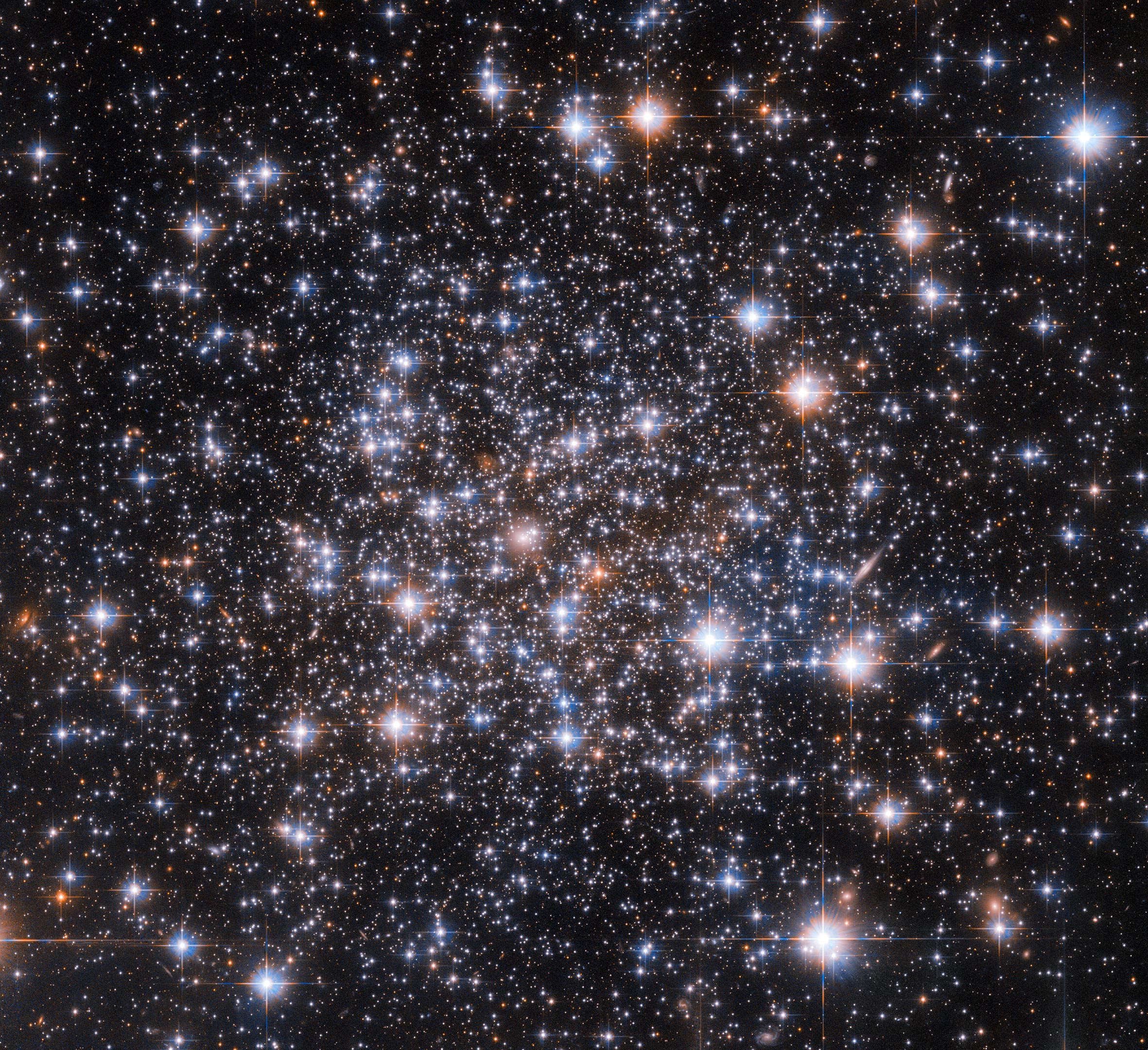
    Globular Cluster Ruprecht 106
    Hubble Space Telescope of globular cluster Ruprecht 106. Credit: ESA/Hubble & NASA, A. Dotter

    Like a gigantic version of Sherlock Holmes’s magnifying glass, the NASA/ESA Hubble Space Telescope has been used to peer into an astronomical mystery in search of clues.

    Globular clusters are stable clusters of tens of thousands to millions of stars. They are typically much larger than open clusters and are tightly gravitationally bound.

    The enigma in question concerns the globular cluster Ruprecht 106, which is pictured in this image. While most of the constituent stars of globular clusters all formed at approximately the same location and time, it turns out that almost all globular clusters contain groups of stars with distinct chemical compositions.

    These distinct chemical fingerprints are left by groups of stars with very slightly different ages or compositions from the rest of the cluster. A tiny handful of globular clusters do not possess these multiple populations of stars, and Ruprecht 106 is a member of this enigmatic group.

    The Advanced Camera for Surveys, which replaced Hubble’s Faint Object Camera during Servicing Mission 3B, offers a wavelength range that extends from the ultraviolet, through the visible and out to the near-infrared. Its wide field of view is nearly twice that of WFPC2, Hubble’s former workhorse camera that it replaced. It offers magnificent image quality and high sensitivity, and has increased Hubble’s potential for new discoveries by a factor of ten.

    Hubble captured this star-studded image using one of its most versatile instruments; the Advanced Camera for Surveys (ACS). Much like the stars in globular clusters, Hubble’s instruments also have distinct generations: ACS is a third-generation instrument that replaced the original Faint Object Camera in 2002. Some of Hubble’s other instruments have also gone through three iterations: the Wide Field Camera 3 replaced the Wide Field and Planetary Camera 2 (WFPC2) during the final servicing mission to Hubble. WFPC2 itself replaced the original Wide Field and Planetary Camera, which was installed on Hubble at launch.

    Among its numerous accomplishments, ACS has helped map the distribution of dark matter, detected the most distant objects in the universe, searched for massive exoplanets, and studied the evolution of clusters of galaxies.

    Astronauts on the NASA Space Shuttle serviced Hubble in orbit a total of five times and were able to either upgrade aging equipment or replace instruments with newer, more capable versions. This high-tech tinkering in low Earth orbit has helped keep Hubble at the cutting edge of astronomy for more than 3 decades.

    Never miss a breakthrough: Join the SciTechDaily newsletter.
    Follow us on Google and Google News.

    Astronomy European Space Agency Hubble Space Telescope
    Share. Facebook Twitter Pinterest LinkedIn Email Reddit

    Related Articles

    A Diamond Necklace of Cosmic Proportions

    Hubble Snaps a Stunning Close-Up of a Magnificent Spiral Galaxy

    Extraordinary Hubble Image: Light Bends From the Beyond

    Hubble Space Telescope Sees Volcanic Activity Reforming the Atmosphere on a Rocky Exoplanet

    Hubble Spies a Luminous Heart With Dark Tendrils

    Spectacular Return to the Veil Nebula

    Hubble Spots a Peculiar Sight: Unusual Spiral Galaxy With a Heavy Arm

    A Flash of Life: Hubble Spies an Unusual Planetary Nebula

    Through the Cosmic Clouds: Hubble Spots a Beautiful Stellar Nursery

    1 Comment

    1. David on June 7, 2022 2:45 pm

      The whole universe is spinning. The consequence are these clusters/vortices

      Reply
    Leave A Reply Cancel Reply

    • Facebook
    • Twitter
    • Pinterest
    • YouTube

    Don't Miss a Discovery

    Subscribe for the Latest in Science & Tech!

    Trending News

    Breakthrough Bowel Cancer Trial Leaves Patients Cancer-Free for Nearly 3 Years

    Natural Compound Shows Powerful Potential Against Rheumatoid Arthritis

    100,000-Year-Old Neanderthal Fossils in Poland Reveal Unexpected Genetic Connections

    Simple “Gut Reset” May Prevent Weight Gain After Ozempic or Wegovy

    2.8 Days to Disaster: Scientists Warn Low Earth Orbit Could Suddenly Collapse

    Common Food Compound Shows Surprising Power Against Superbugs

    5 Simple Ways To Remember More and Forget Less

    The Atomic Gap That Could Cost the Semiconductor Industry Billions

    Follow SciTechDaily
    • Facebook
    • Twitter
    • YouTube
    • Pinterest
    • Newsletter
    • RSS
    SciTech News
    • Biology News
    • Chemistry News
    • Earth News
    • Health News
    • Physics News
    • Science News
    • Space News
    • Technology News
    Recent Posts
    • After 37 Years, the World’s Longest-Running Soil Warming Experiment Uncovers a Startling Climate Secret
    • NASA Satellite Captures First-Ever High-Res View of Massive Pacific Tsunami
    • ADHD Isn’t Just a Deficit: Study Reveals Powerful Hidden Strengths
    • Scientists Uncover “Astonishing” Hidden Property of Light
    • Scientists Discover Stem Cells That Could Regrow Teeth and Bone
    Copyright © 1998 - 2026 SciTechDaily. All Rights Reserved.
    • Science News
    • About
    • Contact
    • Editorial Board
    • Privacy Policy
    • Terms of Use

    Type above and press Enter to search. Press Esc to cancel.