
Close Menu
    Facebook X (Twitter) Instagram
    SciTechDaily
    • Biology
    • Chemistry
    • Earth
    • Health
    • Physics
    • Science
    • Space
    • Technology
    Facebook X (Twitter) Pinterest YouTube RSS
    SciTechDaily
    Home»Space»Hubble Unveils Galaxies Near and Far
    Space

    Hubble Unveils Galaxies Near and Far

    By Ray Villard, Space Telescope Science InstituteJuly 21, 2016No Comments3 Mins Read
    Facebook Twitter Pinterest Telegram LinkedIn WhatsApp Email Reddit
    Share
    Facebook Twitter LinkedIn Pinterest Telegram Email Reddit
    Hubble Views the Final Frontier
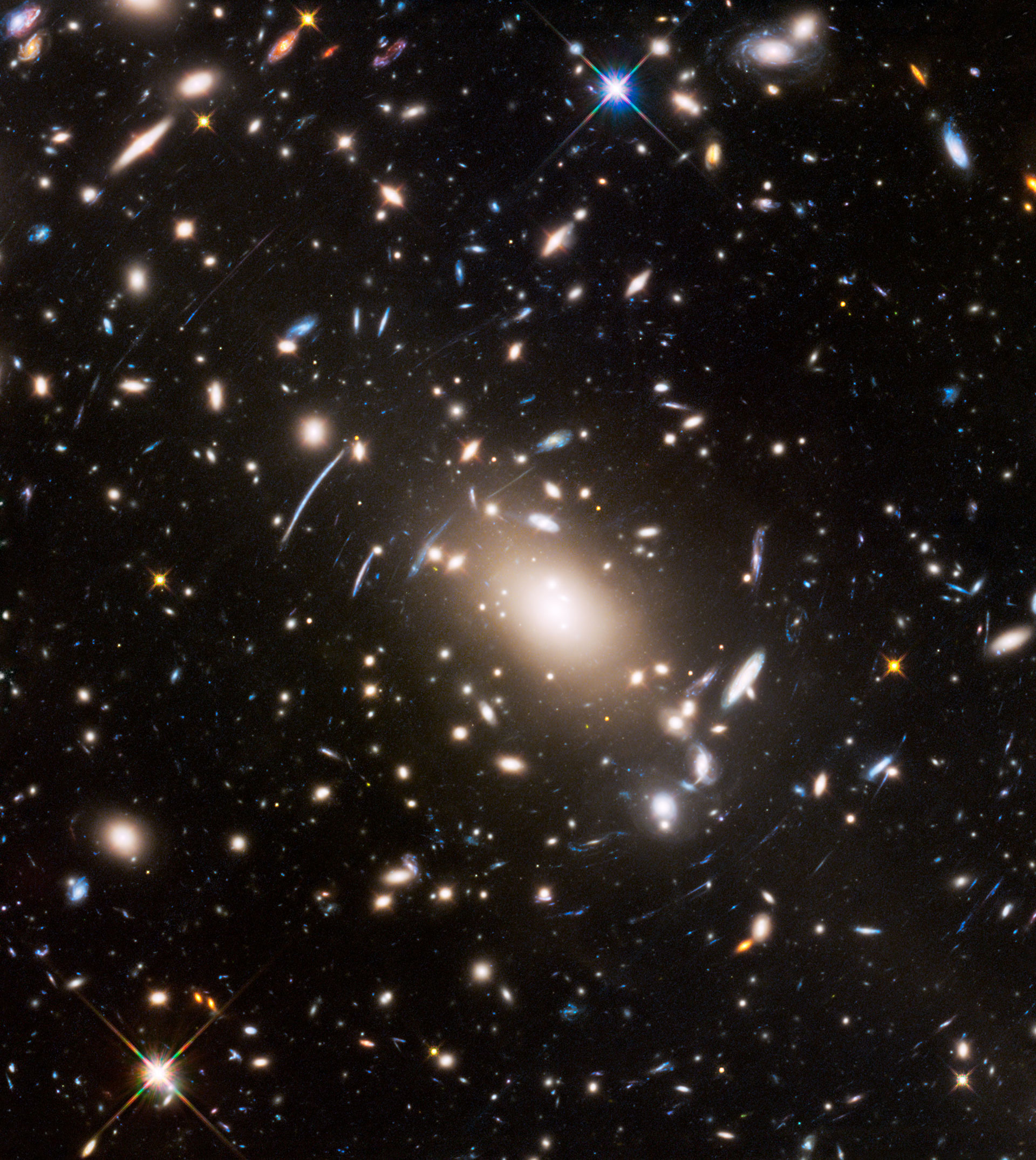
    This view of a massive cluster of galaxies unveils a very cluttered-looking universe filled with galaxies near and far. Some are distorted like a funhouse mirror through a “space warp” phenomenon first predicted by Einstein a century ago.

    Using gravitational lensing, the Hubble Space Telescope unveils a very cluttered-looking universe filled with galaxies near and far.

    Celebrating its 50th anniversary this year, the TV series “Star Trek” has captured the public’s imagination with the signature phrase, “To boldly go where no one has gone before.” NASA’s Hubble Space Telescope doesn’t “boldly go” deep into space, but it is “boldly peering” deeper into the universe than ever before to explore the warping of space and time and uncover some of the farthest objects ever seen.

    When “Star Trek” was first broadcast in 1966, the largest telescopes on Earth could only see about halfway across the universe – the rest was uncharted territory. But Hubble’s powerful vision has carried us into the true “final frontier.”

    This is epitomized in the latest Hubble image released today in time for the new motion picture “Star Trek Beyond.” The Hubble image unveils a very cluttered-looking universe filled with galaxies near and far. Some are distorted like a funhouse mirror through a warping-of-space phenomenon first predicted by Einstein a century ago.

    In the center of the image is the immense galaxy cluster Abell S1063, located 4 billion light-years away, and surrounded by magnified images of galaxies much farther.

    Thanks to Hubble’s exquisite sharpness, the photo unveils the effect of space warping due to gravity. The huge mass of the cluster distorts and magnifies the light from galaxies that lie far behind it due to an effect called gravitational lensing. This phenomenon allows Hubble to see galaxies that would otherwise be too small and faint to observe. This “warp field” makes it possible to get a peek at the very first generation of galaxies. Already, an infant galaxy has been found in the field, as it looked 1 billion years after the Big Bang.

    This frontier image provides a sneak peak of the early universe, and gives us a taste of what the James Webb Space Telescope will be capable of seeing in greater detail when it launches in 2018.


    NASA’s Hubble Space Telescope used gravitational lensing to create this image of distant galaxies.

    The cluster contains approximately 100 million-million solar masses, and contains 51 confirmed galaxies and perhaps over 400 more.

    The Frontier Fields program is an ambitious three-year effort, begun in 2013, that teams Hubble with NASA’s other Great Observatories — the Spitzer Space Telescope and the Chandra X-ray Observatory — to probe the early universe by studying large galaxy clusters. Identifying the magnified images of background galaxies within these clusters will help astronomers to improve their models of the distribution of both ordinary and dark matter in the galaxy cluster. This is key to understanding the mysterious nature of dark matter that comprises most of the mass of the universe.

    Never miss a breakthrough: Join the SciTechDaily newsletter.
    Follow us on Google and Google News.

    Astronomy Hubble Space Telescope NASA
    Share. Facebook Twitter Pinterest LinkedIn Email Reddit

    Related Articles

    Hubble Reveals a Star Disk Three Times Hotter Than the Sun’s Surface

    A Star’s Unexpected Heatwave: FU Orionis Challenges Astrophysics Models

    NASA’s Hubble Reveals How the LMC Defied Galactic Destruction

    Legendary Star’s Smooth Disk Mystifies Astronomers, Challenges Planet Formation Theories

    Cosmic Horror Unveiled: NASA Reveals “Blood-Soaked Eyes” Staring From Deep Space [Video]

    Spanning 248 Billion Miles: Stunning Hubble Timelapse Captures a Star’s Violent Eruptions

    Jupiter’s Great Red Spot Enigma: Unexplained Oscillations Baffle Astronomers

    Unlocking Uranus: NASA’s Dual Observations Pave the Way to Discovering New Worlds

    Astronomers Baffled by Black Hole Jets Igniting Star Explosions

    Leave A Reply Cancel Reply

    • Facebook
    • Twitter
    • Pinterest
    • YouTube

    Don't Miss a Discovery

    Subscribe for the Latest in Science & Tech!

    Trending News

    Your Blood Pressure Reading Could Be Wrong Because of One Simple Mistake

    Astronomers Stunned by Ancient Galaxy With No Spin

    Physicists May Be on the Verge of Discovering “New Physics” at CERN

    Scientists Solve 320-Million-Year Mystery of Reptile Skin Armor

    Scientists Say This Daily Walking Habit May Be the Secret to Keeping Weight Off After Dieting

    New Therapy Rewires the Brain To Restore Joy in Depression Patients

    Giant Squid Detected off Western Australia in Stunning Deep-Sea Discovery

    Popular Sugar-Free Sweetener Linked to Liver Disease, Study Warns

    Follow SciTechDaily
    • Facebook
    • Twitter
    • YouTube
    • Pinterest
    • Newsletter
    • RSS
    SciTech News
    • Biology News
    • Chemistry News
    • Earth News
    • Health News
    • Physics News
    • Science News
    • Space News
    • Technology News
    Recent Posts
    • Scientists Say a 40-Year-Old Childhood Obesity Warning May Be Completely Wrong
    • Marijuana Use May Raise Lung Cancer Risk, Researchers Warn
    • This Common Type of Food May Be Raising Your Risk of Heart Disease
    • Fur Seals’ Hearts Suddenly Spike Hours After Returning to Land
    • Scientists Say Cognitive Decline Isn’t Inevitable — Your Brain Can Improve at Any Age
    Copyright © 1998 - 2026 SciTechDaily. All Rights Reserved.
    • Science News
    • About
    • Contact
    • Editorial Board
    • Privacy Policy
    • Terms of Use

    Type above and press Enter to search. Press Esc to cancel.