
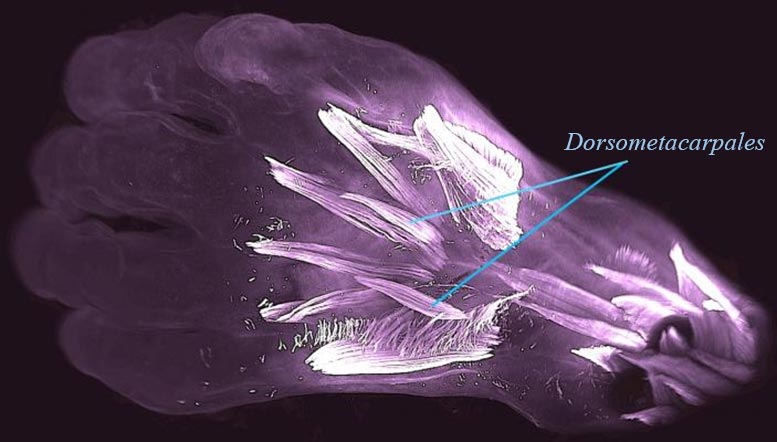
A team of evolutionary biologists, led by Dr. Rui Diogo at Howard University, USA, and writing in the journal Development, have demonstrated that numerous atavistic limb muscles — known to be present in many limbed animals but usually absent in adult humans — are actually formed during early human development and then lost prior to birth. Strikingly, some of these muscles, such as the dorsometacarpales shown in the picture, disappeared from our adult ancestors more than 250 million years ago, during the transition from synapsid reptiles to mammals.
Also remarkably, in both the hand and the foot, of the 30 muscles formed at about 7 weeks of gestation one third will become fused or completely absent by about 13 weeks of gestation. This dramatic decrease parallels what happened in evolution and deconstructs the myth that in both our evolution and prenatal development we tend to become more complex, with more anatomical structures such as muscles being continuously formed by the splitting of earlier muscles. These findings offer new insights into how our arms and legs evolved from our ancestors’, and also about human variations and pathologies, as atavistic muscles are often found either as rare variations in the common human population or as anomalies found in humans born with congenital malformations.
Since Darwin proposed his evolutionary theory, scientists have argued that the occurrence of atavistic structures (anatomical structures lost in the evolution of a certain group of organisms that can be present in their embryos or reappear in adults as variations or anomalies) strongly supports the idea that species change over time from a common ancestor through “descent with modification”. For example, ostriches and other flightless birds have vestigial wings, while whales, dolphins, and porpoises lack hind limbs but their embryos initiate and then abort hind limb development. Similarly, temporary small tail-like structures are found in human embryos and the remnant of the lost ancestral tail is retained as our coccyx. Researchers have also suggested that atavistic muscles and bones can also be seen in human embryos, but it has been difficult to visualize these structures clearly, and the images that appear in modern textbooks are mainly based on decades old analyses.
This is changing with the development of new technology that provides high-quality 3D images of human embryos and fetuses. In the new study published in the journal Development, the authors have used these images to produce the first detailed analysis of the development of human arm and leg muscles. The unprecedented resolution offered by the 3D images reveals the transient presence of several of such atavistic muscles. Dr. Diogo said: “It used to be that we had more understanding of the early development of fishes, frogs, chickens, and mice than in our own species, but these new techniques allow us to see human development in much greater detail. What is fascinating is that we observed various muscles that have never been described in human prenatal development, and that some of these atavistic muscles were seen even in 11.5-weeks old fetuses, which is strikingly late for developmental atavisms “.
He further added: “Interestingly, some of the atavistic muscles are found on rare occasions in adults, either as anatomical variations without any noticeable effect for the healthy individual, or as the result of congenital malformations. This reinforces the idea that both muscle variations and pathologies can be related to delayed or arrested embryonic development, in this case perhaps a delay or decrease of muscle apoptosis, and helps to explain why these muscles are occasionally found in adult people. It provides a fascinating, powerful example of evolution at play.”
Reference: “Development of human limb muscles based on whole-mount immunostaining and the links between ontogeny and evolution” by Rui Diogo, Natalia Siomava and Yorick Gitton, DOI: 10.1242/dev.180349
Never miss a breakthrough: Join the SciTechDaily newsletter.
Follow us on Google and Google News.
1 Comment
More evidence for Haeckel’s “ontogeny recapitulates phylogeny.”