
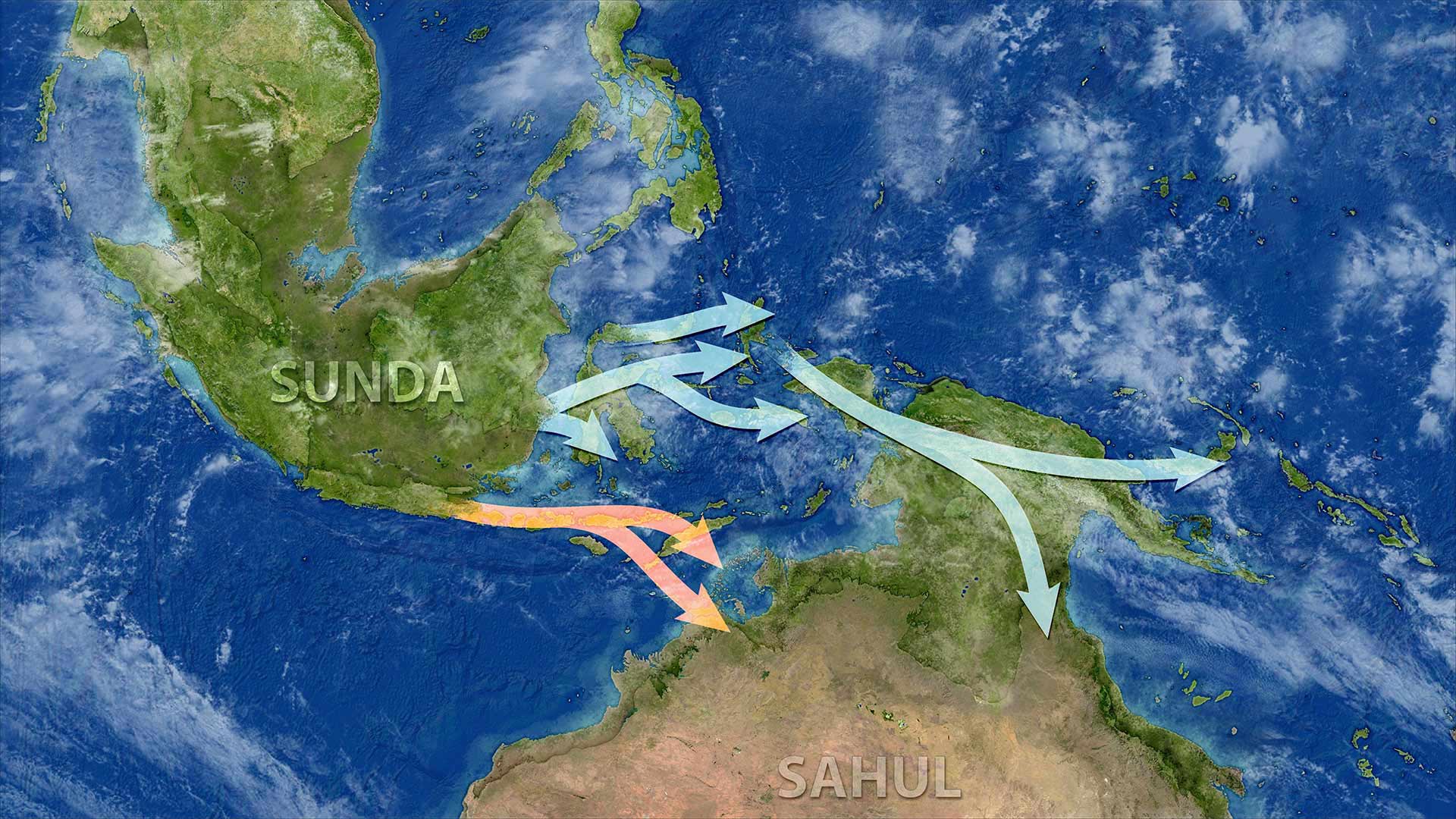
Genetic data strengthens the case that humans first settled Sahul around 60,000 years ago, using multiple seafaring routes.
A large research collaboration between the University of Huddersfield’s Archaeogenetics Research Group and the University of Southampton’s Centre for Maritime Archaeology has helped clarify when and how modern humans, Homo sapiens, first settled New Guinea and Australia.
The project was supported by a European Research Council grant awarded to maritime archaeologist Professor Helen Farr at the University of Southampton, with the archaeogenetics research led by Professor Martin Richards at the University of Huddersfield.
During the last Ice Age, lower sea levels connected New Guinea and Australia into a single landmass called Sahul. For decades, researchers have debated both the timing of the first human arrival on Sahul and the migration routes used to reach this vast continent.
Bringing together expertise from archaeogenetics, archaeology, earth science, and oceanography, the new study helps clarify who made these early sea crossings, where they came from, and when they arrived.
Long versus short chronology debate
There is broad agreement that the ancestors of present-day New Guineans and Aboriginal Australians have lived on Sahul for many tens of thousands of years, with many Aboriginal Australians holding a deep cultural understanding of always having been on country.
However, within Western scientific research, the details of early human dispersal remain contested. Two main timelines have been proposed: the “long chronology,” which places the first settlement at around 60,000 years ago, and the “short chronology,” which suggests humans arrived much later, roughly between 45,000 and 50,000 years ago.
Genetics provides a clearer timeline
The interdisciplinary team, including colleagues at the University of Minho in Portugal, at La Trobe University in Australia, and the University of Oxford, focused firstly on human mitochondrial DNA (mtDNA) genomes to address this question. The mtDNA is inherited only from the mother, and the way the mtDNA sequences vary from one person to the next can therefore be used to recreate the maternal genealogy in great detail.
The team analyzed almost 2,500 mtDNA genomes from Aboriginal Australians, New Guineans, and people from the western Pacific and Southeast Asia. They used these to build a genealogical tree and looked at the way the lineages in the tree were distributed from one population to the next. As all DNA changes gradually over time, they used the amount of change in the lineages – known as the “molecular clock” – to date lineages from each region.

Their findings showed that the most ancient lineages seen either in Aboriginal Australians, New Guineans, or both, but nowhere else, dated to around 60,000 years, coming down firmly in support of the long chronology.
The ancestry of the most ancient lineages could be traced back to Southeast Asia. But the team also found that while the majority traced back to more northerly parts of Southeast Asia – northern Indonesia and the Philippines – a significant minority traced to more southerly parts – southern Indonesia, Malaysia, and Indochina. This suggested there were at least two distinct dispersal routes into Sahul with lineages from both routes dated to around the same arrival time.
Significance of research findings
The work is especially significant, as although the new genetic results fit well with the archaeological and paleoenvironmental picture, in the last few years, many geneticists have been moving in the opposite direction, towards a short chronology
Professor Richards said: “We feel that this is strong support for the long chronology. Still, estimates based on the molecular clock can always be challenged, and the mitochondrial DNA is only one line of descent. We are currently analyzing hundreds of whole human genome sequences – 3 billion bases each, compared to 16,000 – to test our results against the many thousands of other lines of descent throughout the human genome. In the future, there will be further archaeological discoveries, and we can also hope that ancient DNA might be recovered from key remains, so we can more directly test these models and distinguish between them.”
Professor Farr added: “This is a great story that helps refine our understanding of human origins, maritime mobility, and early seafaring narratives. It reflects the really deep heritage that Indigenous communities have in this region and the skills and technology of these early voyagers.”
References: “Genomic evidence supports the “long chronology” for the peopling of Sahul” by Francesca Gandini, Mafalda Almeida, M. George B. Foody, Nano Nagle, Anders Bergström, Anna Olivieri, Simão Rodrigues, Alessandro Fichera, Gonzalo Oteo-Garcia, Antonio Torroni, Alessandro Achilli, William Pomat, Zafarina Zainuddin, Ken Khong Eng, Tarek Shoeib, Teresa Rito, David Bulbeck, Sue O’Connor, Jarosław Bryk, Maria Pala, Michael J. Grant, Ceiridwen J. Edwards, Stephen J. Oppenheimer, Robert J. Mitchell, Pedro A. Soares, Helen Farr and Martin B. Richards, 28 November 2025, Science Advances.
DOI: 10.1126/sciadv.ady9493
“Leveraging known Pacific colonization times to test models for the ancestry of Southeast Asians” by Mafalda Almeida, Francesca Gandini, Teresa Rito, M. George Foody, Andreia Brandão, Marisa Oliveira, Anna Olivieri, Alessandro Fichera, Gonzalo Oteo-Garcia, Zafarina Zainuddin, Ken Khong Eng, William Pomat, Jarosław Bryk, Luísa Pereira, Helen Farr, Maria Pala, Stephen J. Oppenheimer, Martin B. Richards and Pedro Soares, 23 October 2025, Scientific Reports.
DOI: 10.1038/s41598-025-20856-3
The Sahul/Pacific research has received funding from the European Research Council (ERC) under the European Union’s Horizon 2020 research and innovation program under grant agreement no. 759677, ACROSS: the origins of seafaring to Sahul (H.F.)
Never miss a breakthrough: Join the SciTechDaily newsletter.
Follow us on Google and Google News.
9 Comments
Of considerably greater interest is the story behind H erectus whose bones have been found in Indonesia and dated at 100 000 years BP. Assuming these remains are of an extant population how did this allegedly less intelligent ancestor of ours get to Indonesia without walking across land in a glacial low-stand? One might surmise H erectus could build a boat of some sort and even add a sail to it. Two hollowed out logs could make a seaworthy catamaran allowing a population to travel by sea from Malaysia, and if so, why not onwards to PNG/Australia? One could wonder about the ancestry of Mungo Man and his lady whose remains from 45 000 years BP have been stolen from the possibilities of human genetic research and buried deliberately somewhere in Australia by the descendents of what could conceivably have been latecomers 60 000 years ago. It is of course now politically incorrect to make such suppositions; and who is going to apply for research grant to test the weird notion that could H erectus have got to Australia? H erectus was, after all, the most successful hominim amongst the assorted variations on the human theme.
If there was any evidence to support homo erectus predating modern humans arriving in Australia it would be of considerable interest. But as you know there’s not. So let’s not beat around the bush pretending there isn’t a racist dog whistle behind what you’re claiming. Trying to mask your theory as only lacking due to being politically incorrect, in the face of all the evidence, puts you on the wrong side of history.
What intrigues me from this and other studies like this one is how expert homosapien were on maritime mapping and finding their ways around the world.
That may reflect modern human in the area but looking at the brow ridge I would say ancient humans arrived in Australia around no less than 200,000 BC.
Can the genetics give any indication of the number if individuals involved in the migration?
That may reflect modern human in the area but looking at the brow ridge I would say ancient humans arrived in Australia around no less than 200,000 BC.
Graham
so, who did the modern day aboriginals?(60k) take the land from.?
Certainly wasnt white people fella. Unintelligent question buffoon.
Please buddy, stop ya crap ok.