
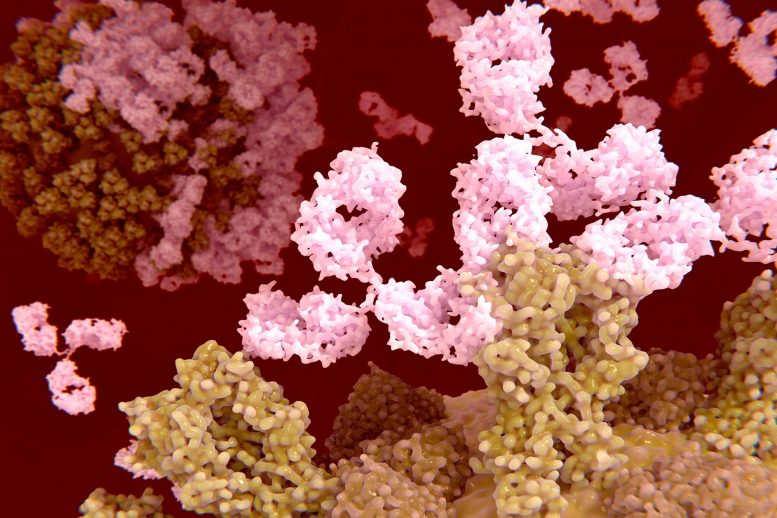
A new review discusses the findings from over 40 studies on coronavirus immunity and what they could mean for the Covid-19 pandemic.
Written by top UK virologists, the article discusses the existing knowledge about immune responses to SARS-CoV-2 and other coronaviruses, and how this could be used to inform virus control strategies. The review, which is free to read in the Journal of General Virology (JGV), collates the available scientific evidence in a number of key areas, including how long immunity to coronaviruses lasts and the prospect of antibody testing.
In the review, Professors Paul Kellam and Wendy Barclay from Imperial College London examine what is so far known about immunity to coronaviruses including SARS, MERS and the four strains of seasonal coronaviruses that circulate in humans every winter. The article goes on to suggest that SARS-CoV-2 could become the fifth seasonal coronavirus with epidemics of the virus occurring over the next several years.
“SARS-CoV-2 is a new virus in humans and because of this we are having to learn quickly many of its basic properties. In the absence of such data right now, we can try to make predictions about the immune response to SARS-CoV-2 by re-examining what we know about the two epidemic coronavirus of humans, SARS and MERS and the four seasonal human coronavirus. We need to be cautious about inferring too much, but it is a good place to start.’
“We do not really know what happens on the pathway of a new coronavirus in humans becoming an endemic seasonal infection, but it could be that when the four seasonal coronavirus first jumped from animals into humans they were much like SARS-CoV-2 in their transmission and pathogenesis. Over time as population immunity to the seasonal coronavirus became widespread, the amount of severe disease probably declines. However, seasonal coronavirus can still cause pneumonia in some people,” said Professor Kellam.
A number of factors, including severity of disease influence how long antibody protection against both SARS and MERS lasts. Studies have shown that antibody protection wanes over time. For seasonal coronaviruses where disease is mild, there have even been reports of reinfection after as little as 80 days. “We need to find out many things about SARS-CoV-2 immunity, such as how good is the immune response and how long does it last. We also need to understand if people with mild or asymptomatic infections develop a strong or weak immune response and what measurable properties of immunity predict protection from infection. When we know more about these things, we will be better able to understand how SARS-CoV-2 infections will continue over time. However, vaccines are not infections, therefore it is likely that some of the vaccines candidates will be better at inducing long lasting immunity and protection from infection,” said Professor Kellam.
The authors also discuss the currently available antibody tests for SARS-CoV-2 and explain the differences between these tests, their accuracy and limitations. Knowing the level of immunity to SARS-CoV-2 in the population could be key in controlling the spread of disease and understanding how many people are at risk of infection.
“Understanding immune responses to these viruses is on many people’s minds- from the public hearing about vaccines, testing and antibodies, to policy makers, and scientists working on or with an interest in the current pandemic.” said Alain Kohl, Deputy Editor-in-Chief of JGV). The Editor-in-Chief Paul Duprex added: “This review gives an up to date, and superbly researched overview of this field. Many people will find areas or topics of interest in this article, that should help them understand the important discussions going on. We are delighted to see it published in the journal.”
Reference: “The dynamics of humoral immune responses following SARS-CoV-2 infection and the potential for reinfection” by Paul Kellam and Wendy Barclay, 20 May 2020, Journal of General Virology.
DOI: 10.1099/jgv.0.001439
Never miss a breakthrough: Join the SciTechDaily newsletter.
Follow us on Google and Google News.