
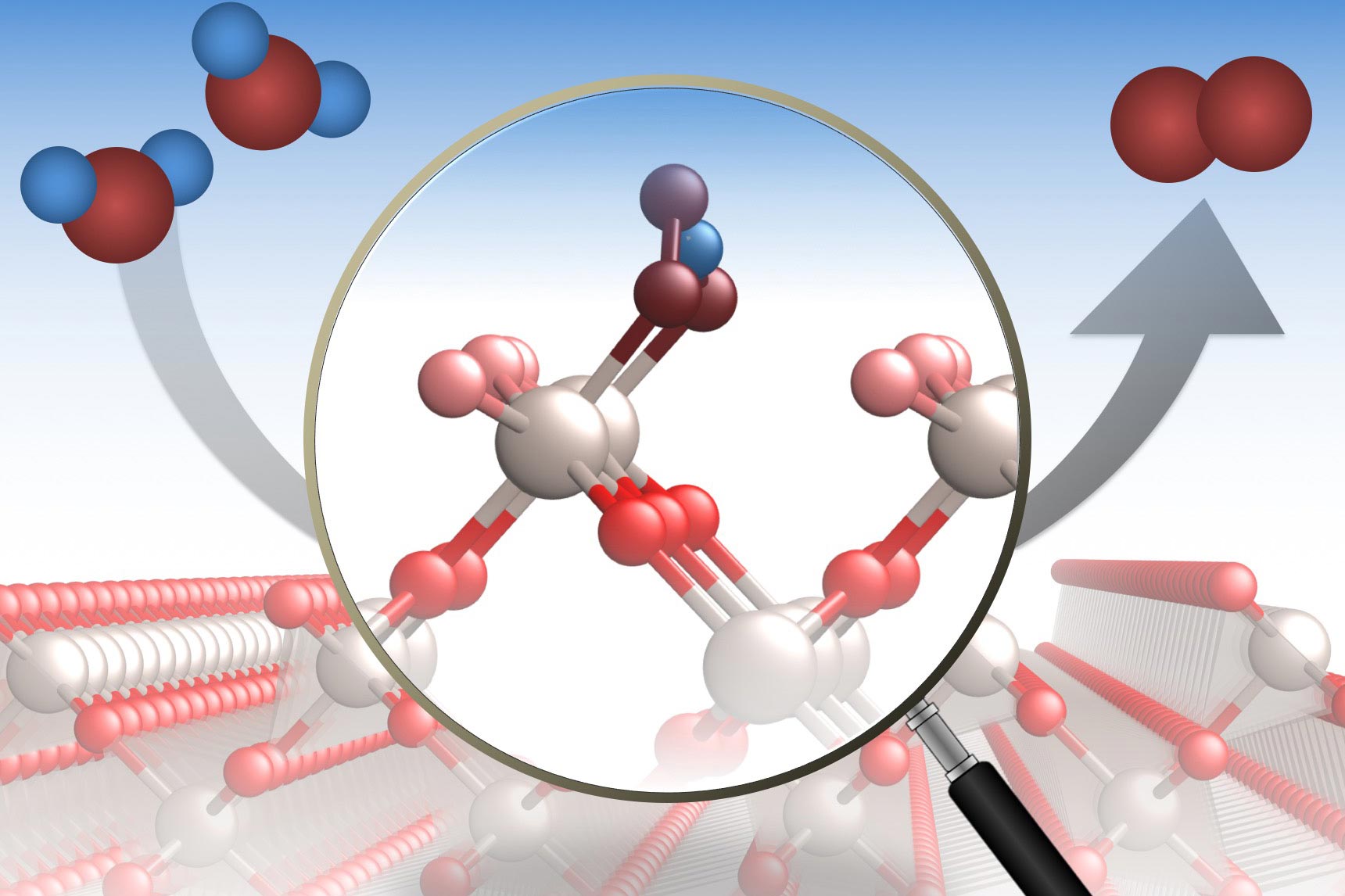
“Gold standard” material for generating oxygen from water divulges its molecular mechanisms.
A crystalline compound called ruthenium dioxide is widely used in industrial processes, where it’s particularly important for catalyzing a chemical reaction that splits molecules of water and releases oxygen. But the exact mechanism that takes place on this material’s surface, and how that reaction is affected by the orientation of the crystal surfaces, had never been determined in detail. Now, a team of researchers at MIT and several other institutions has for the first time been able to directly study the process at an atomic level.
The new findings are reported this month in the journal Nature Catalysis, in a paper by MIT Professor Yang Shao-Horn, recent graduate students Reshma Rao, Manuel Kolb, Livia Giordano, and Jaclyn Lunger, and 10 others at MIT, Argonne National Laboratory, and other institutions.
The work involved years of collaboration and an iterative process between atom-by-atom computer modeling of the catalytic process, and precision experiments including some using a unique synchrotron X-ray facility at Argonne, which allows atomic-scale probing of the material’s surface.
“I think the exciting aspect of the work is that we push a little bit the boundary of our understanding of the catalysis of splitting water,” Shao-Horn says. “We try to learn what happens on surface oxygen sites under reacting conditions, a critical step toward defining the active sites for splitting water.”
The catalytic process, known as the oxygen evolution reaction, is crucial for producing hydrogen and ammonia for energy use, making synthetic carbon-neutral fuels, and making metals from metal oxides. And currently, ruthenium dioxide surfaces are “the gold standard of catalysts for water splitting,” according to Shao-Horn.
While the process of splitting water to separate oxygen atoms from their two attached hydrogen atoms at a catalyst’s surface may seem straightforward, at the molecular level, Rao says, “this interface is quite complicated. You have a really large number of water molecules and your surface can be completely disordered and have multiple processes happening at the same time.” In order to make sense of it all, “the first thing we do is reduce the complexity by having really well-defined single crystal surfaces” where the exact location of every atom has been determined using synchrotron X-ray scattering to probe the surface.
“Using this technique, we can basically zoom into that top layer,” she says, and then they can vary the voltage applied to the surface to see how the water oxidation process is affected. In the new study, because the researchers had determined the activity and reaction sites for different surface orientations of the crystal, they were able to incorporate that information into their molecular modeling on the computer. This allowed them to get more insight into the energetics of reactions taking place at specific atomic configurations at the surface.
What they found was that “it’s a lot more intriguing,” because there’s not just one site that’s responsible for the reaction, Rao says. “It’s not like each site is identical, but you have different sites that can play different roles” in the set of steps in the reaction. Different rate-determining steps can be possible, with the relative rates of water splitting influenced by the orientation of the crystal lattice faces exposed, and the new insights may help in optimizing the way catalysts are prepared in order to optimize the reaction rates.
Rao says that understanding at a molecular level the influence of these subtle differences could help in the designing of future catalysts that could surpass the highest activity levels that would be predicted by the traditional methods of describing electronic structures.
Shao-Horn adds that while their study looked specifically at ruthenium dioxide, the modeling work they did could be applied to a variety of catalytic processes, all of which involved similar reactions of breaking and remaking chemical bonds through interactions with active sites on the material’s surface.
The modeling of surface activity could be used to help in the screening of new potential catalytic materials for a variety of reactions, she says, for example to find materials that use less of rare, expensive elements.
Reference: “Operando identification of site-dependent water oxidation activity on ruthenium dioxide single-crystal surfaces” by Reshma R. Rao, Manuel J. Kolb, Livia Giordano, Anders Filsøe Pedersen, Yu Katayama, Jonathan Hwang, Apurva Mehta, Hoydoo You, Jaclyn R. Lunger, Hua Zhou, Niels Bendtsen Halck, Tejs Vegge, Ib Chorkendorff, Ifan E. L. Stephens and Yang Shao-Horn, 11 May 2020, Nature Catalysis.
DOI: 10.1038/s41929-020-0457-6
The team included researchers in MIT’s departments of Mechanical Engineering and Materials Science and Engineering and the Research Laboratory of Electronics; the Technical University of Denmark; Argonne National Laboratory; and the SLAC National Accelerator Laboratory in California. The work was supported by the Toyota Research Institute through the Accelerated Materials Design and Discovery program, Skoltech-MIT Center for Electromechanical Engineering, the Masdar Institute, and the U.S. Department of Energy.
Never miss a breakthrough: Join the SciTechDaily newsletter.
Follow us on Google and Google News.