
A new AI implant can identify heart issues in real time with high accuracy, potentially enabling early detection and smartphone alerts for patients.
Artificial intelligence (AI) will fundamentally change medicine and healthcare: Diagnostic patient data, e.g. from ECG, EEG or X-ray images, can be analyzed with the help of machine learning, so that diseases can be detected at a very early stage based on subtle changes. However, implanting AI within the human body is still a major technical challenge. TU Dresden scientists at the Chair of Optoelectronics have now succeeded for the first time in developing a bio-compatible implantable AI platform that classifies in real time healthy and pathological patterns in biological signals such as heartbeats. It detects pathological changes even without medical supervision. The research results have now been published in the journal Science Advances.
Neuromorphic Design: Mimicking the Human Brain
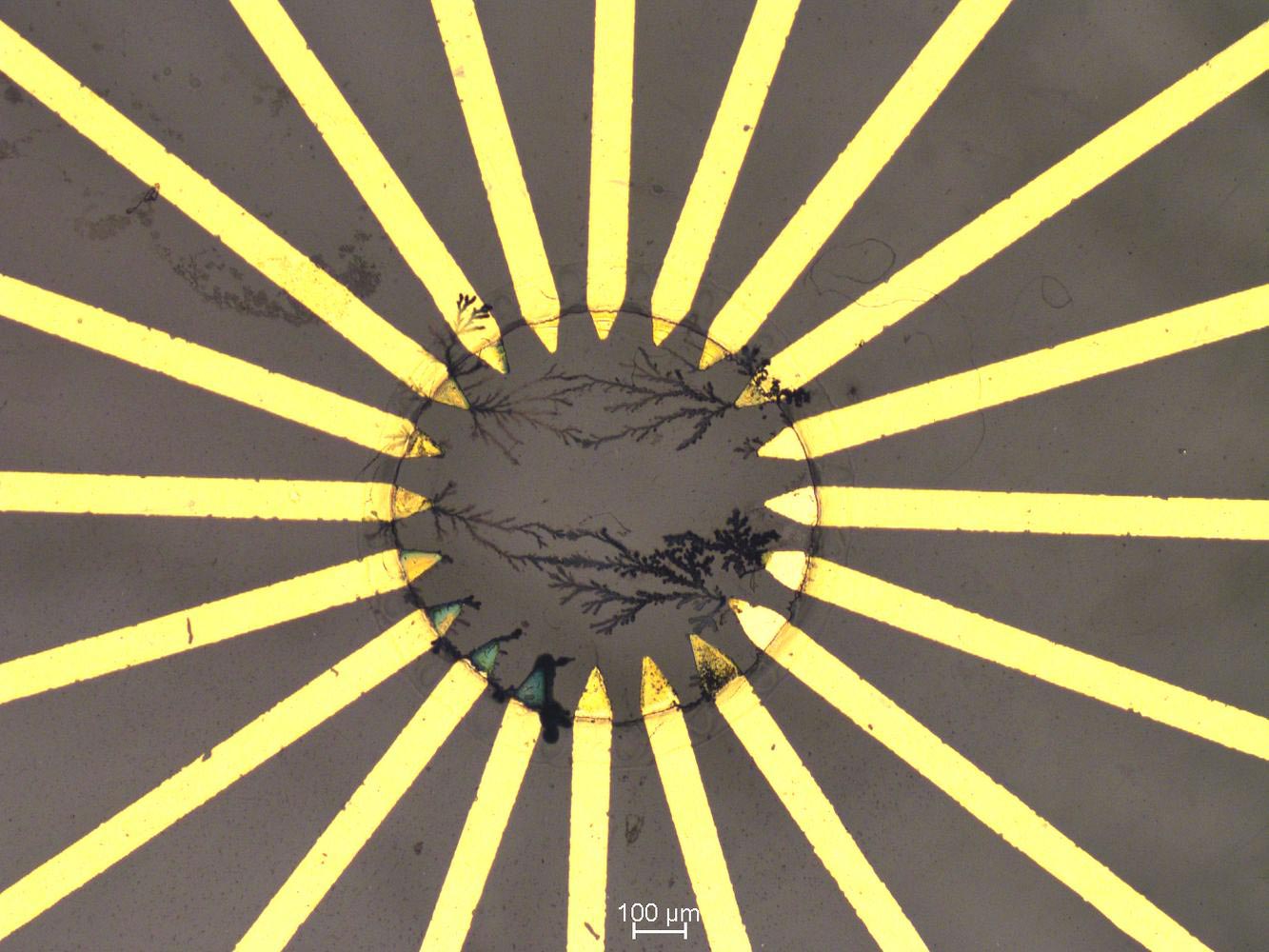
In this work, the research team led by Prof. Karl Leo, Dr. Hans Kleemann and Matteo Cucchi demonstrates an approach for real-time classification of healthy and diseased bio-signals based on a biocompatible AI chip. They used polymer-based fiber networks that structurally resemble the human brain and enable the neuromorphic AI principle of reservoir computing. The random arrangement of polymer fibers forms a so-called “recurrent network,” which allows it to process data, analogous to the human brain. The nonlinearity of these networks enables to amplify even the smallest signal changes, which – in the case of the heartbeat, for example – are often difficult for doctors to evaluate. However, the nonlinear transformation using the polymer network makes this possible without any problems.
In trials, the AI was able to differentiate between healthy heartbeats from three common arrhythmias with an 88% accuracy rate. In the process, the polymer network consumed less energy than a pacemaker. The potential applications for implantable AI systems are manifold: For example, they could be used to monitor cardiac arrhythmias or complications after surgery and report them to both doctors and patients via smartphone, allowing for swift medical assistance.
“The vision of combining modern electronics with biology has come a long way in recent years with the development of so-called organic mixed conductors,” explains Matteo Cucchi, PhD student and first author of the paper. “So far, however, successes have been limited to simple electronic components such as individual synapses or sensors. Solving complex tasks has not been possible so far. In our research, we have now taken a crucial step toward realizing this vision. By harnessing the power of neuromorphic computing, such as reservoir computing used here, we have succeeded in not only solving complex classification tasks in real time but we will also potentially be able to do this within the human body. This approach will make it possible to develop further intelligent systems in the future that can help save human lives.”
Reference: “Reservoir computing with biocompatible organic electrochemical networks for brain-inspired biosignal classification” by Matteo Cucchi, Christopher Gruener, Lautaro Petrauskas, Peter Steiner, Hsin Tseng, Axel Fischer, Bogdan Penkovsky, Christian Matthus, Peter Birkholz, Hans Kleemann and Karl Leo, 18 August 2021, Science Advances.
DOI: 10.1126/sciadv.abh0693
Never miss a breakthrough: Join the SciTechDaily newsletter.
Follow us on Google and Google News.
2 Comments
… it would be better to develop healthy environment, that will render that ai code useless…
You mentioned Tesla vehicles that crashed while in Autopilot. Are you aware of the numbers? It was 9 crashes. Data has proven that cars are 10 times safer with Autopilot engaged as opposed to human driver’s acting alone.