
Close Menu
    Facebook X (Twitter) Instagram
    SciTechDaily
    • Biology
    • Chemistry
    • Earth
    • Health
    • Physics
    • Science
    • Space
    • Technology
    Facebook X (Twitter) Pinterest YouTube RSS
    SciTechDaily
    Home»Science»Improvements to LIGO Detector Will Allow Scientists to ‘Listen’ to Black Holes Forming
    Science

    Improvements to LIGO Detector Will Allow Scientists to ‘Listen’ to Black Holes Forming

    By Geoff Vivian, University of Western AustraliaAugust 16, 2013No Comments3 Mins Read
    Facebook Twitter Pinterest Telegram LinkedIn WhatsApp Email Reddit
    Share
    Facebook Twitter LinkedIn Pinterest Telegram Email Reddit
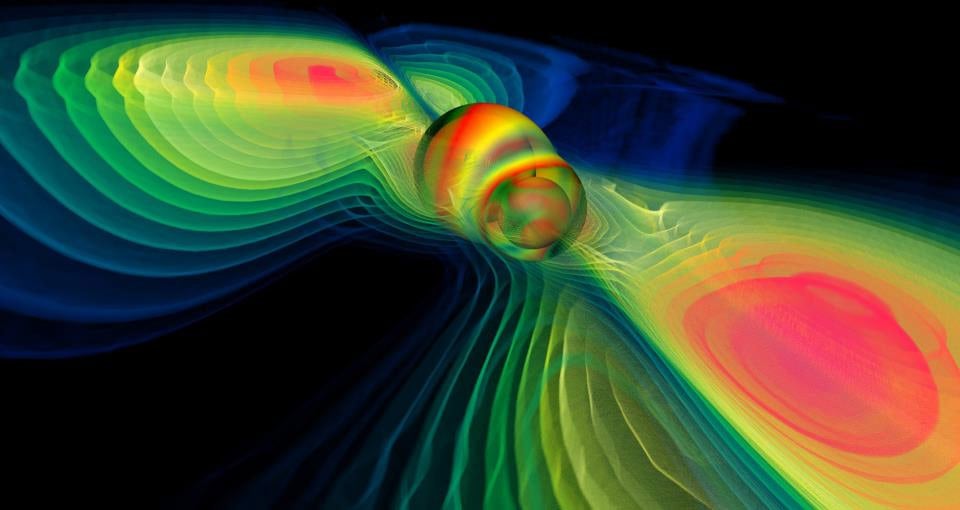
    LIGO Breaks the Quantum Measurement Barrier Allows Astronomers to Listen to Black Holes Forming
    Gravity waves are ripples in space generated by extreme cosmic events such as colliding stars, black holes, and supernova explosions, which carry vast amounts of energy at the speed of light. Credit: Werner Benger, NASAblueshift

    Enhanced sensitivity of the LIGO gravitational wave detector will allow researchers to listen to the Big Bang and to black holes forming throughout the universe.

    New technology that breaks the quantum measurement barrier has been developed to detect the gravity waves first predicted by Einstein in 1916.

    Professor David Blair was one of 800 physicists from around the world who announced a breakthrough in measurement science last month.

    “Gravitational wave astronomy is going to be the new astronomy that’s likely to really revolutionize our understanding of the universe,” he says. “It will allow us to listen to the Big Bang and to black holes forming throughout the universe.”

    “These are detectors that can allow humanity to explore the beginning of time and the end of time.”

    According to current theory, time began with the Big Bang and ends in black holes. Specialized equipment known as the Laser Interferometer Gravitational-Wave Observatory (LIGO) uses laser beams to measure gravitational ripples of space and time.

    The detector consists of an L-shaped vacuum system, four kilometers long, with mirrors at the ends. Lasers directed at the mirrors are isolated from irrelevant vibrations by a vibration isolation system.

    He says the addition of a new technique called ‘quantum squeezing’ at the world’s largest gravitational wave detector allowed researchers to eliminate a lot of the ‘noise’ caused by quantum fluctuations.

    “The recent announcement is the first implementation in a multi-kilometer detector.” “It proves that the quantum barrier [that] physicists thought would limit sensitivity can be overcome.”

    The new equipment has allowed the physicists to break the quantum measurement barrier, defined until recently by Heisenberg’s uncertainty principle.

    “This is a major breakthrough that makes us even more confident that in a few years, we will begin to directly measure the ripples in space,” he says. As a result, there is no lower limit on the amount of measurable energy, and extremely subtle gravitational waves will become detectable.

    “These instruments represent the pinnacle of technology,” he says. “They’ve got the most perfect mirrors ever created, they’ve got the most powerful laser light that’s ever been used in any measuring system.”

    “They’ve got a vacuum that is so good that the size of any leak would represent less than a teaspoon full of air leaking into it in about 300 years.”

    “They can measure the smallest amounts of energy that has ever been measured but the new method enables them measure even less.”

    “The uncertainties from empty space can be suppressed so as to measure something even smaller.”

    Publication: “Enhanced sensitivity of the LIGO gravitational wave detector by using squeezed states of light” by J. Aasi, et al., 21 July 2013, Nature Photonics.
    DOI: 10.1038/nphoton.2013.177

    Never miss a breakthrough: Join the SciTechDaily newsletter.
    Follow us on Google and Google News.

    Gravitational Waves Photonics University of Western Australia
    Share. Facebook Twitter Pinterest LinkedIn Email Reddit

    Related Articles

    Electro-Optical Innovation: New Way To Control and Manipulate Optical Signals Developed

    Revolutionizing Temperature Measurement: The Magic of Upconversion Luminescence

    Roman Relics to Tech Treasures: Glass Fragments Unlock Future Secrets

    Nature’s Nanotechnology: The Wonders of Ancient Roman Glass

    Thinner Than the Photon Itself – Scientists Invent Smallest Known Way To Guide Light

    Decoding Deep Space Mysteries: Researchers Uncover Potential Link Between Two of Astronomy’s Most Enigmatic Phenomena

    Uncovering the Secrets of an Ancient Stone Monument: New Findings From an Archaeological Site in Saudi Arabia

    Space Interferometer Constellation To Reveal Elusive Gravitational Wave Sources and Unravel the Universe

    New Laser Breakthrough for Gravitational Waves Will Test the Fundamental Limits of General Relativity

    Leave A Reply Cancel Reply

    • Facebook
    • Twitter
    • Pinterest
    • YouTube

    Don't Miss a Discovery

    Subscribe for the Latest in Science & Tech!

    Trending News

    Popular Supplement Ingredient Linked to Shorter Lifespan in Men

    Scientists May Have Found a Way To Repair Nerve Damage in Multiple Sclerosis

    “Totally Unexpected” – Scientists Discover Pancreatic Cancer’s Fatal Addiction

    A Strange Quantum Effect May Explain One of Biology’s Greatest Mysteries

    James Webb Telescope Reveals the Universe’s Hidden Cosmic Web in Stunning Detail

    Scientists Identify Simple Supplement That Greatly Reduces Alzheimer’s Damage

    You May Have a Dangerous Type of Cholesterol Even if Your Tests Look Normal

    Your Blood Pressure Reading Could Be Wrong Because of One Simple Mistake

    Follow SciTechDaily
    • Facebook
    • Twitter
    • YouTube
    • Pinterest
    • Newsletter
    • RSS
    SciTech News
    • Biology News
    • Chemistry News
    • Earth News
    • Health News
    • Physics News
    • Science News
    • Space News
    • Technology News
    Recent Posts
    • Scientists Say a 40-Year-Old Childhood Obesity Warning May Be Completely Wrong
    • Marijuana Use May Raise Lung Cancer Risk, Researchers Warn
    • This Common Type of Food May Be Raising Your Risk of Heart Disease
    • Fur Seals’ Hearts Suddenly Spike Hours After Returning to Land
    • Scientists Say Cognitive Decline Isn’t Inevitable — Your Brain Can Improve at Any Age
    Copyright © 1998 - 2026 SciTechDaily. All Rights Reserved.
    • Science News
    • About
    • Contact
    • Editorial Board
    • Privacy Policy
    • Terms of Use

    Type above and press Enter to search. Press Esc to cancel.