
New machine learning study finds different habits take varying amounts of time to take root.
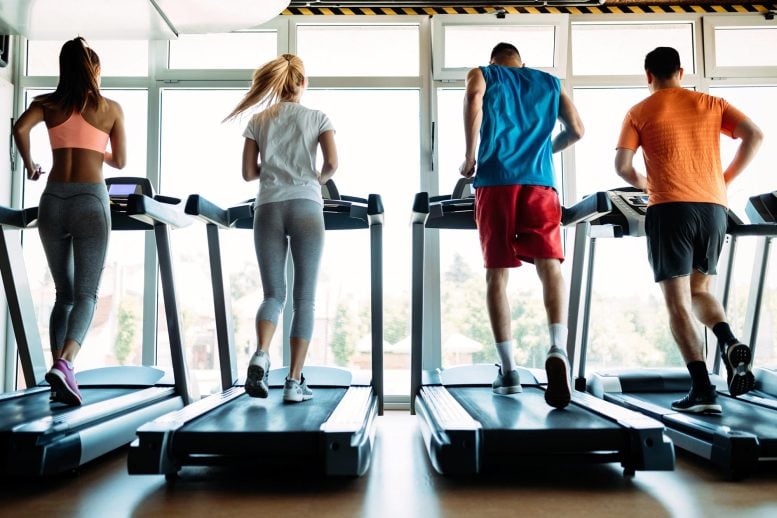
Putting on your workout clothes and getting to the gym can feel like a slog at first. Eventually, you might get in the habit of going to the gym and readily pop over to your Zumba class or for a run on the treadmill. A new study from social scientists at Caltech now shows how long it takes to form the gym habit: an average of about six months.
The same study also looked at how long it takes healthcare workers to get in the habit of washing their hands: an average of a few weeks.
“There is no magic number for habit formation,” says Anastasia Buyalskaya (PhD ’21), now an assistant professor of marketing at HEC Paris. Other authors of the study, which appears in the journal Proceedings of the National Academy of Sciences, include Caltech’s Colin Camerer, Robert Kirby Professor of Behavioral Economics and director and leadership chair of the T&C Chen Center for Social and Decision Neuroscience, and researchers from the University of Chicago and the University of Pennsylvania. Xiaomin Li (MS ’17, PhD ’21), formerly a graduate student and postdoctoral scholar at Caltech, is also an author.
“You may have heard that it takes about 21 days to form a habit, but that estimate was not based on any science,” Camerer says. “Our works supports the idea that the speed of habit formation differs according to the behavior in question and a variety of other factors.”
A New Approach to Studying Habits
The study is the first to use machine learning tools to study habit formation. The researchers employed machine learning to analyze large data sets of tens of thousands of people who were either swiping their badges to enter their gym or washing their hands during hospital shifts. For the gym research, the researchers partnered with 24 Hour Fitness, and for the hand-washing research, they partnered with a company that used radio frequency identification (RFID) technology to monitor hand-washing in hospitals. The data sets tracked more than 30,000 gymgoers over four years and more than 3,000 hospital workers over nearly 100 shifts.
“With machine learning, we can observe hundreds of context variables that may be predictive of behavioral execution,” explains Buyalskaya. “You don’t necessarily have to start with a hypothesis about a specific variable, as the machine learning does the work for us to find the relevant ones.”
Machine learning also let the researchers study people over time in their natural environments; most previous studies were limited to participants filling out surveys.
The study found that certain variables had no effect on gym habit formation, such as time of day. Other factors, such as one’s past behavior, did come into play. For instance, for 76 percent of gymgoers, the amount of time that had passed since a previous gym visit was an important predicator of whether the person would go again. In other words, the longer it had been since a gymgoer last went to the gym, the less likely they were to make a habit of it. Sixty-nine percent of the gymgoers were more likely to go to the gym on the same days of the week, with Monday and Tuesday being the most well-attended.
For the hand-washing part of the study, the researchers looked at data from healthcare workers who were given new requirements to wear RFID badges that recorded their hand-washing activity. “It is possible that some health workers already had the habit prior to us observing them, however, we treat the introduction of the RFID technology as a ‘shock’ and assume that they may need to rebuild their habit from the moment they use the technology,” Buyalskaya says.
“Overall, we are seeing that machine learning is a powerful tool to study human habits outside the lab,” Buyalskaya says.
Reference: “What can machine learning teach us about habit formation? Evidence from exercise and hygiene” by Anastasia Buyalskaya, Hung Ho, Katherine L. Milkman, Xiaomin Li, Angela L. Duckworth and Colin Camerer, 17 April 2023, Proceedings of the National Academy of Sciences.
DOI: 10.1073/pnas.2216115120
The study was funded by the Behavior Change for Good Initiative, the Ronald and Maxine Linde Institute of Economics and Management Sciences at Caltech, and the Tianqiao and Chrissy Chen Institute for Neuroscience at Caltech.
Never miss a breakthrough: Join the SciTechDaily newsletter.
Follow us on Google and Google News.