
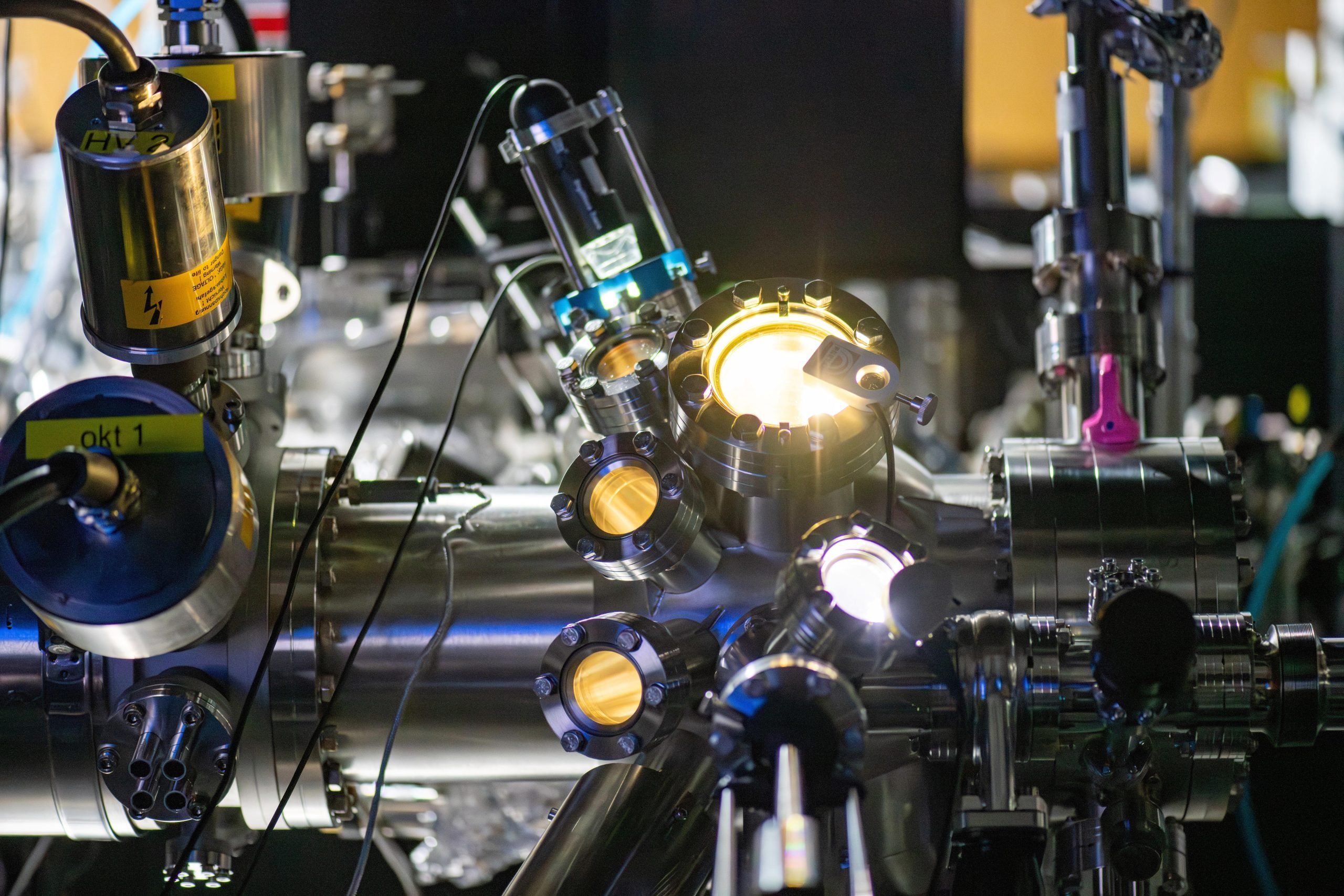
Using one of the world’s most advanced spectroscopy systems, researchers have developed a framework to guide studies in next-generation quantum information technologies.
For the first time, scientists in the Femtosecond Spectroscopy Unit at the Okinawa Institute of Science and Technology (OIST) have directly tracked how dark excitons evolve in atomically thin materials. This achievement paves the way for advances in both classical and quantum information technologies. The study was published in Nature Communications.
Professor Keshav Dani, who leads the unit, emphasized the importance of the work: “Dark excitons have great potential as information carriers, because they are inherently less likely to interact with light, and hence less prone to degradation of their quantum properties. However, this invisibility also makes them very challenging to study and manipulate. Building on a previous breakthrough at OIST in 2020, we have opened a route to the creation, observation, and manipulation of dark excitons.”
“In the general field of electronics, one manipulates electron charge to process information,” explains Xing Zhu, co-first author and PhD student in the unit. “In the field of spintronics, we exploit the spin of electrons to carry information. Going further, in valleytronics, the crystal structure of unique materials enables us to encode information into distinct momentum states of the electrons, known as valleys.”
The ability to use the valley dimension of dark excitons to carry information positions them as promising candidates for quantum technologies. Dark excitons are by nature more resistant to environmental factors like thermal background than the current generation of qubits, potentially requiring less extreme cooling and making them less prone to decoherence, where the unique quantum state breaks down.
Defining landscapes of energy with bright and dark excitons
In the last ten years, researchers have made significant strides in studying a family of atomically thin semiconductors called TMDs (transition metal dichalcogenides). Like all semiconductors, TMDs consist of atoms arranged in a crystal lattice that restricts electrons to defined energy levels, or bands, such as the valence band. When light strikes the material, electrons are lifted from the valence band into the higher-energy conduction band, leaving behind positively charged vacancies known as holes.
The mutual attraction between the negatively charged electrons and positively charged holes binds them into hydrogen-like quasiparticles called excitons. If the electron and hole share specific quantum features, such as having the same spin configuration and occupying the same “valley” in momentum space (the energy minima available in the crystal lattice), they recombine within a trillionth of a second (1ps = 10−12 second), releasing light. These are known as “bright” excitons.
However, if the quantum properties of the electron and hole do not match up, the electron and hole are forbidden from recombining on their own and do not emit light. These are characterized as ‘dark’ excitons. “There are two ‘species’ of dark excitons,” explains Dr. David Bacon, co-first author who is now at University College London, “momentum-dark and spin-dark, depending on where the properties of electron and hole are in conflict. The mismatch in properties not only prevents immediate recombination, allowing them to exist up to several nanoseconds (1ns = 10−9 second – a much more useful timescale), but also makes dark excitons more isolated from environmental interactions.”
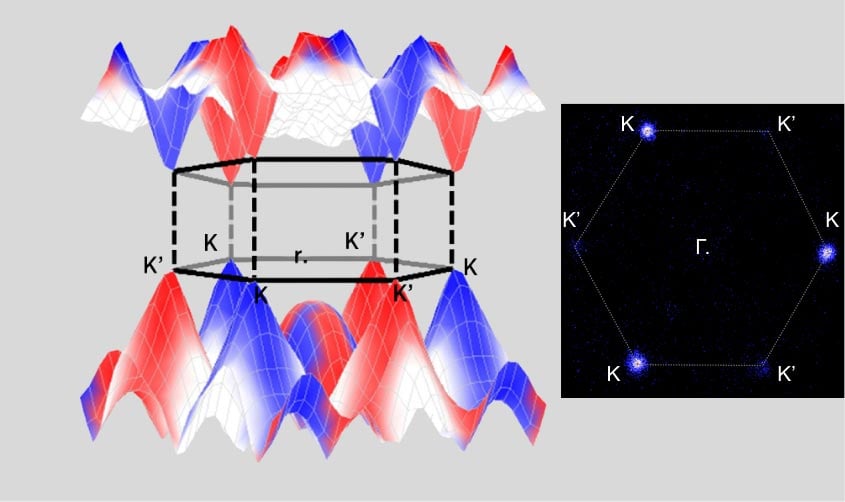
“The unique atomic symmetry of TMDs means that when exposed to a state of light with a circular polarization, one can selectively create bright excitons only in a specific valley. This is the fundamental principle of valleytronics. However, bright excitons rapidly turn into numerous dark excitons that can potentially preserve the valley information. Which species of dark excitons are involved and to what degree they can sustain the valley information is unclear, but this is a key step in the pursuit of valleytronic applications,” explains Dr. Vivek Pareek, co-first author and OIST graduate who is now a Presidential Postdoctoral Fellow at the California Institute of Technology.
Observing electrons at the femtosecond scale
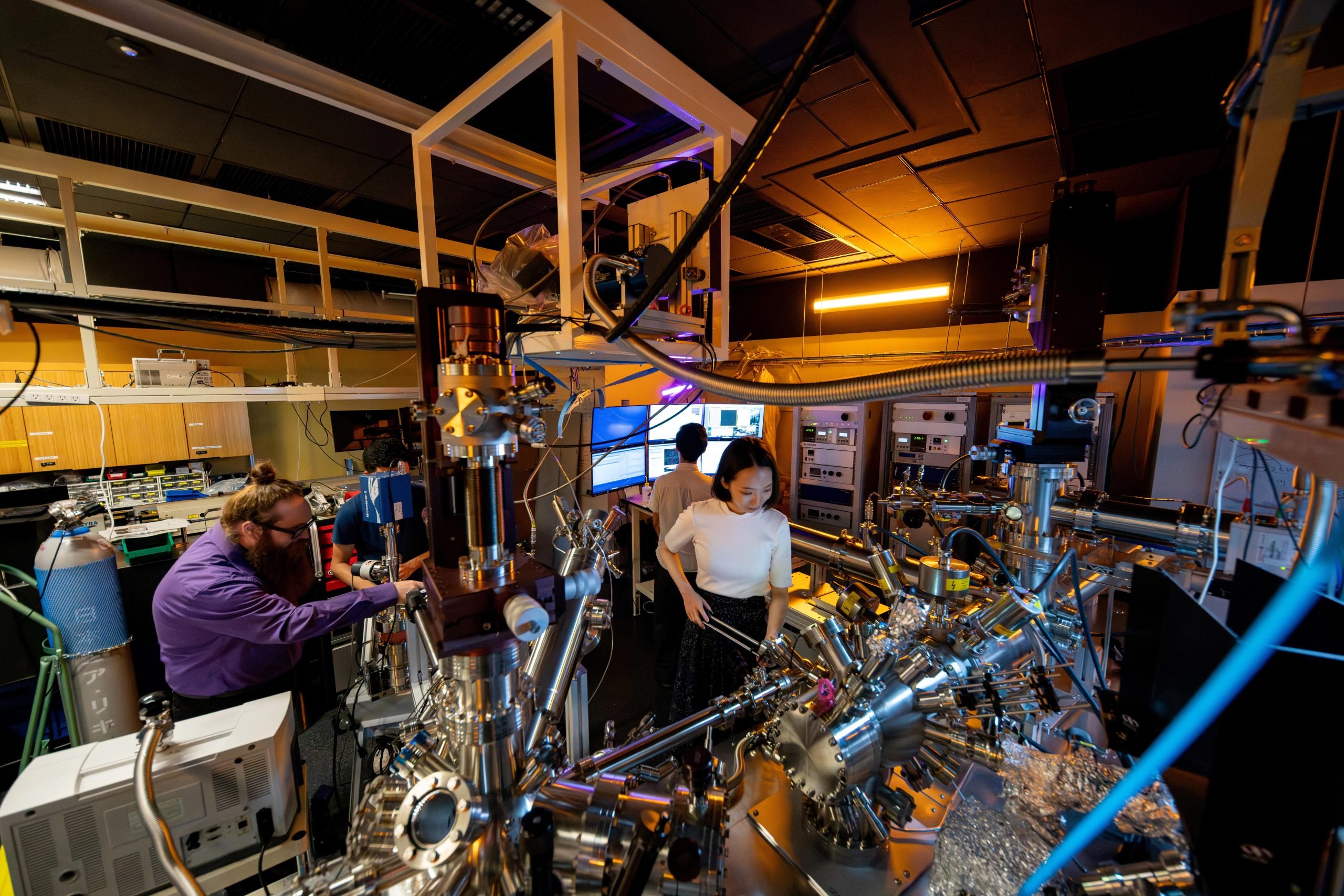
With the state-of-the-art TR-ARPES (time- and angle-resolved photoemission spectroscopy) system at OIST, equipped with a custom-built table-top XUV (extreme ultraviolet) source, the researchers were able to monitor how different excitons evolved after bright excitons formed in a particular valley of a TMD semiconductor. They accomplished this by measuring momentum, spin state, and the population of electrons and holes at the same time, a combination of properties that had never previously been quantified together.
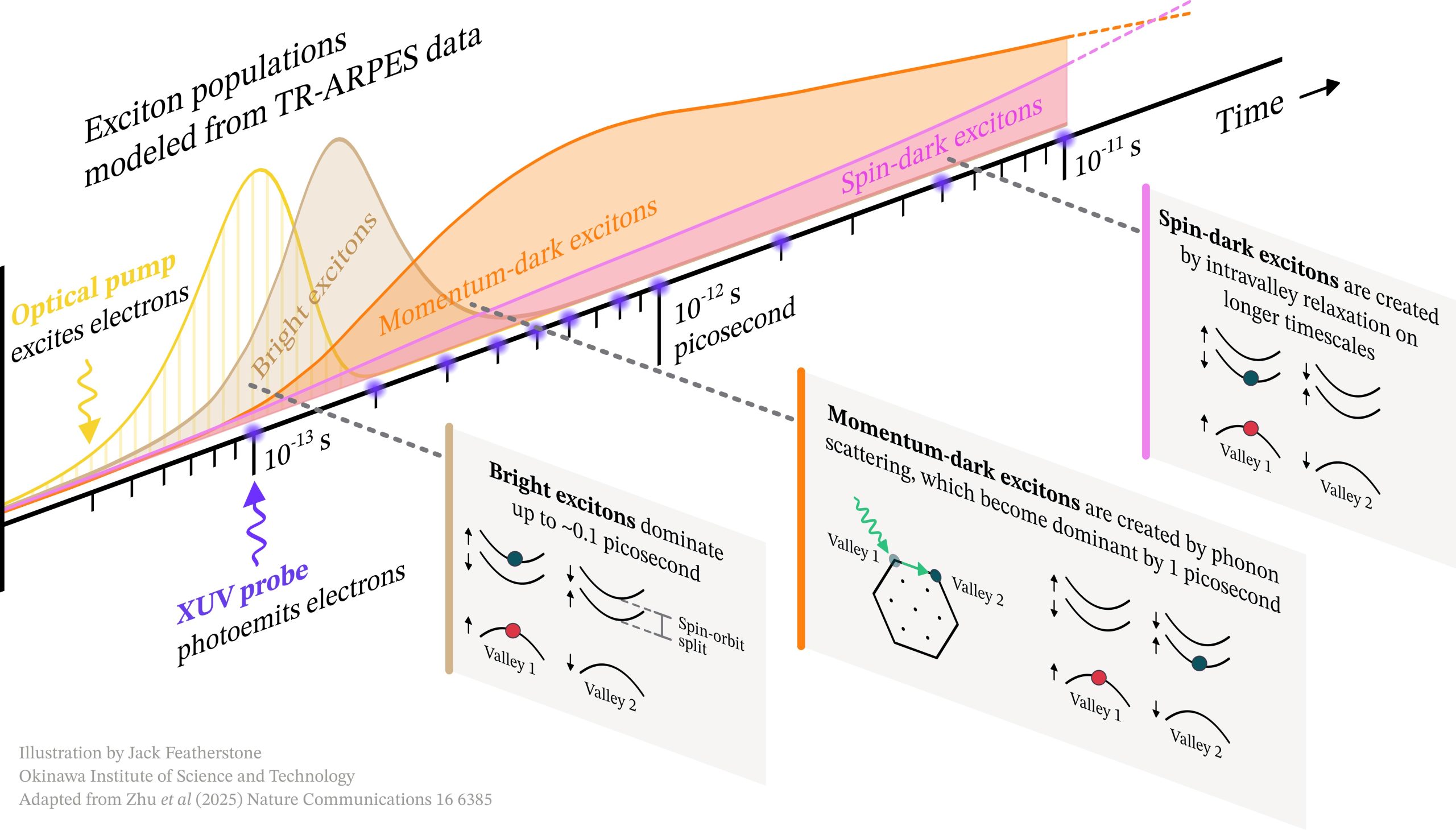
Their findings show that within a picosecond, some bright excitons are scattered by phonons (quantized crystal lattice vibrations) into different momentum valleys, rendering them momentum-dark. Later, spin-dark excitons dominate, where electrons have flipped spin within the same valley, persisting on nanosecond scales.
With this, the team has overcome the fundamental challenge of how to access and track dark excitons, laying the foundation for dark valleytronics as a field. Dr. Julien Madéo of the unit summarizes: “Thanks to the sophisticated TR-ARPES setup at OIST, we have directly accessed and mapped how and what dark excitons keep long-lived valley information. Future developments to read out the dark excitons valley properties will unlock broad dark valleytronic applications across information systems.”
Reference: “A holistic view of the dynamics of long-lived valley polarized dark excitonic states in monolayer WS2” by Xing Zhu, David R. Bacon, Vivek Pareek, Julien Madéo, Takashi Taniguchi, Kenji Watanabe, Michael K. L. Man and Keshav M. Dani, 10 July 2025, Nature Communications.
DOI: 10.1038/s41467-025-61677-2
Funding: Okinawa Institute of Science and Technology Graduate University, Japan Society for the Promotion of Science, Fusion Oriented REsearch for disruptive Science and Technology, Japan Society for the Promotion of Science, Japan Society for the Promotion of Science, Japan Society for the Promotion of Science, Japan Society for the Promotion of Science, Japan Society for the Promotion of Science, Japan Science and Technology Agency
Never miss a breakthrough: Join the SciTechDaily newsletter.
Follow us on Google and Google News.
4 Comments
In a World-First, Scientists Directly Observe Elusive “Dark Excitons”
VERY GOOD!
Please ask researchers to think deeply:
Are the Dark Excitons in space derived from the dynamic evolution of space or from God?
Space constitutes the fundamental medium in which matter (or objects) exist and undergo motion. Within this framework, diverse forms of matter manifest, occupying distinct spatial domains and persisting through specific temporal intervals. This raises profound questions: What governs the origin of matter in space? Can space autonomously generate and structure matter? By what mechanisms are motion, vitality, and cyclical dynamics imparted to cosmic entities?
Symmetry principles dominate the formulation of fundamental physical laws, acting as both heuristic and axiomatic guides. Theoretical unification efforts are intrinsically tied to symmetry preservation, with global symmetries often approximating emergent gauge symmetries—a perspective corroborated by condensed-matter physics and experimental evidence. Crucially, symmetries enable the extraction of universal laws from chaotic initial conditions, underscoring their indispensability in physical discovery.
Vortex research intersects fluid mechanics, astrophysics, and quantum theory, offering fertile ground for interdisciplinary innovation. Cross-disciplinary synthesis may catalyze paradigm shifts in modern physics, driving novel methodologies and unifying disparate phenomena under coherent theoretical frameworks.
Excerpted from https://zhuanlan.zhihu.com/p/1933828835322856603.
все становится очень просто. Надо понять что имеющееся во Вселенной есть и в каждой фундаментальной, единой частице. Своя масса,с силой притяжения. Свое время, как вращение, скорость и температура. И пространство как размер, и промежутки взаимодействия, ослабляющие силу притяжения с квадратом расстояния. Частица крутится это его способность и сила. В стабильных фигурках силы складываются во вращающиеся импульсы. Вот наложение их и все и строит. Обеспечивая стабильность при сочетании, массы времени, и пространства, как внутри тел так и снаружи. Мир един и прост.
This breakthrough is extraordinary. Directly observing the formation and evolution of dark excitons — from bright to momentum‑dark to long‑lived spin‑dark states — is exactly the kind of experimental foundation needed to push quantum information science forward.
What stands out most is the team’s ability to track valley polarization through the entire exciton cascade. The fact that dark excitons can preserve valley information on nanosecond timescales, while remaining naturally shielded from radiative loss, makes them uniquely promising as information carriers. Their robustness at or near room temperature is especially compelling for scalable solid‑state quantum systems.
I’m actively working on architectures that use dark excitons as long‑lived logical carriers and would be very interested in learning more about your methods, especially the TR‑ARPES setup and how you controlled the bright‑to‑dark scattering pathways. If there are opportunities for collaboration or discussion, I would be excited to connect.
Congratulations to the entire OIST team — this work opens a real path toward practical dark‑exciton‑based quantum technologies.
—[email protected]