

Scientists have shown that it may be possible to transform materials simply by triggering internal quantum ripples rather than blasting them with intense light.
Imagine being able to change what a material is capable of simply by shining light on it.
That idea may sound like something out of science fiction, but it is exactly what physicists aim to achieve through a growing research area known as Floquet engineering. By exposing a material to a repeating external influence such as light, scientists can temporarily reshape how its electrons behave. This process allows materials to take on entirely new properties, including behaviors normally associated with exotic states of matter, like superconductivity.
The underlying theory behind Floquet physics has been studied for years, dating back to a bold proposal by Oka and Aoki in 2009. However, real-world demonstrations have been rare. Only a small number of experiments over the past decade have successfully shown clear Floquet effects. A major obstacle has been the reliance on intense light, which must be powerful enough to alter electronic behavior but often comes close to damaging or destroying the material itself while delivering limited results.
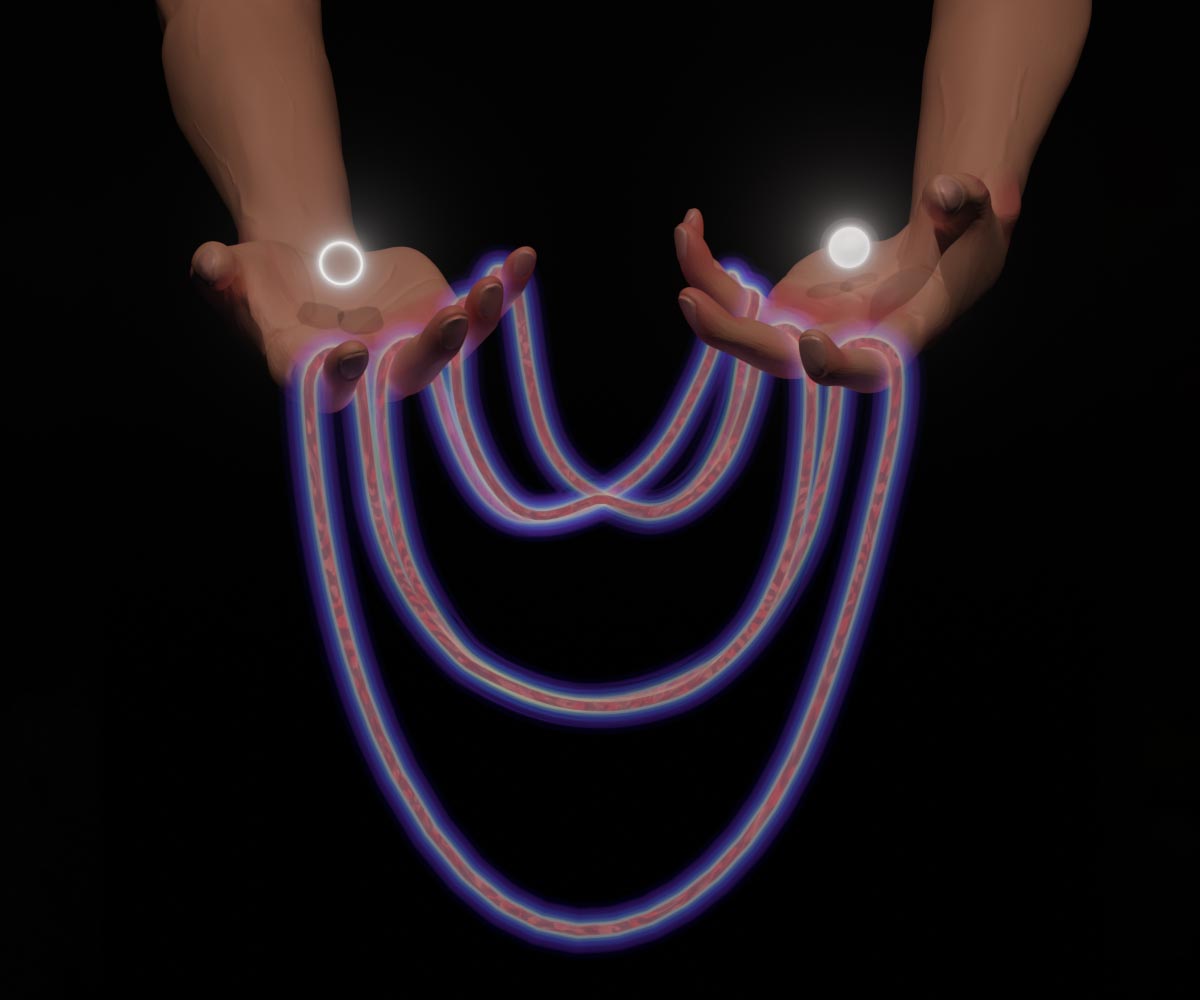
A New Approach Beyond High Intensity Light
Researchers have now uncovered a more efficient way forward. An international team co-led by the Okinawa Institute of Science and Technology (OIST) and Stanford University has demonstrated that particles known as excitons can drive Floquet effects far more effectively than light alone. Their findings were published in Nature Physics.
“Excitons couple much more strongly to the material than photons due to the strong Coulomb interaction, particularly in 2D materials,” says Professor Keshav Dani from the Femtosecond Spectroscopy Unit at OIST. “And they can thus achieve strong Floquet effects while avoiding the challenges posed by light. With this, we have a new potential pathway to the exotic future quantum devices and materials that Floquet engineering promises.”
This discovery offers a promising alternative to laser-driven methods, opening new possibilities for controlling quantum materials without extreme energy input.
How Floquet Engineering Works in Quantum Materials
Floquet engineering has long been viewed as a potential route to creating quantum materials on demand using ordinary semiconductors. The basic idea comes from a simple physical principle. When a system experiences a repeating force, its overall behavior can become more complex than the repetition itself. A familiar example is a playground swing. Regular pushes can send the swing higher, even though the motion remains rhythmic.
In the quantum world, this principle takes on new meaning. Inside a crystal, electrons already experience a repeating structure in space because atoms are arranged in a precise lattice. This spatial repetition defines which energy levels, known as bands, electrons are allowed to occupy.
When light with a specific frequency shines on the crystal, it adds a second repeating influence, this time in time rather than space. As photons interact with electrons in a rhythmic pattern, the allowed energy bands shift. By carefully tuning the light’s frequency and intensity, researchers can create hybrid energy bands that alter how electrons move and interact. These changes temporarily give the material new properties, much like how two musical notes combine to create a new sound.
Once the light is turned off, the material returns to its original state. But while the drive is active, scientists can effectively dress materials in new quantum behaviors.
Why Light Alone Has Not Been Enough
“Until now, Floquet engineering has been synonymous with light drives,” says Xing Zhu, PhD student at OIST. “But while these systems have been instrumental to proving the existence of Floquet effects, light couples weakly to matter, meaning that very high frequencies, often at the femtosecond scale, are required to achieve hybridization. Such high energy levels tend to vaporize the material, and the effects are very short-lived. By contrast, excitonic Floquet engineering requires much lower intensities.”
This limitation has kept Floquet engineering largely confined to laboratory demonstrations rather than practical applications.
What Makes Excitons So Effective
Excitons form inside semiconductors when electrons absorb energy and jump from their normal position in the valence band to a higher energy level known as the conduction band. This jump leaves behind a positively charged hole. The electron and hole remain bound together, forming a short-lived quasiparticle.
These excitons naturally carry oscillating energy from their initial excitation. That energy interacts with nearby electrons at adjustable frequencies. Because excitons are made from the material’s own electrons, they interact much more strongly with the surrounding structure than external light does.
“Excitons carry self-oscillating energy, imparted by the initial excitation, which impacts the surrounding electrons in the material at tunable frequencies. Because the excitons are created from the electrons of the material itself, they couple much more strongly with the material than light. And crucially, it takes significantly less light to create a population of excitons dense enough to serve as an effective periodic drive for hybridization, which is what we have now observed,” explains co-author Professor Gianluca Stefanucci of the University of Rome Tor Vergata.
Observing Excitonic Floquet Effects in Real Time
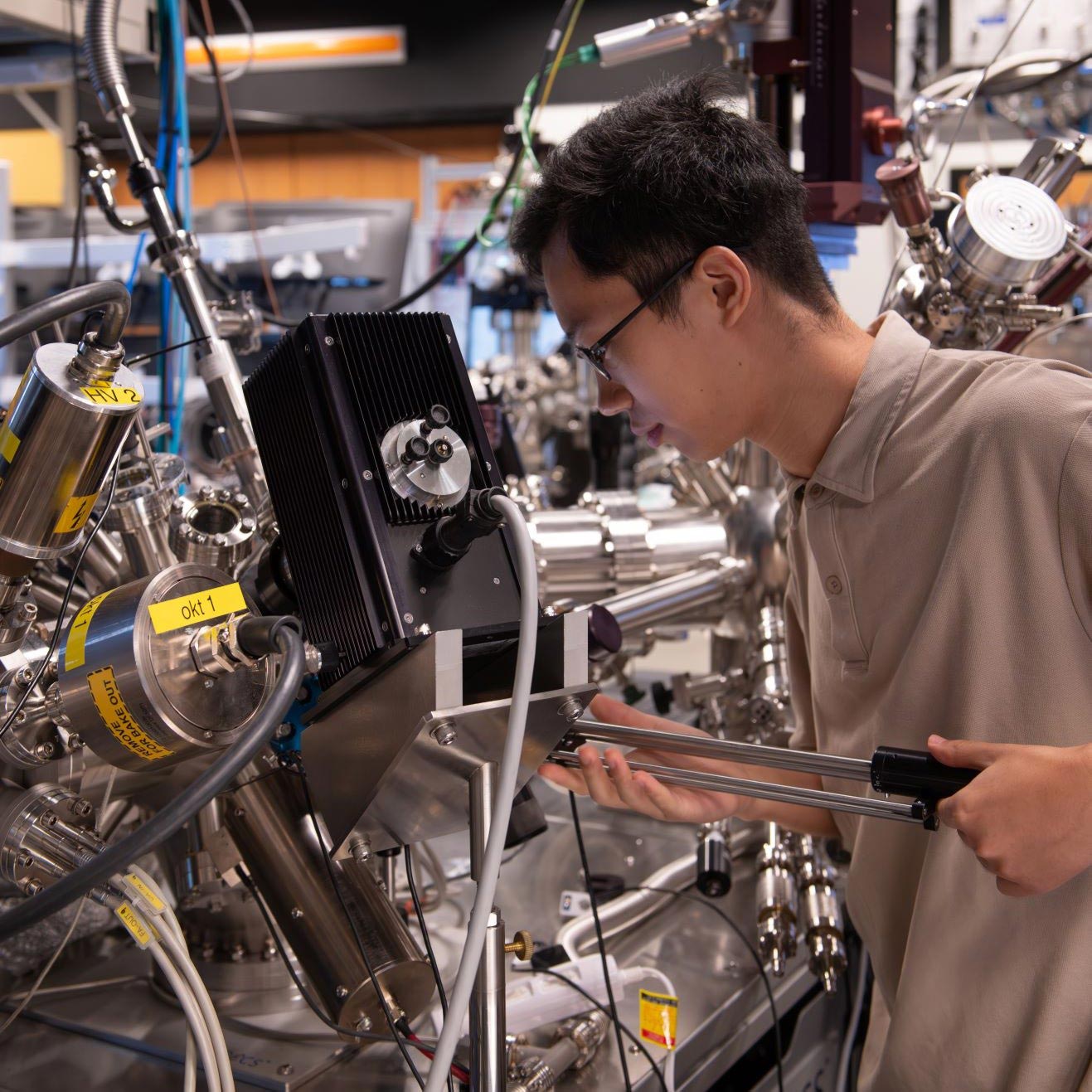
The breakthrough builds on years of exciton research at OIST and the development of a state-of-the-art TR-ARPES (time- and angle-resolved photoemission spectroscopy) system.
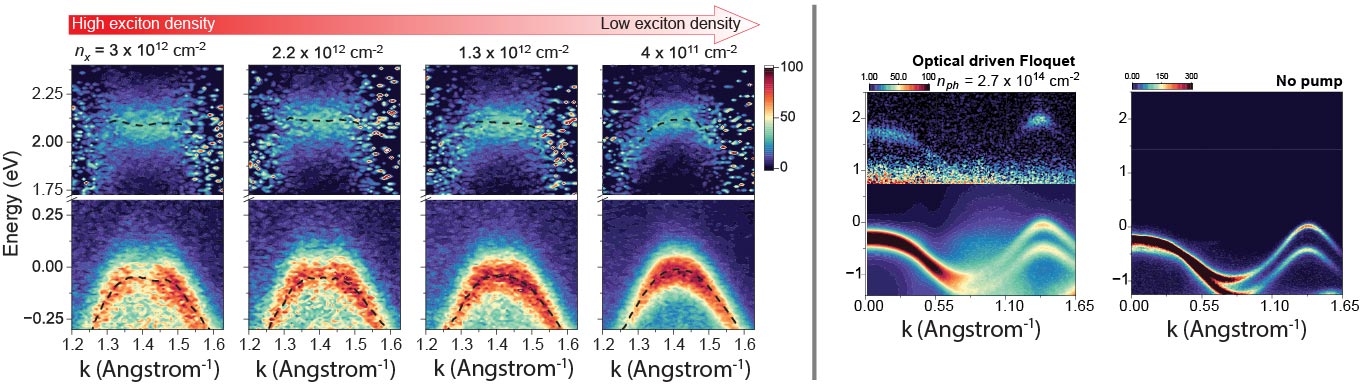
To separate the effects of light from those of excitons, the team studied an atomically thin semiconductor. They first applied a strong optical drive to directly observe changes in the electronic band structure, confirming traditional Floquet behavior. Next, they reduced the light intensity by more than an order of magnitude and examined the electronic response 200 femtoseconds later. This timing allowed them to isolate the effects driven by excitons rather than the light itself.
“The experiments spoke for themselves,” says Dr. Vivek Pareek, OIST graduate who is now a Presidential Postdoctoral Fellow at the California Institute of Technology. “It took us tens of hours of data acquisition to observe Floquet replicas with light, but only around two to achieve excitonic Floquet – and with a much stronger effect.”
Opening the Door to Practical Floquet Engineering
The results confirm that Floquet effects are not limited to light-based methods. They can also be reliably generated using other bosonic particles beyond photons. Excitonic Floquet engineering requires far less energy than optical approaches and points toward a broader toolkit for controlling quantum materials.
In theory, similar effects could be achieved using other excitations such as phonons (using acoustic vibration), plasmons (using free-floating electrons), or magnons (using magnetic fields). Together, these possibilities lay the groundwork for practical Floquet engineering and the controlled creation of advanced quantum materials and devices.
“We’ve opened the gates to applied Floquet physics,” concludes study co-first author Dr. David Bacon, former OIST researcher now at the University College London, “to a wide variety of bosons. This is very exciting, given its strong potential for creating and directly manipulating quantum materials. We don’t have the recipe for this just yet – but we now have the spectral signature necessary for the first, practical steps.”
Reference: “Driving Floquet physics with excitonic fields” by Vivek Pareek, David R. Bacon, Xing Zhu, Yang-Hao Chan, Fabio Bussolotti, Marcos G. Menezes, Nicholas S. Chan, Joel Pérez Urquizo, Kenji Watanabe, Takashi Taniguchi, Enrico Perfetto, Michael K. L. Man, Julien Madéo, Gianluca Stefanucci, Diana Y. Qiu, Kuan Eng Johnson Goh, Felipe H. da Jornada and Keshav M. Dani, 19 January 2026, Nature Physics.
DOI: 10.1038/s41567-025-03132-z
Never miss a breakthrough: Join the SciTechDaily newsletter.
Follow us on Google and Google News.
2 Comments
Once the light is turned off, the material returns to its original state. But while the drive is active, scientists can effectively dress materials in new quantum behaviors.
VERY GOOD.
Please ask the researchers to think deeply:
How do you understand the quantum behavior of light?
Any so-called evidence tainted by human intervention risks distorting our understanding and cognition of the intrinsic dynamics of natural laws.
—— Excerpted from https://zhuanlan.zhihu.com/p/1996561896279667777.
Example 1: Two sets of cobalt-60 are manually rotated in opposite directions, and even without detection, people around the world know that they will not be symmetrical because these two objects are not mirror images of each other at all. However, a group of so-called physicists and so-called academic publications do not believe it. They conducted experiments and the results were indeed asymmetric, but they still firmly believed that these two objects were mirror images of each other, and the asymmetry was due to a violation of the previous natural laws (CP violation). In the history of science, there can never be a dirtier and uglier operation and explanation than this. These people and the so-called academic publications they manipulate no longer know what shame is.
—— Excerpted from https://scitechdaily.com/what-happens-when-light-gains-extra-dimensions/#comment-947619.
Example 2: Please see how the so-called “mystery of θ – τ” is explained: θ and τ are completely identical in all measurable physical properties such as mass, lifetime, charge, spin, etc. However, experimental observations have shown that the θ meson decays into two π mesons, while the τ meson decays into three π mesons, making it difficult for physicists to explain why they are so similar. Physicist Martin Block proposed a highly challenging idea: θ and τ are the same particle, but in weak interactions, parity is not conserved. An easy to understand explanation is the following analogy:: There are two boxes of apples with identical weight, color, and taste. However, when one box is opened, there are two apples, while when the other box is opened, there are three apples. This confuses the old farmer who buys apples. He circled around the orchard and came up with a highly challenging idea: these two boxes of apples are not from the same tree, so they are the same.
—— Excerpted from https://scitechdaily.com/what-happens-when-light-gains-extra-dimensions/#comment-947686.
When we pursue the ultimate truth of all things, the space in which our bodies and all things exist may itself be the final and deepest puzzle we need to explore. This is not only the pursuit of physics, but also the most magnificent exploration of the origin of the universe by human reason.
Based on the Topological Vortex Theory (TVT), space is an uniformly incompressible physical entity. Space-time vortices are the products of topological phase transitions of the tipping points in space, are the point defects in spacetime. Point defects do not only impact the thermodynamic properties, but are also central to kinetic processes. They create all things and shape the world through spin and self-organization.
In today’s physics, some so-called peer-reviewed journals—including Physical Review Letters, Nature, Science, and others—stubbornly insist on and promote the following:
1. Even though θ and τ particles exhibit differences in experiments, physics can claim they are the same particle. This is science.
2. Even though topological vortices and antivortices have identical structures and opposite rotational directions, physics can define their structures and directions as entirely different. This is science.
3. Even though two sets of cobalt-60 rotate in opposite directions and experiments reveal asymmetry, physics can still define them as mirror images of each other. This is science.
4. Even though vortex structures are ubiquitous—from cosmic accretion disks to particle spins—physics must insist that vortex structures do not exist and require verification. Only the particles that like God, Demonic, or Angelic are the most fundamental structures of the universe. This is science.
5. Even though everything occupies space and maintains its existence in time, physics must still debate and insist on whether space exists and whether time is a figment of the human mind. This is science.
6. Even though space, with its non-stick, incompressible, and isotropic characteristics, provides a solid foundation for the development of physics, physics must still insist that the ideal fluid properties of space do not exist. This is science.
and go on.
Is this the counterintuitive science they widely promote? Compromising with pseudo academic publications and peer review by pseudo scholars is an insult to science and public intelligence. Some so-called scholars no longer understand what shame is. The study of Topological Vortex Theory (TVT) reminds us that the most profound problems in physics often lie at the intersection of different theories. By exploring these border regions, we can not only resolve contradictions in existing theories but also discover new physical phenomena and application possibilities.
Under the topological vortex architecture, it is highly challenging for even two hydrogen atoms or two quarks to be perfectly symmetrical, let alone counter-rotating two sets of cobalt-60. Contemporary physics and so-called peer-reviewed publications (including the Proceedings of the National Academy of Sciences, Physical Review Letters, Science, Nature, Science Bulletin, etc.) stubbornly believe that two sets of counter rotating cobalt-60 are two mirror images of each other, constructing a more shocking pseudoscientific theoretical framework in the history of science than the “geocentric model”. This pseudo scientific framework and system have seriously hindered scientific progress and social development.
For nearly a century, physics has been manipulated by this pseudo scientific theoretical system and the interest groups behind it, wasting a lot of manpower, funds, and time. A large amount of pseudo scientific research has been conducted, and countless pseudo scientific papers have been published, causing serious negative impacts on scientific and social progress, as well as humanistic development.
Complexity does not necessarily mean that there is no logical and architectural framework to follow. Mathematics is the language and tool that reveals the motion of spacetime, rather than the motion itself. Although the physical form of spacetime vortices is extremely simple, their interaction patterns are highly complex, and we must develop more and richer mathematical languages to describe and understand them.
The development of the Topological Vortex Theory (TVT) reflects a progression from concrete physical phenomena to abstract mathematical modeling and, ultimately, to interdisciplinary unification. Its core innovation lies in forging the continuous spacetime geometry of general relativity with the discrete interactions of quantum field theory within the same topological dynamical system. The core idea of TVT — space is physical, and matter is its topological excitation—already provides a solid and elegant scientific path for understanding the origin of all things.
——Excerpted from https://scitechdaily.com/microscope-spacecrafts-most-precise-test-of-key-component-of-the-theory-of-general-relativity/#comment-909171 and https://t.pineal.cn/blogs/6255/A-Mathematical-and-Physical-Analysis-On-the-Origin-of-Objects.