
Scientists have identified a one-dimensional topological insulator that could revolutionize quantum computing and solar cell efficiency. This groundbreaking discovery paves the way for advancements in quantum computing and solar cell efficiency.
Researchers have discovered a new topological insulator (TI), a unique state of matter that differs from conventional metals, insulators, and semiconductors. Unlike most known TIs, which are either three-dimensional or two-dimensional, this TI is one-dimensional. This groundbreaking work is expected to further the development of qubits and highly efficient solar cells.
The research, conducted by scientists from Tohoku University, Osaka University, Kyoto Sangyo University, the High Energy Accelerator Research Organization (KEK), and the National Institute of Quantum Science and Technology, was published in the journal Nature.
Breakthrough in Quantum Computing Potential
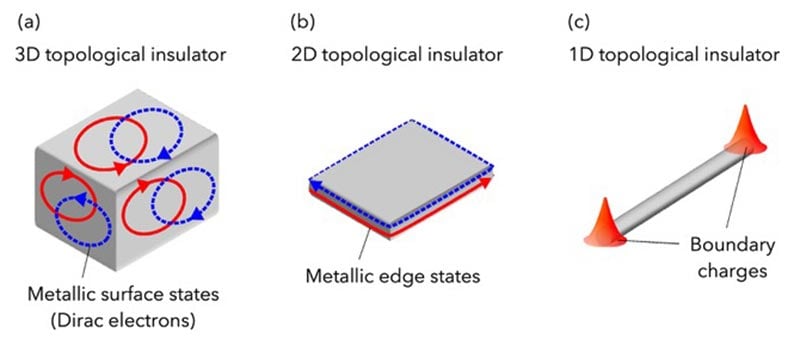
TIs boast an interior that behaves as an electrical insulator, meaning electrons cannot easily move; Whereas its surface acts as an electrical conductor, with the electrons able to move along the surface. Since the emergence of three-dimensional TIs in the 2000s, researchers have been on the hunt for new ones. However, one-dimensional TIs have remained largely elusive.
“One-dimensional TIs are particularly intriguing because the electric charges that appear on their end points effectively constitute qubits – the basic unit of information in quantum computing. And hence vitally important to quantum physics,” points out Kosuke Nakayama, an assistant professor at Tohoku University’s Graduate School of Science and co-author of the study.
Methodology of the Research
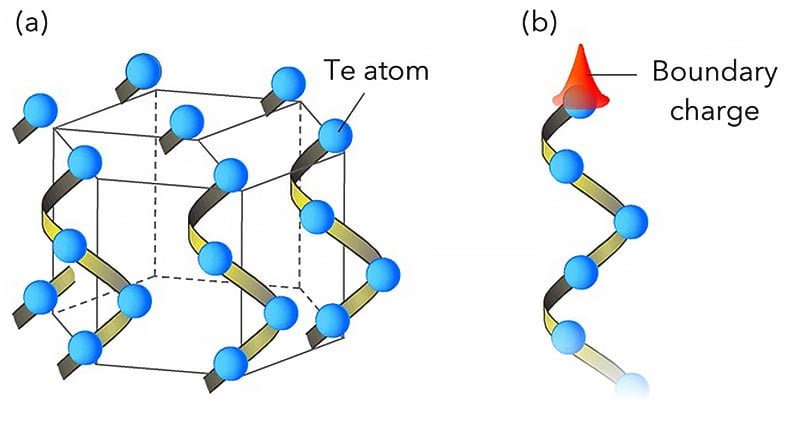
Nakayama and his colleagues focused their attention on tellurium (Te), a semiconductor whose primary commercial use is in solar panels and thermoelectric devices. Recent theoretical predictions have suggested that single helix chains could in fact be one-dimensional TIs. To verify this, the team needed to observe the electrical charges confined to the endpoints of these chains.
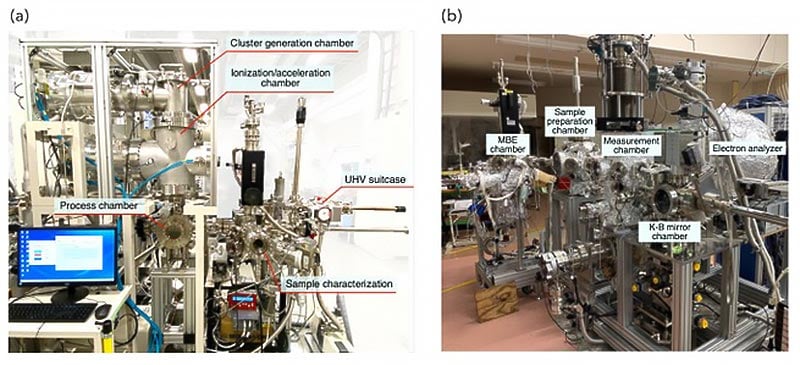
This required preparing clean edges of the Te chains without structural damage, something made possible by employing a newly developed gas-cluster ion-beam (GCIB) system, which can modify surfaces to within a nanometer. They then visualized the spatial distribution of electric charges using an angle-resolved photoemission spectroscopy (ARPES) with a micro-focused beam. Their investigations confirmed that the electric charges did indeed appear at the endpoints of the chains, thus supporting the one-dimensional TI nature of Te.
Implications for Future Technologies
Nakayama stressed that their research marks a crucial step toward understanding the properties of one-dimensional TIs and will have wide-ranging benefits. “The charges at the endpoints of one-dimensional TIs have a variety of uses: qubits, high-efficiency solar cells, high-sensitivity photodetectors, and nanotransistors. Our discovery of a one-dimensional TI will help accelerate research towards the realization of these applications.”
Reference: “Observation of edge states derived from topological helix chains” by K. Nakayama, A. Tokuyama, K. Yamauchi, A. Moriya, T. Kato, K. Sugawara, S. Souma, M. Kitamura, K. Horiba, H. Kumigashira, T. Oguchi, T. Takahashi, K. Segawa and T. Sato, 5 June 2024, Nature.
DOI: 10.1038/s41586-024-07484-z
Never miss a breakthrough: Join the SciTechDaily newsletter.
Follow us on Google and Google News.
2 Comments
Recent theoretical predictions have suggested that single helix chains could in fact be one-dimensional TIs. To verify this, the team needed to observe the electrical charges confined to the endpoints of these chains.
VERY GOOD!
Please ask researchers to think deeply:
1. What is the difference between one-dimensional and two-dimensional?
2. How do you confirm that the physical phenomenon observed in your verification experiment is indeed a one-dimensional?
3. What is the dimension of the electrical charges you are observing?
and so on.
Low dimensional spacetime matter is the substructure of high-dimensional spacetime matter. Topological vortices and their antivortices have identical spatiotemporal structures. The synchronous effect of countless topological vortex fractal structures makes spatiotemporal motion more complex. One-dimensional or two-dimensional is mainly manifested between topological vortices and their antivortices, rather than between the high-dimensional spacetime matter formed by their interactions. In theory, it is difficult for any atoms, any electrons, or even any observable high-dimensional spacetime objects to be absolutely one-dimensional or two-dimensional.
The physical phenomena observed in scientific experiments are always just appearances, not the natural essence of things. The natural essence of things needs to be extracted and sublimated based on natural phenomena via mathematical theories. Mathematics is the main environment for modeling problems in other areas. Observations and experiments, theory, and modeling reinforce each other and together lead to our understanding of physical phenomena. After understanding and mastering the natural essence of things, humans can predict more possible natural phenomena, and even manipulate and implement them.
Mathematics is the main environment for modeling problems in other areas. The synchronous effect of countless topological vortices makes spacetime motion complex, and the energy gap formed by and between vortices would be the linchpin to the evolution of vortices motion from low dimensional spacetime to high-dimensional spacetime. This is the natural essence that the mathematical probabilities give over to physical reality.