
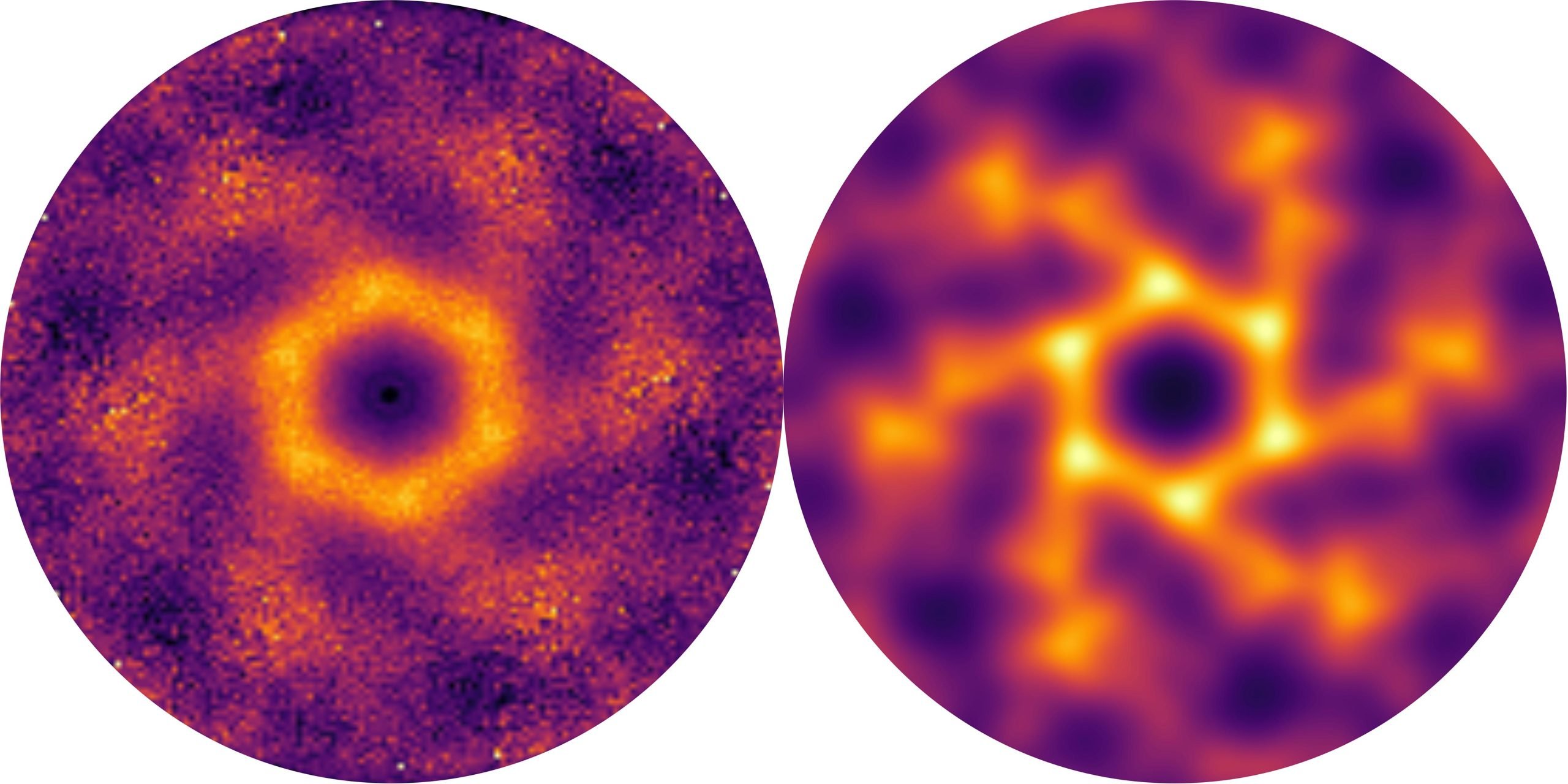
With neutron experiments and theoretical modeling, an international team uncovered 3D QSL behavior in Nickel Langbeinite.
Researchers have uncovered a 3D quantum spin liquid within the vicinity of a member of the langbeinite family, showcasing magnetic behaviors enabled by the unique crystalline structure. This breakthrough, supported by both experimental data and theoretical models, reveals the material’s capacity to maintain disordered magnetic fluctuations even at low temperatures, offering potential applications in quantum computing due to its topologically protected properties.
Discovery of a 3D Quantum Spin Liquid
Magnetic frustration is when spins in a crystal lattice cannot align to reach a minimum energy together. If this frustration becomes large enough, the spins continue to fluctuate in a disordered way, even as the temperature approaches zero and the material behaves as a quantum spin liquid.
Quantum spin liquids (QSLs) have remarkable properties, including topologically protected phenomena, potentially useful, for example, for future, particularly stable qubits. Initially, quantum spin liquids were mainly studied in two-dimensional structures, but the phenomenon can also occur in 3D structures, although much less frequently.
The Role of Nickel in Langbeinites
An international collaboration has now demonstrated this behavior in a new class of materials with a 3D structure: Langbeinites are sulfate minerals, rarely found in nature; replacing one or two elements in the sum formula produces variations that all belong to this class of materials.
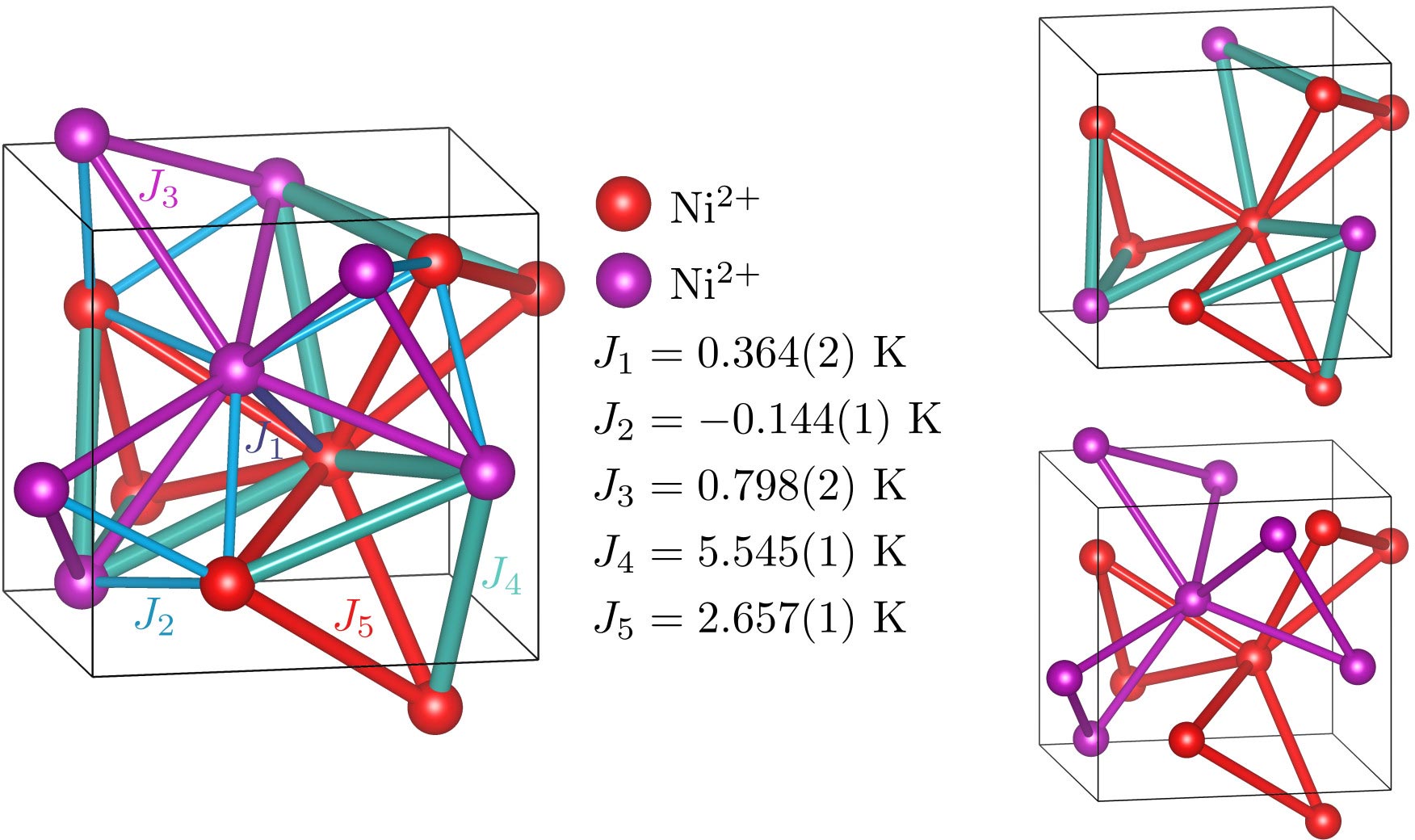
Artificial langbeinite crystals with the molecular formula K2Ni2(SO4)3 were created for the study. The magnetic element nickel plays a key role here: the nickel ions form two so-called trillium lattices that are entangled with each other. This creates the desired magnetic frustration, which is further enhanced when an external magnetic field is applied: The magnetic moments of the nickel ions cannot all align in an energetically favorable way, but fluctuate and form a quantum spin liquid.
Correlation Between Experiment and Theory
The team led by Ivica Živkovič at the EPFL was able to measure the magnetic fluctuations at the British neutron source ISIS in Oxford. The samples behave like a quantum spin liquid, not only at extremely low temperatures, but even at “lukewarm” 2 Kelvin.
The team led by HZB theorist Johannes Reuther was able to explain the measured data using several theoretical methods. “Our theoretical phase diagram even identifies an “island of liquidity” at the center of a strongly frustrated tetratrillium lattice,” says Matias Gonzalez, first author of the study and postdoctoral researcher in Reuther’s team, who carried out the Monte Carlo simulations.
PhD student Vincent Noculak calculated the interactions between the spins using a method based on Feynman diagrams that Reuther developed several years ago (pseudo-fermion function renormalization group, PFFRG). The agreement between the measured data and the theoretical results is surprisingly good. “Despite its extremely complex interactions, we can reproduce this system very well,” says Reuther.
Exploring Langbeinite’s Potential in Quantum Technologies
Langbeinites are a large and largely unexplored class of materials. The study shows that the search for quantum behavior can be worthwhile here. The team led by HZB physicist Bella Lake has already synthesized new representatives of this class of materials, which could also be regarded as 3D quantum spin liquids.
“This is still purely fundamental science,” emphasizes Johannes Reuther, “but with the growing interest in new types of quantum materials, the Langbeinite materials could become interesting for applications in quantum information.
Reference: “Dynamics of K2Ni2(SO4)3 governed by proximity to a 3D spin liquid model” by Matías G. Gonzalez, Vincent Noculak, Aman Sharma, Virgile Favre, Jian-Rui Soh, Arnaud Magrez, Robert Bewley, Harald O. Jeschke, Johannes Reuther, Henrik M. Rønnow, Yasir Iqbal and Ivica Živković, 21 August 2024, Nature Communications.
DOI: 10.1038/s41467-024-51362-1
Never miss a breakthrough: Join the SciTechDaily newsletter.
Follow us on Google and Google News.
1 Comment
With neutron experiments and theoretical modeling, an international team uncovered 3D QSL behavior in Nickel Langbeinite. Rewriting the Rules of Technology With 3D Quantum Spin Liquids.
VERY GOOD! You’ve been working hard! Digging caves and colliding are busier than this.
Please ask researchers to think deeply:
1. Should the so-called quantum be 2D or 3D?
2. What is the difference between 3D quantum and 2D quantum?
3. Is 2D topological vortex related to quantum?
4. What are the differences and similarities between quantum physics and classical physics?
and so on.
If the researcher is interested, you can browse https://scitechdaily.com/microscope-spacecrafts-most-precise-test-of-key-component-of-the-theory-of-general-relativity/#comment-775504, https://zhuanlan.zhihu.com/p/697274113, and https://zhuanlan.zhihu.com/p/695926158.
Space has physical properties of zero viscosity and absolute incompressibility. Zero viscosity and absolute incompressibility are physical characteristics of ideal fluids. The space with ideal fluid physical characteristics forms vortices via topological phase transitions, which is not difficult to understand mathematically. Once the topological vortex is formed, it occupies space and maintains its presence in time. This is the transition from chaos to order via two bidirectional coupled continuous chaotic systems.
Symmetry of topological vortex can be used to explore particle behavior under spatial, temporal, and quantum reversals, involving quantum gravity, discrete and continuous changes. It underpins the consistency of natural laws and experiment reproducibility.
Scientific research guided by correct theories can help humanity avoid detours, failures, and pomposity. Please witness the exemplary collaboration between theoretical physicists and experimentalists (https://scitechdaily.com/microscope-spacecrafts-most-precise-test-of-key-component-of-the-theory-of-general-relativity/#comment-854286). Some people in contemporary physics has always lived in a self righteous children’s story world. Whose values have been overturned by such a comical and ridiculous reality?
From Physical Review Letters (PRL), to Nature, and Science, even the Proceedings of the National Academy of Sciences (PNAS), the so-called academic journals firmly believe that two high-dimensional spacetime objects (such as two sets of cobalt-60) rotating in opposite directions can be transformed into two objects that mirror each other, and that the asymmetry between the amount of created matter and antimatter led to the matter-dominated Universe as we know it today.
Does the facts tell the so-called academic journals that two sets of cobalt-60 rotating in opposite directions can be transformed into two objects that mirror each other? Does mathematics tell the so-called academic journals that matter and antimatter are asymmetric? When physics no longer believes in facts and mathematics, it is no different from theology.
Naked walkers never consider themselves ugly, but rather consider themselves cool.
The physical phenomena observed in scientific experiments are always just appearances, not the natural essence of things. The natural essence of things needs to be extracted and sublimated based on natural phenomena via mathematical theories. After understanding and mastering the natural essence of things, humans can predict more possible natural phenomena, and even manipulate and implement them.