
Close Menu
    Facebook X (Twitter) Instagram
    SciTechDaily
    • Biology
    • Chemistry
    • Earth
    • Health
    • Physics
    • Science
    • Space
    • Technology
    Facebook X (Twitter) Pinterest YouTube RSS
    SciTechDaily
    Home»Physics»Quantum Leap in Stabilizing Qubits Unlocks New Possibilities
    Physics

    Quantum Leap in Stabilizing Qubits Unlocks New Possibilities

    By Talia Ogliore, Washington University in St. LouisMay 29, 2024No Comments2 Mins Read
    Facebook Twitter Pinterest Telegram LinkedIn WhatsApp Email Reddit
    Share
    Facebook Twitter LinkedIn Pinterest Telegram Email Reddit
    Quantum Computing Qubits Concept
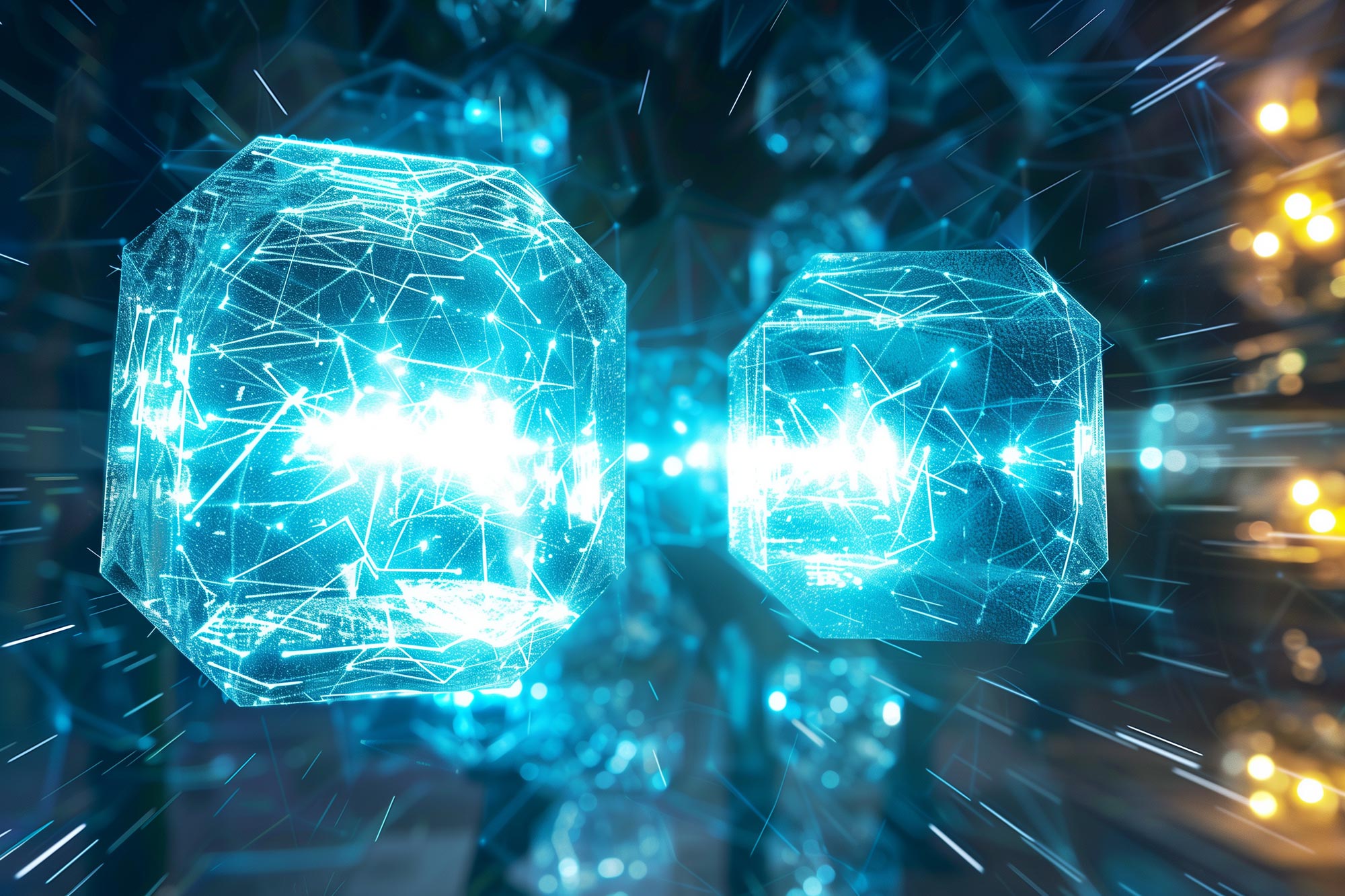
    At the Center for Quantum Leaps, researchers use nano-fabrication to create superconducting quantum circuits to explore fundamental quantum mechanics questions. They have created a novel approach to combating decoherence in quantum systems, using dissipation to maintain quantum entanglement within qubits, marking a significant advancement in the field of quantum technology. Credit: SciTechDaily.com

    Research at the Center for Quantum Leaps has led to a new method for reducing decoherence in quantum systems, enhancing the stability and feasibility of quantum technologies.

    As part of the Center for Quantum Leaps, a signature initiative of the Arts & Sciences strategic plan, physicist Kater Murch and his research group use nano-fabrication techniques to construct superconducting quantum circuits that allow them to probe fundamental questions in quantum mechanics. Qubits are promising systems for realizing quantum schemes for computation, simulation, and data encryption.

    Murch and his collaborators published a new paper, published on May 13 in Physical Review Letters, that explores the effects of memory in quantum systems and ultimately offers a novel solution to decoherence, one of the primary problems facing quantum technologies.

    “Our work shows that there’s a new way to prevent decoherence from corrupting quantum entanglement,” said Murch, the Charles M. Hohenberg Professor of Physics at Washington University in St. Louis. “We can use dissipation to prevent entanglement from leaving our qubits in the first place.”

    View the team’s illustrated video about their research findings:

    Reference: “Entanglement Assisted Probe of the Non-Markovian to Markovian Transition in Open Quantum System Dynamics” by Chandrashekhar Gaikwad, Daria Kowsari, Carson Brame, Xingrui Song, Haimeng Zhang, Martina Esposito, Arpit Ranadive, Giulio Cappelli, Nicolas Roch, Eli M. Levenson-Falk and Kater W. Murch, 13 May 2024, Physical Review Letters.
    DOI: 10.1103/PhysRevLett.132.200401

    Never miss a breakthrough: Join the SciTechDaily newsletter.
    Follow us on Google and Google News.

    Quantum Computing Quantum Information Science Quantum Mechanics Qubits Washington University in St. Louis
    Share. Facebook Twitter Pinterest LinkedIn Email Reddit

    Related Articles

    Is Your Quantum Computer Faking It? Physicists Unveil a “Quantum Lie Detector”

    Quantum Computers Keep Losing Qubits but Scientists Just Found a Fix

    Unlocking Quantum Secrets – Simulations Reveal the Atomic-Scale Story of Qubits

    Quantum Leap – Harvard Scientists Use Sound To Test Devices, Control Qubits

    Journey to Quantum Supremacy: First Steps Toward Realizing Mechanical Qubits

    Quantum Entanglement Shatters Einstein’s Local Causality: The Future of Computing and Cryptography

    Flawed Diamonds May Provide Perfect Interface for Quantum Computers – Faster and More Secure

    Physicists Create and Control a Large Quantum Mechanical System Built on Photons

    Quantum Bits Store Data for Nearly Two Seconds Using Laboratory Grown Diamonds

    Leave A Reply Cancel Reply

    • Facebook
    • Twitter
    • Pinterest
    • YouTube

    Don't Miss a Discovery

    Subscribe for the Latest in Science & Tech!

    Trending News

    Largest-Ever Study Finds Medicinal Cannabis Ineffective for Anxiety, Depression, PTSD

    250-Million-Year-Old Egg Solves One of Evolution’s Biggest Mysteries

    Living With Roommates Might Be Changing Your Gut Microbiome Without You Knowing

    Century-Old Cleaning Chemical Linked to 500% Increased Risk of Parkinson’s Disease

    What if Your Memories Never Happened? Physicists Take a New Look at the Boltzmann Brain Paradox

    One of the Universe’s Largest Stars May Be Getting Ready To Explode

    Scientists Discover Enzyme That Could Supercharge Ozempic-Like Weight Loss Drugs

    Popular Sweetener Linked to DNA Damage – “It’s Something You Should Not Be Eating”

    Follow SciTechDaily
    • Facebook
    • Twitter
    • YouTube
    • Pinterest
    • Newsletter
    • RSS
    SciTech News
    • Biology News
    • Chemistry News
    • Earth News
    • Health News
    • Physics News
    • Science News
    • Space News
    • Technology News
    Recent Posts
    • The Surprising Diet Rule That Makes “Good” Parasites Work
    • This Simple Blood Test Could Outperform “Bad Cholesterol” in Preventing Heart Disease
    • Scientists Uncover Potential Brain Risks of Popular Fish Oil Supplements
    • Scientists Prove There Are Just Six Degrees of Separation in a Social Network
    • Bee Bacteria Could Fix a Major Flaw in Plant-Based Milk
    Copyright © 1998 - 2026 SciTechDaily. All Rights Reserved.
    • Science News
    • About
    • Contact
    • Editorial Board
    • Privacy Policy
    • Terms of Use

    Type above and press Enter to search. Press Esc to cancel.