
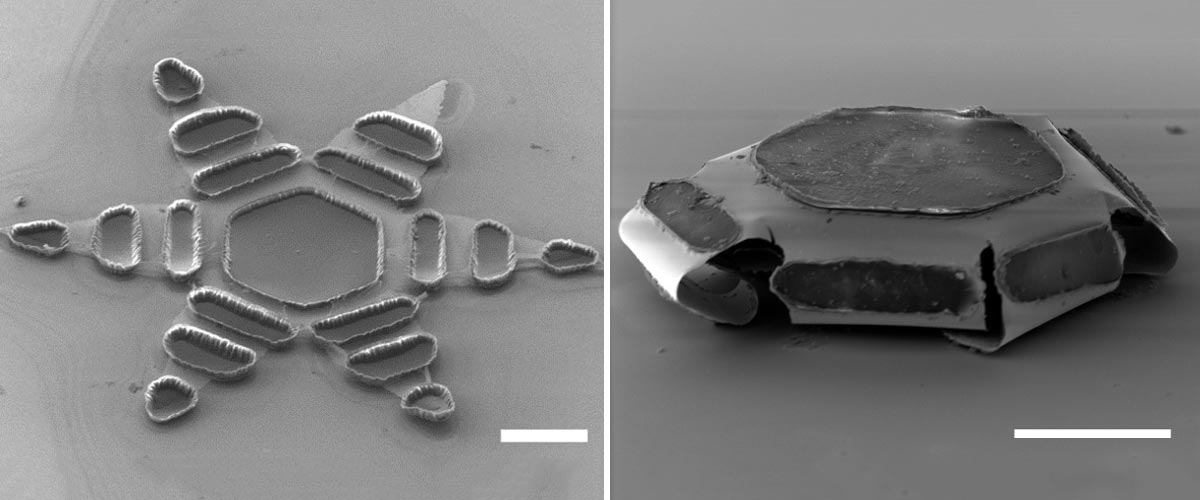
“Theragrippers” are inspired by a parasitic worm that clamps onto its host’s intestines.
Inspired by a parasitic worm that digs its sharp teeth into its host’s intestines, Johns Hopkins researchers have designed tiny, star-shaped microdevices that can latch onto intestinal mucosa and release drugs into the body.
David Gracias, Ph.D., a professor in the Johns Hopkins University Whiting School of Engineering, and Johns Hopkins gastroenterologist Florin M. Selaru, M.D., director of the Johns Hopkins Inflammatory Bowel Disease Center, led a team of researchers and biomedical engineers that designed and tested shape-changing microdevices that mimic the way the parasitic hookworm affixes itself to an organism’s intestines.
Made of metal and thin, shape-changing film and coated in a heat-sensitive paraffin wax, “theragrippers,” each roughly the size of a dust speck, potentially can carry any drug and release it gradually into the body.
The team published the results of an animal study recently as the cover article in the journal Science Advances.
Gradual or extended release of a drug is a long-sought goal in medicine. Selaru explains that a problem with extended-release drugs is they often make their way entirely through the gastrointestinal tract before they’ve finished dispensing their medication.
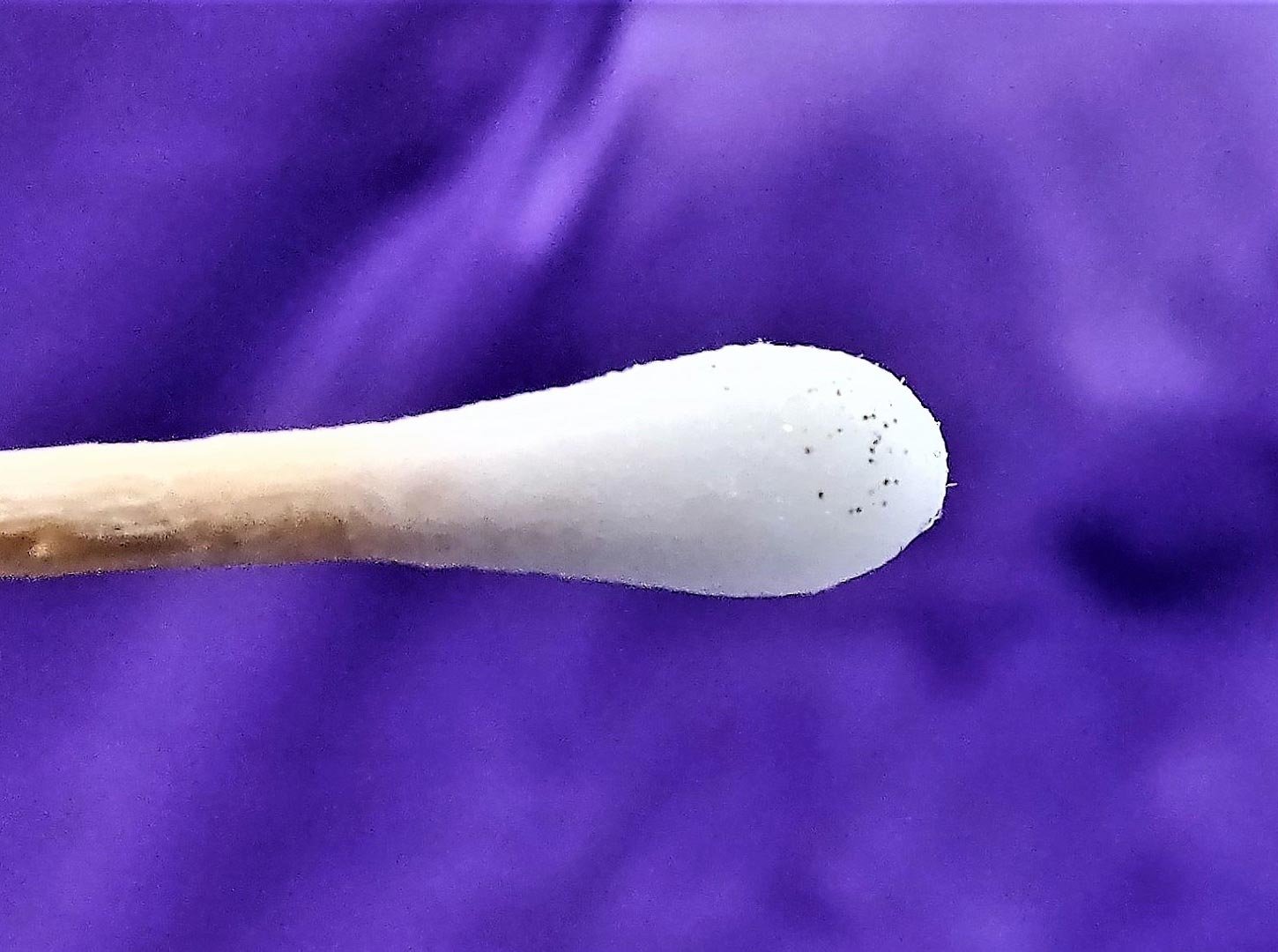
“Normal constriction and relaxation of GI tract muscles make it impossible for extended-release drugs to stay in the intestine long enough for the patient to receive the full dose,” says Selaru, who has collaborated with Gracias for more than 10 years. “We’ve been working to solve this problem by designing these small drug carriers that can autonomously latch onto the intestinal mucosa and keep the drug load inside the GI tract for a desired duration of time.”
Thousands of theragrippers can be deployed in the GI tract. When the paraffin wax coating on the grippers reaches the temperature inside the body, the devices close autonomously and clamp onto the colonic wall. The closing action causes the tiny, six-pointed devices to dig into the mucosa and remain attached to the colon, where they are retained and release their medicine payloads gradually into the body. Eventually, the theragrippers lose their hold on the tissue and are cleared from the intestine via normal gastrointestinal muscular function.
Gracias notes advances in the field of biomedical engineering in recent years.
“We have seen the introduction of dynamic, microfabricated smart devices that can be controlled by electrical or chemical signals,” he says. “But these grippers are so small that batteries, antennas, and other components will not fit on them.”
Theragrippers, says Gracias, don’t rely on electricity, wireless signals or external controls. “Instead, they operate like small, compressed springs with a temperature-triggered coating on the devices that releases the stored energy autonomously at body temperature.”
The Johns Hopkins researchers fabricated the devices with about 6,000 theragrippers per 3-inch silicon wafer. In their animal experiments, they loaded a pain-relieving drug onto the grippers. The researchers’ studies found that the animals into which theragrippers were administered had higher concentrations of the pain reliever in their bloodstreams than did the control group. The drug stayed in the test subjects’ systems for nearly 12 hours versus two hours in the control group.
Reference: “Gastrointestinal-resident, shape-changing microdevices extend drug release in vivo” by Arijit Ghosh, Ling Li, Liyi Xu, Ranjeet P. Dash, Neha Gupta, Jenny Lam, Qianru Jin, Venkata Akshintala, Gayatri Pahapale, Wangqu Liu, Anjishnu Sarkar, Rana Rais, David H. Gracias and Florin M. Selaru, 28 October 2020, Science Advances.
DOI: 10.1126/sciadv.abb4133
In addition to Gracias and Selaru, the journal article’s authors are Arijit Ghosh, Liyi Xu, Neha Gupta, Qianru Lin, Gayatri Pahapale, Wangqu Lu and Anjishnu Sarkar of the Johns Hopkins University Department of Chemical and Biomolecular Engineering; Ling Li and Venkata Akshintala of the Johns Hopkins University School of Medicine’s Division of Gastroenterology and Hepatology; Ranjeet Dash, Jenny Lam and Rana Rais of Johns Hopkins Drug Discovery and the Johns Hopkins University School of Medicine Department of Neurology.
The work was funded by the National Institute of Biomedical Imaging and Bioengineering at the National Institutes of Health and the National Science Foundation. The Johns Hopkins University has filed patents on behalf of Gracias and Selaru related to this technology in accordance with the university’s conflict of interest policies.
The technology is available for licensing through Johns Hopkins Technology Ventures.
Never miss a breakthrough: Join the SciTechDaily newsletter.
Follow us on Google and Google News.