
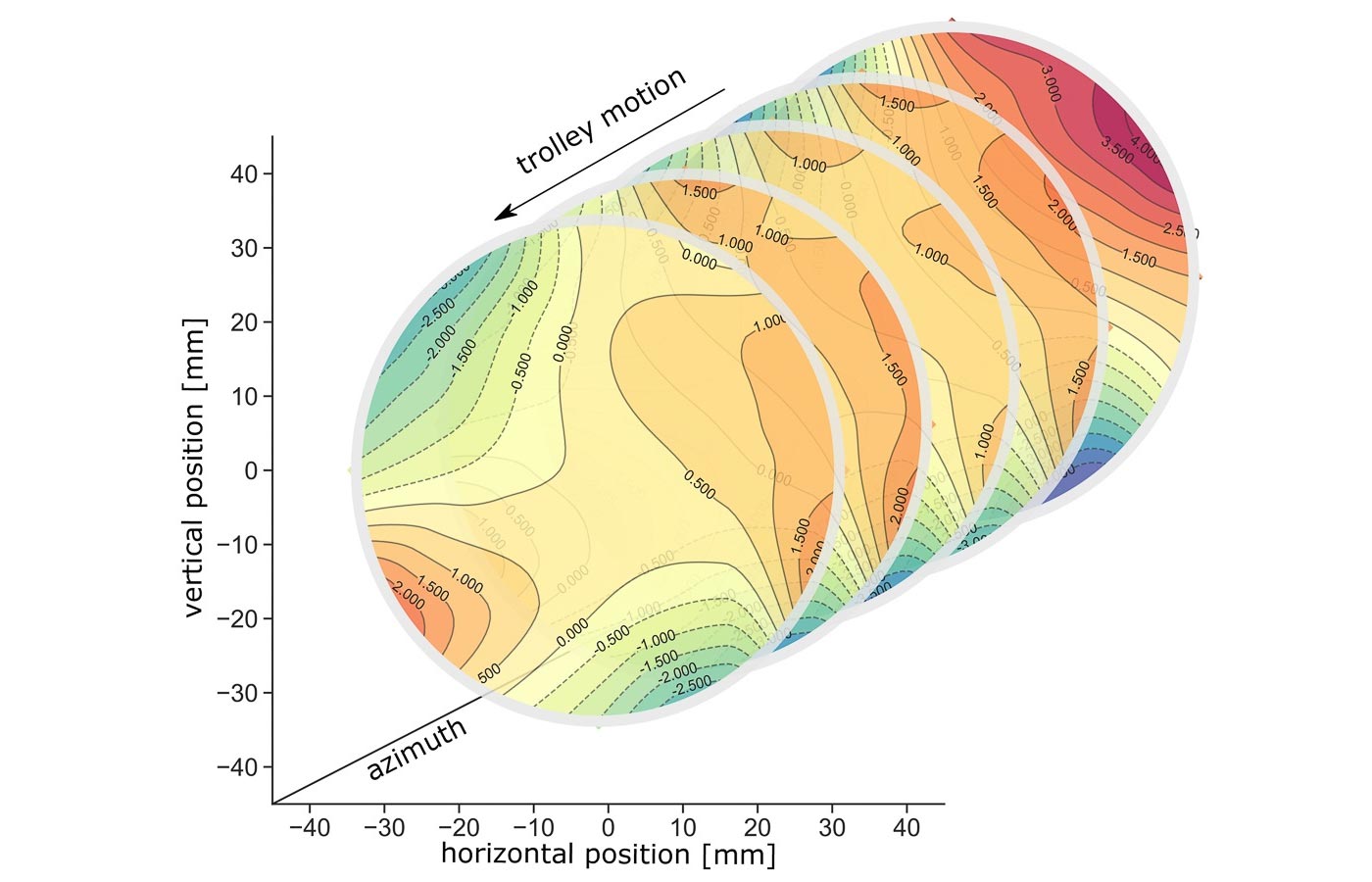
Typical magnetic field variations as mapped by the trolley at different positions in the Muon g-2 experiment’s storage ring, shown at the parts-per-million level. Credit: Argonne National Laboratory
Mapping the magnetic field for Fermilab’s Muon g-2 experiment.
As scientists await the highly anticipated initial results of the Muon g- 2 experiment at the U.S. Department of Energy’s ( DOE) Fermi National Accelerator Laboratory, collaborating scientists from DOE’s Argonne National Laboratory continue to employ and maintain the unique system that maps the magnetic field in the experiment with unprecedented precision.
Argonne scientists upgraded the measurement system, which uses an advanced communication scheme and new magnetic field probes and electronics to map the field throughout the 45-meter circumference ring in which the experiment takes place.
“There was a large deviation between Brookhaven’s measurement and the theoretical prediction, and if we confirm this discrepancy, it will signal the existence of undiscovered particles.” — Simon Corrodi, postdoctoral appointee in Argonne’s HEP division
The experiment, which began in 2017 and continues today, could be of great consequence to the field of particle physics. As a follow-up to a past experiment at DOE’s Brookhaven National Laboratory, it has the power to affirm or discount the previous results, which could shed light on the validity of parts of the reigning Standard Model of particle physics.
High-precision measurements of important quantities in the experiment are crucial for producing meaningful results. The primary quantity of interest is the muon’s g-factor, a property that characterizes magnetic and quantum mechanical attributes of the particle.
The Standard Model predicts the value of the muon’s g-factor very precisely. “Because the theory so clearly predicts this number, testing the g-factor through experiment is an effective way to test the theory,” said Simon Corrodi, a postdoctoral appointee in Argonne’s High Energy Physics ( HEP) division. “There was a large deviation between Brookhaven’s measurement and the theoretical prediction, and if we confirm this discrepancy, it will signal the existence of undiscovered particles.”
Just as the Earth’s rotational axis precesses — meaning the poles gradually travel in circles — the muon’s spin, a quantum version of angular momentum, precesses in the presence of a magnetic field. The strength of the magnetic field surrounding a muon influences the rate at which its spin precesses. Scientists can determine the muon’s g-factor using measurements of the spin precession rate and the magnetic field strength.
The more precise these initial measurements are, the more convincing the final result will be. The scientists are on their way to achieve field measurements accurate to 70 parts per billion. This level of precision enables the final calculation of the g-factor to be accurate to four times the precision of the results of the Brookhaven experiment. If the experimentally measured value differs significantly from the expected Standard Model value, it may indicate the existence of unknown particles whose presence disturbs the local magnetic field around the muon.
Trolley ride
During data collection, a magnetic field causes a beam of muons to travel around a large, hollow ring. To map the magnetic field strength throughout the ring with high resolution and precision, the scientists designed a trolley system to drive measurement probes around the ring and collect data.
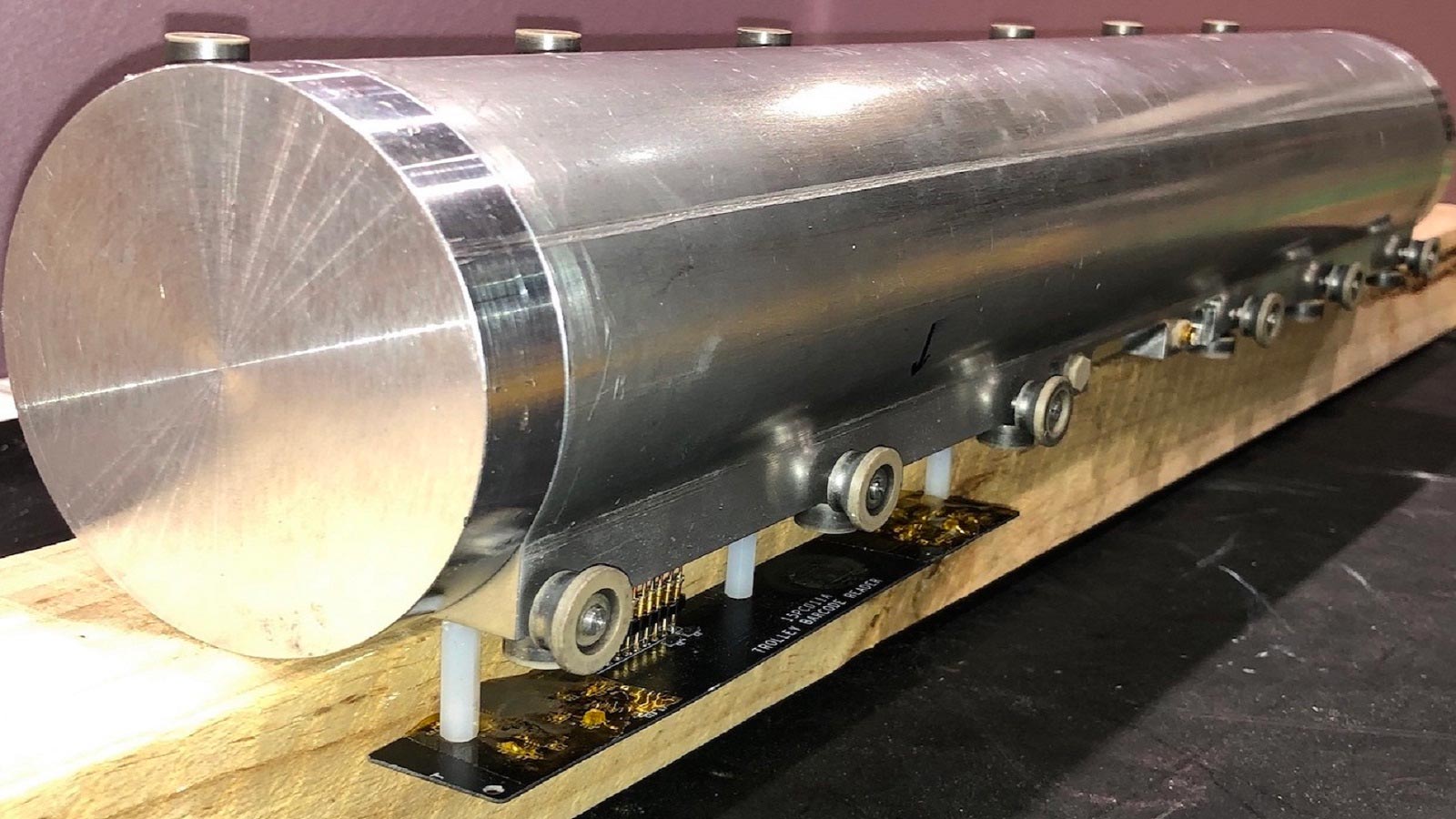
The University of Heidelberg developed the trolley system for the Brookhaven experiment, and Argonne scientists refurbished the equipment and replaced the electronics. In addition to 378 probes that are mounted within the ring to constantly monitor field drifts, the trolley holds 17 probes that periodically measure the field with higher resolution.
“Every three days, the trolley goes around the ring in both directions, taking around 9, 000 measurements per probe and direction,” said Corrodi. “Then we take the measurements to construct slices of the magnetic field and then a full, 3D map of the ring.”
The scientists know the exact location of the trolley in the ring from a new barcode reader that records marks on the bottom of the ring as it moves around.
The ring is filled with a vacuum to facilitate controlled decay of the muons. To preserve the vacuum within the ring, a garage connected to the ring and vacuum stores the trolley between measurements. Automating the process of loading and unloading the trolley into the ring reduces the risk of the scientists compromising the vacuum and the magnetic field by interacting with the system. They also minimized the power consumption of the trolley’s electronics in order to limit the heat introduced to the system, which would otherwise disrupt the precision of the field measurement.
The scientists designed the trolley and garage to operate in the ring’s strong magnetic field without influencing it. “We used a motor that works in the strong magnetic field and with minimal magnetic signature, and the motor moves the trolley mechanically, using strings,” said Corrodi. “This reduces noise in the field measurements introduced by the equipment.”
The system uses the least amount of magnetic material possible, and the scientists tested the magnetic footprint of every single component using test magnets at the University of Washington and Argonne to characterize the overall magnetic signature of the trolley system.
The power of communication
Of the two cables pulling the trolley around the ring, one of them also acts as the power and communication cable between the control station and the measurement probes.
To measure the field, the scientists send a radio frequency through the cable to the 17 trolley probes. The radio frequency causes the spins of the molecules inside the probe to rotate in the magnetic field. The radio frequency is then switched off at just the right moment, causing the water molecules’ spins to precess. This approach is called nuclear magnetic resonance ( NMR).
The frequency at which the probes’ spins precess depends on the magnetic field in the ring, and a digitizer on board the trolley converts the analog radio frequency into multiple digital values communicated through the cable to a control station. At the control station, the scientists analyze the digital data to construct the spin precession frequency and, from that, a complete magnetic field map.
During the Brookhaven experiment, all signals were sent through the cable simultaneously. However, due to the conversion from analog to digital signal in the new experiment, much more data has to travel over the cable, and this increased rate could disturb the very precise radio frequency needed for the probe measurement. To prevent this disturbance, the scientists separated the signals in time, switching between the radio frequency signal and data communication in the cable.
“We provide the probes with a radio frequency through an analog signal,” said Corrodi, “and we use a digital signal for communicating the data. The cable switches between these two modes every 35 milliseconds.”
The tactic of switching between signals traveling through the same cable is called “time-division multiplexing,” and it helps the scientists reach specifications for not only accuracy, but also noise levels. An upgrade from the Brookhaven experiment, time-division multiplexing allows for higher-resolution mapping and new capabilities in magnetic field data analysis.
Upcoming results
Both the field mapping NMR system and its motion control were successfully commissioned at Fermilab and have been in reliable operation during the first three data-taking periods of the experiment.
The scientists have achieved unprecedented precision for field measurements, as well as record uniformity of the ring’s magnetic field, in this Muon g- 2 experiment. Scientists are currently analyzing the first round of data from 2018, and they expect to publish the results by the end of 2020.
The scientists detailed the complex setup in a paper, published in the Journal of Instrumentation.
Reference: “Design and performance of an in-vacuum, magnetic field mapping system for the Muon g- 2 experiment” by S. Corrodia, P. De Lurgioa, D. Flayb, J. Grangea, R. Honga, D. Kawallb, M. Oberlinga, S. Ramachandrana and P. Wintera, 4 November 2020, Journal of Instrumentation.
DOI: 10.1088/1748-0221/15/11/P11008
This research was funded by DOE’s Office of Science, High Energy Physics ( HEP). The Fermilab particle accelerator complex is a DOE Office of Science User Facility.
Never miss a breakthrough: Join the SciTechDaily newsletter.
Follow us on Google and Google News.
5 Comments
Nothing more or new van be possìblè in the universe as every thing is completly described by the physics.Somethìñg can be done ìs to ďìscòver more and more,beyònd the ĺimìt than nòw.
If nothing is present more to explaìn certain natural phenomena,then this dùes for a new dìscovery.Dìscovery must defined by the present domain of physics as this is concerned.
If nothing is present more to explaìn certain natural phenomena,then this dùes for a new dìscovery.Dìscovery must defined by the present domain of physics as this is concerned. Muon g_2 experiments claim so,but hope some extraordinary resuĺt.
If nothing is present more to explaìn certain natural phenomena,then this dùes for a new dìscovery.Dìscovery must defined by the present domain of physics as this is concerned.Muon g_2 experiments claim so,but hope some extraordinary resuĺt.That can show light for a new path able to cope of with present time needs in astrophysics to propagate.
If nothing is present more to explaìn certain natural phenomena,then this dùes for a new dìscovery.Dìscovery must defined by the present domain of physics as this is concerned.Muon g_2 experiments claim so,but hope some extraordinary resuĺt.That can show light for a new path able to relate present time needs in astrophysics to propagate.This may ĺead us a step forward unified field theory.