
Fermilab’s Muon g-2 experiment confirms a significant deviation from the Standard Model in the muon’s magnetic moment, suggesting potential new physics.
The long-awaited first results from the Muon g-2 experiment at the U.S. Department of Energy’s Fermi National Accelerator Laboratory show fundamental particles called muons behaving in a way that is not predicted by scientists’ best theory, the Standard Model of particle physics. This landmark result, made with unprecedented precision, confirms a discrepancy that has been gnawing at researchers for decades.
The strong evidence that muons deviate from the Standard Model calculation might hint at exciting new physics. Muons act as a window into the subatomic world and could be interacting with yet undiscovered particles or forces.
“Today is an extraordinary day, long awaited not only by us but by the whole international physics community,” said Graziano Venanzoni, co-spokesperson of the Muon g-2 experiment and physicist at the Italian National Institute for Nuclear Physics. “A large amount of credit goes to our young researchers who, with their talent, ideas, and enthusiasm, have allowed us to achieve this incredible result.”

A muon is about 200 times as massive as its cousin, the electron. Muons occur naturally when cosmic rays strike Earth’s atmosphere, and particle accelerators at Fermilab can produce them in large numbers. Like electrons, muons act as if they have a tiny internal magnet. In a strong magnetic field, the direction of the muon’s magnet precesses, or wobbles, much like the axis of a spinning top or gyroscope. The strength of the internal magnet determines the rate that the muon precesses in an external magnetic field and is described by a number that physicists call the g-factor. This number can be calculated with ultra-high precision.
Magnetic Moments and Quantum Foam
As the muons circulate in the Muon g-2 magnet, they also interact with a quantum foam of subatomic particles popping in and out of existence. Interactions with these short-lived particles affect the value of the g-factor, causing the muons’ precession to speed up or slow down very slightly. The Standard Model predicts this so-called anomalous magnetic moment extremely precisely. But if the quantum foam contains additional forces or particles not accounted for by the Standard Model, that would tweak the muon g-factor further.
“This quantity we measure reflects the interactions of the muon with everything else in the universe. But when the theorists calculate the same quantity, using all of the known forces and particles in the Standard Model, we don’t get the same answer,” said Renee Fatemi, a physicist at the University of Kentucky and the simulations manager for the Muon g-2 experiment. “This is strong evidence that the muon is sensitive to something that is not in our best theory.”
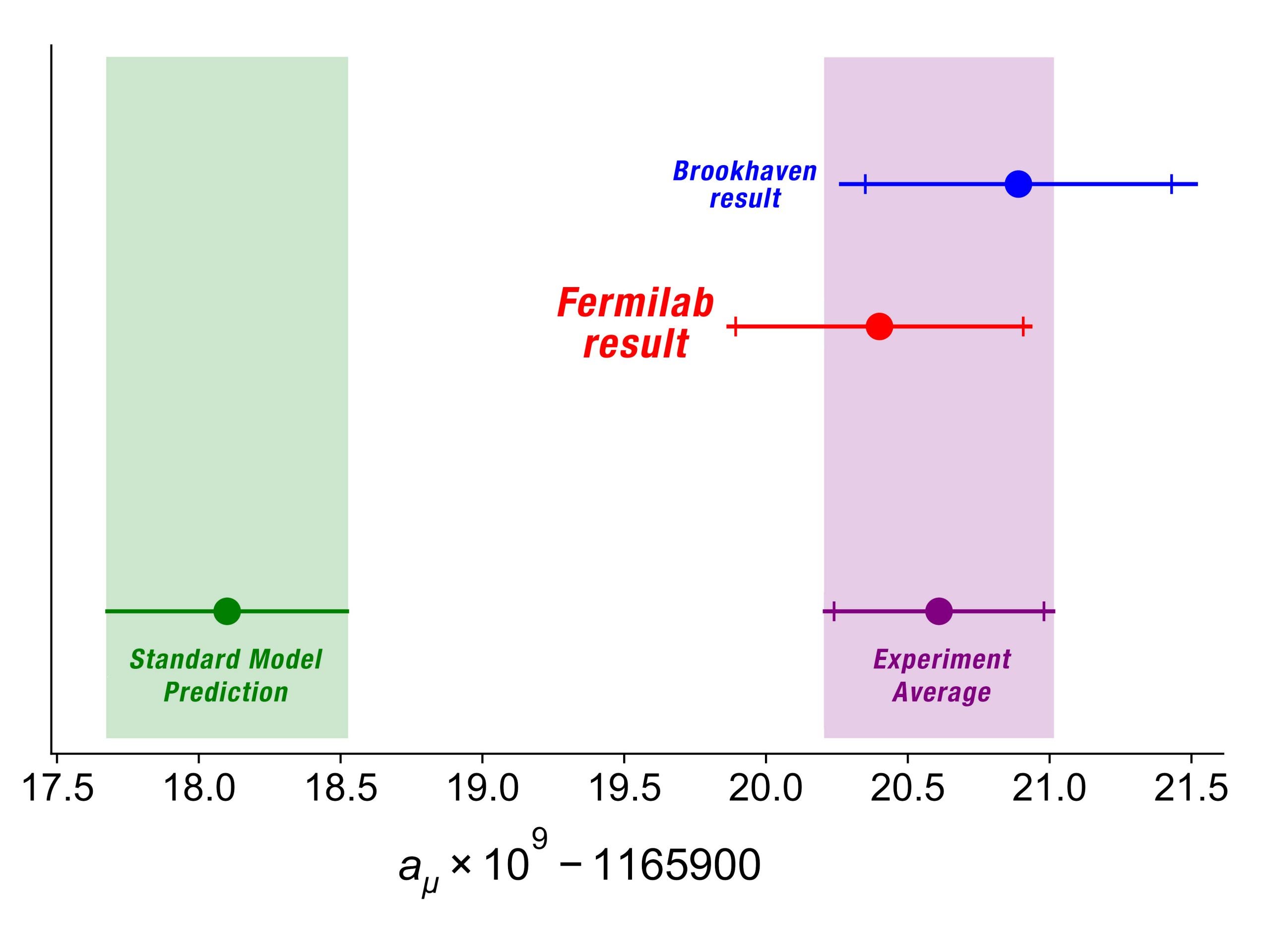
The predecessor experiment at DOE’s Brookhaven National Laboratory, which concluded in 2001, offered hints that the muon’s behavior disagreed with the Standard Model. The new measurement from the Muon g-2 experiment at Fermilab strongly agrees with the value found at Brookhaven and diverges from theory with the most precise measurement to date.
Experimental vs. Theoretical Results
The accepted theoretical values for the muon are:
g-factor: 2.00233183620(86)
anomalous magnetic moment: 0.00116591810(43)
[uncertainty in parentheses]
The new experimental world-average results announced by the Muon g-2 collaboration today are:
g-factor: 2.00233184122(82)
anomalous magnetic moment: 0.00116592061(41)
The combined results from Fermilab and Brookhaven show a difference with theory at a significance of 4.2 sigma, a little shy of the 5 sigma (or standard deviations) that scientists require to claim a discovery but still compelling evidence of new physics. The chance that the results are a statistical fluctuation is about 1 in 40,000.
The Fermilab experiment reuses the main component from the Brookhaven experiment, a 50-foot-diameter (15-meter) superconducting magnetic storage ring. In 2013, it was transported 3,200 miles (5,100 kilometers) by land and sea from Long Island to the Chicago suburbs, where scientists could take advantage of Fermilab’s particle accelerator and produce the most intense beam of muons in the United States. Over the next four years, researchers assembled the experiment; tuned and calibrated an incredibly uniform magnetic field; developed new techniques, instrumentation, and simulations; and thoroughly tested the entire system.
The Muon g-2 experiment sends a beam of muons into the storage ring, where they circulate thousands of times at nearly the speed of light. Detectors lining the ring allow scientists to determine how fast the muons are precessing.
In its first year of operation, in 2018, the Fermilab experiment collected more data than all prior muon g-factor experiments combined. With more than 200 scientists from 35 institutions in seven countries, the Muon g-2 collaboration has now finished analyzing the motion of more than 8 billion muons from that first run.
“After the 20 years that have passed since the Brookhaven experiment ended, it is so gratifying to finally be resolving this mystery,” said Fermilab scientist Chris Polly, who is a co-spokesperson for the current experiment and was a lead graduate student on the Brookhaven experiment.
Data analysis on the second and third runs of the experiment is under way, the fourth run is ongoing, and a fifth run is planned. Combining the results from all five runs will give scientists an even more precise measurement of the muon’s wobble, revealing with greater certainty whether new physics is hiding within the quantum foam.
“So far we have analyzed less than 6% of the data that the experiment will eventually collect. Although these first results are telling us that there is an intriguing difference with the Standard Model, we will learn much more in the next couple of years,” Polly said.
“Pinning down the subtle behavior of muons is a remarkable achievement that will guide the search for physics beyond the Standard Model for years to come,” said Fermilab Deputy Director of Research Joe Lykken. “This is an exciting time for particle physics research, and Fermilab is at the forefront.”
References:
“Measurement of the Positive Muon Anomalous Magnetic Moment to 0.46 ppm” by B. Abi et al. (Muon g-2 Collaboration), 7 April 2021, Physical Review Letters.
DOI: 10.1103/PhysRevLett.126.141801
“Magnetic-field measurement and analysis for the Muon g – 2 Experiment at Fermilab” by T. Albahri et al. (The Muon g-2 Collaboration), 7 April 2021, Physical Review A.
DOI: 10.1103/PhysRevA.103.042208
The Muon g-2 experiment is supported by the Department of Energy (US); National Science Foundation (US); Istituto Nazionale di Fisica Nucleare (Italy); Science and Technology Facilities Council (UK); Royal Society (UK); European Union’s Horizon 2020; National Natural Science Foundation of China; MSIP, NRF and IBS-R017-D1 (Republic of Korea); and German Research Foundation (DFG).
Fermilab is America’s premier national laboratory for particle physics research. A U.S. Department of Energy Office of Science laboratory, Fermilab is located near Chicago, Illinois, and operated under contract by the Fermi Research Alliance LLC.
The DOE Office of Science is the single largest supporter of basic research in the physical sciences in the United States and is working to address some of the most pressing challenges of our time.
[Editor’s Note: Today a different group of researchers announced very different results, concluding that the muon’s magnetic field aligns with the standard model of particle physics.]
Never miss a breakthrough: Join the SciTechDaily newsletter.
Follow us on Google and Google News.
10 Comments
You guys are making gps coordinates in time and space. Enjoy the demons for not paying me for my work you fools
Hahaha, whats immortality to a demon like me if i know you’d enslave me
Oh a backdoor to hell
Or should I say Hellman the guy who says he stole my odea from a DMT trip
Every country outside of the USA will be plauged by space time abnormally like the new strain of covid
Thief’s smell bad and you summoning demons , death eaters who get tired of evil then you stupidly steal my energetic dispersal enjoy my demonncore fatal mistake
I am the new god king
I put a price tag of 2 trillion on my assets I am yet to receive if you want to stay ahead of your own corruption you will pay up and you will pay before the summer solstice
If i had my computer and my time as i wish we would already have human teleported from celeste body to body it makes me so sad to see that my gifts were given only to show me how foolish as a planet we are
We get mews that we have AI for nanobots what do you do everything but pay the man who died to find out
People are by the masses saying they have demtia only to fight the rebate of the crime that they are frauds. Who drank through medical school
Let the world know that when the bombs dropped I dropped them first for us
… kicked can caused it …
Hey do me a Favor please stop posting my Name with my hacked Email thanks