
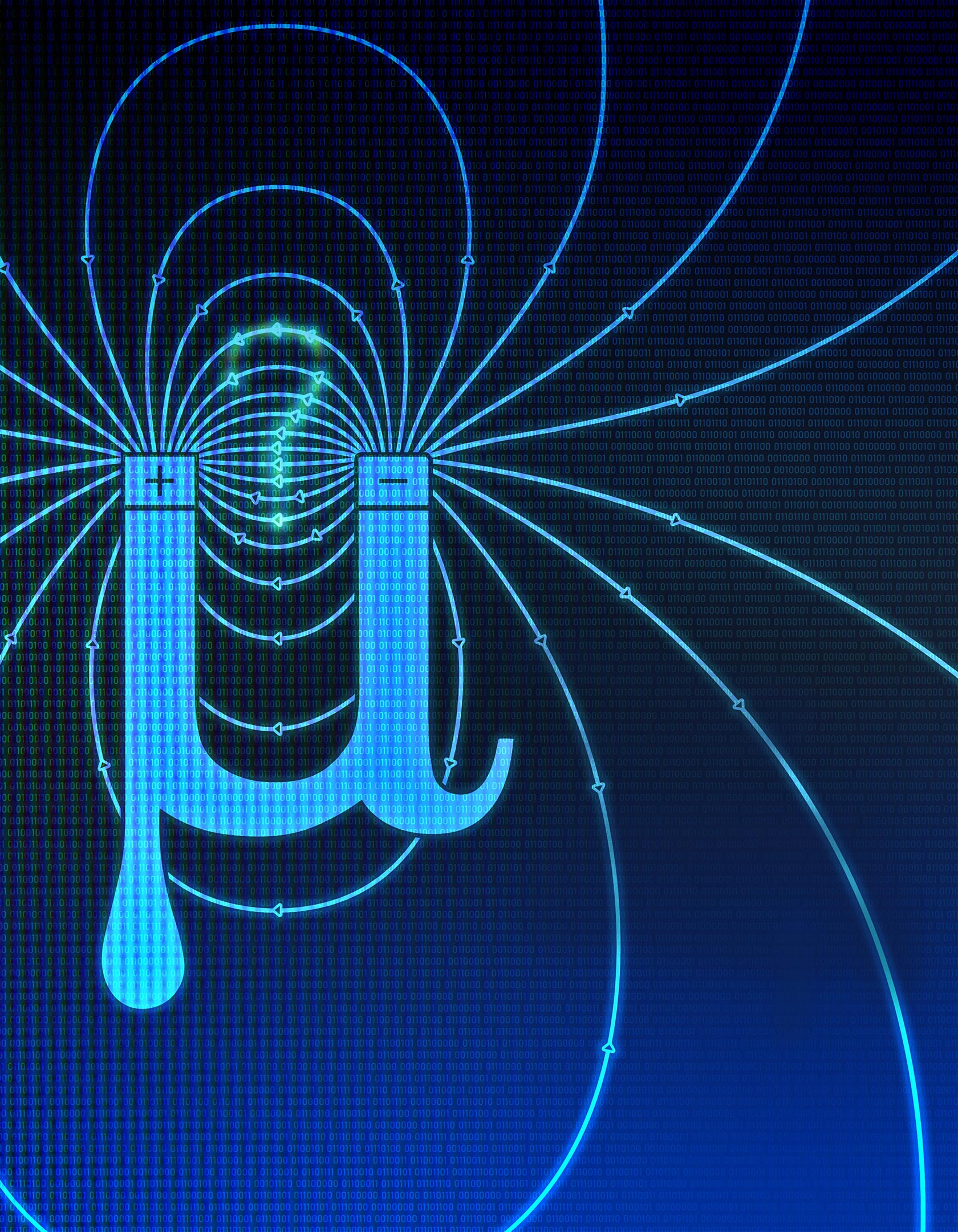
A new estimate of the strength of the sub-atomic particle’s magnetic field aligns with the standard model of particle physics.
A new estimation of the strength of the magnetic field around the muon — a sub-atomic particle similar to, but heavier than, an electron — closes the gap between theory and experimental measurements, bringing it in line with the standard model that has guided particle physics for decades.
A paper describing the research by an international team of scientists appears today (April 7, 2021) in the journal Nature.
Twenty years ago, in an experiment at Brookhaven National Laboratory, physicists detected what seemed to be a discrepancy between measurements of the muon’s “magnetic moment” — the strength of its magnetic field — and theoretical calculations of what that measurement should be, raising the tantalizing possibility of physical particles or forces as yet undiscovered. The new finding shrinks this discrepancy, suggesting that the muon’s magnetism is likely not mysterious at all. To achieve this result, instead of relying on experimental data, researchers simulated every aspect of their calculations from the ground up — a task requiring massive supercomputing power.
“Most of the phenomena in nature can be explained by what we call the ‘standard model’ of particle physics,” said Zoltan Fodor, professor of physics at Penn State and a leader of the research team. “We can predict the properties of particles extremely precisely based on this theory alone, so when theory and experiment don’t match up, we can get excited that we might have found something new, something beyond the standard model.”
For a discovery of new physics beyond the standard model, there is consensus among physicists that the disagreement between theory and measurement must reach five sigma — a statistical measure that equates to a probability of about 1 in 3.5 million.
In the case of the muon, measurements of its magnetic field deviated from the existing theoretical predictions by about 3.7 sigma. Intriguing, but not enough to declare a discovery of a new break in the rules of physics. So, researchers set out to improve both the measurements and the theory in the hopes of either reconciling theory and measurement or increasing the sigma to a level that would allow the declaration of discovery of new physics.
Ground-Up Theoretical Modeling
“The existing theory for estimating the strength of the muon’s magnetic field relied on experimental electron-positron annihilation measurements,” said Fodor. “In order to have another approach, we used a fully verified theory that was completely independent of reliance on experimental measurements. We started with rather basic equations and built the entire estimation from the ground up.”
The new calculations required hundreds of millions of CPU hours at multiple supercomputer centers in Europe and brought theory back in line with measurement. However, the story is not over yet. New, more precise experimental measurements of the muon’s magnetic moment are expected soon.
“If our calculations are correct and the new measurements do not change the story, it appears that we don’t need any new physics to explain the muon’s magnetic moment — it follows the rules of the standard model,” said Fodor. “Although, the prospect of new physics is always enticing, it’s also exciting to see theory and experiment align. It demonstrates the depth of our understanding and opens up new opportunities for exploration.”
The excitement is far from over.
“Our result should be cross-checked by other groups and we anticipate them,” said Fodor. “Furthermore, our finding means that there is a tension between the previous theoretical results and our new ones. This discrepancy should be understood. In addition, the new experimental results might be close to old ones or closer to the previous theoretical calculations. We have many years of excitement ahead of us.”
Reference: “Leading hadronic contribution to the muon magnetic moment from lattice QCD” by Sz. Borsanyi, Z. Fodor, J. N. Guenther, C. Hoelbling, S. D. Katz, L. Lellouch, T. Lippert, K. Miura, L. Parato, K. K. Szabo, F. Stokes, B. C. Toth, Cs. Torok and L. Varnhorst, 7 April 2021, Nature.
DOI: 10.1038/s41586-021-03418-1
In addition to Fodor, the research team includes Szabolcs Borsanyi, Jana N. Guenther, Christian Hoelbling, Sandor D. Katz, Laurent Lellouch, Thomas Lippert, Laurent Lellouch, Kohtaroh Miura, Letizia Parato, Kalman K. Szabo, Finn Stokes, Balint C. Toth, Csaba Torok, Lukas Varnhorst.
Participating institutions include Penn State, the University of Wuppertal in Germany; the Jülich Supercomputing Centre in Germany; Eötvös University in Budapest, Hungary; the University of California, San Diego; the University of Regensburg in Germany; Aix Marseille Univ, Université de Toulon in Marseille, France; Helmholtz Institute Mainz in Germany; the Kobayashi-Maskawa Institute for the Origin of Particles and the Universe, Nagoya University in Japan.
The research was funded by the German Research Foundation (DFG); the German Federal Ministry of Education and Research (BMBF); the Hungarian National Research, Development and Innovation Office; and the Excellence Initiative of Aix-Marseille, a French Investissements d’Avenirf program, through the Chaire d’Excellence initiative and the Laboratoire d’Excellence.
Never miss a breakthrough: Join the SciTechDaily newsletter.
Follow us on Google and Google News.
4 Comments
The auther is perfect in his most honoured view about muon g_2 value discrepancy phenomenon.Thanks,New physics is a simultaneous linear extension of the SM with due modification.
Not now,but we are waiting for too fine new discovery of a force accounting for this new extra magnetism.
… lets estimate till it fits…
“In order to have another approach, we used a fully verified theory that was completely independent of reliance on experimental measurements.”
This sentence contradicts itself. How do you fully verify a theory without experimental measurements? Math does not prove the veracity of a model, only its usability.
There is much not right with the standard model and whenever an article like this first praises the accepted dogma, you know it is going be meaningless but fanciful language that the reader will find emotionally appealing.
This is scientism and welcome to the new dark age.
This result of a simulation study (supporting the Standard Model over the Brookhaven experimental result, and presumably based on the Standard Model) was announced on the same day* as the first results of the Muon g-2 experiment at Fermilab**, which confirmed the discrepancy discovered by the Brookhaven experiment (and with much more confidence than before). I bet these researchers are feeling like they wasted a lot of time (their own and the supercomputer’s).
*going by the dates of the articles here
**I don’t know if the comments here allow links, so look in the related articles section above the comments for “Evidence of Exciting New Physics From U.S. Department of Energy’s Muon G-2 Experiment – “Today Is an Extraordinary Day””.