
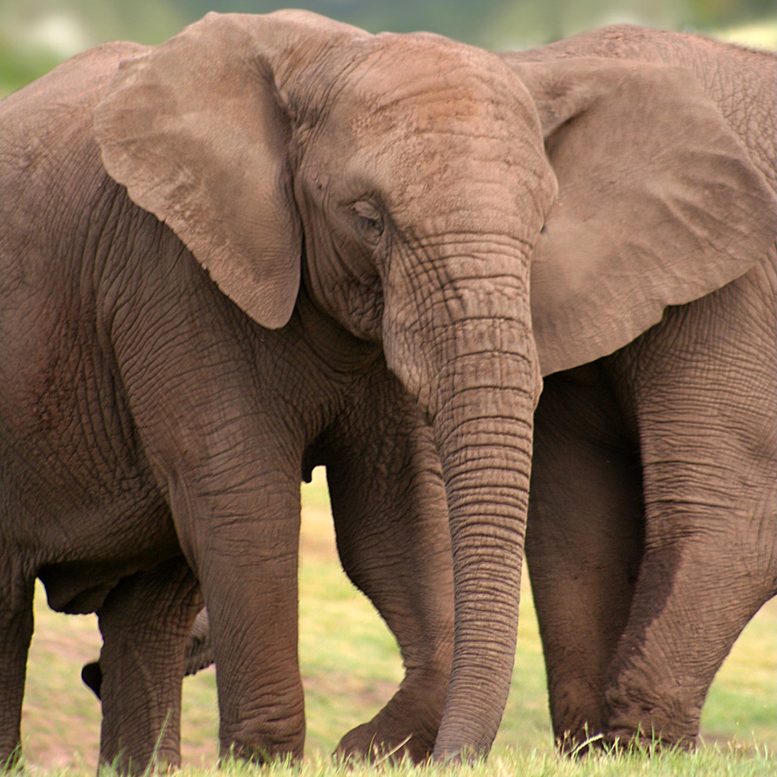
Civil war poaching in Mozambique drove the rapid evolution of tusklessness in female elephants through genetic selection.
Researchers report that intense ivory poaching during the Mozambican Civil War (1977-1992) resulted in the rapid evolution of tusklessness in female African elephants amid a precipitous population decline. This resulted in a phenotype far more likely to survive in the face of poaching. The findings shed new light on the powerful selective forces human harvesting can exert on wild animal populations.
The selective killing of species – whether for food, safety, or profit – has only become more common and intense as human populations and technology have grown. So much so, it’s suggested that wildlife exploitation by humans has become a powerful selective driver in the evolution of targeted species. However, the resulting evolutionary signatures remain unclear.
In this study, Shane Campbell-Staton and colleagues investigated the impacts of ivory hunting on the evolution of African elephants in Gorongosa National Park, Mozambique, during and after the Mozambican Civil War. During this conflict, armed forces on both sides heavily relied on the ivory trade to finance war efforts, which led to a rapid population decline of more than 90%.
Using historical field data and population modeling, Campbell-Staton et al. show that intense poaching during this period resulted in an increase in the frequency of complete tusklessness in female elephants from the region. According to the authors, the stark lack of tuskless males suggested a sex-linked genetic origin for the pattern.
Genetic Basis of Tusklessness: The AMELX Connection
Whole-genome analysis revealed a pair of candidate genes, including AMELX, a loci with known roles in mammalian tooth development. In humans, these genes are associated with an X-linked dominant, male-lethal syndrome that diminishes the growth of lateral incisors, which are homologous to elephant tusks.
“Campbell-Staton et al.’s elegant approach is among the rare studies that document a genetic response to harvest selection, informing debate about the potential for selective harvests to lead to evolutionary responses,” write Chris Darimont and Fanie Pelletier in a related Perspective.
Reference: “Ivory poaching and the rapid evolution of tusklessness in African elephants” by Shane C. Campbell-Staton, Brian J. Arnold, Dominique Gonçalves, Petter Granli, Joyce Poole, Ryan A. Long and Robert M. Pringle, 21 October 2021, Science.
DOI: 10.1126/science.abe7389
Never miss a breakthrough: Join the SciTechDaily newsletter.
Follow us on Google and Google News.
3 Comments
This is not the theorized evolution. Elephants being tuskless is merely a gene expression being modified and passed on by epigenetic methylation chemical modification. All life has this epigenome in which this occurs that runs overtop of the DNA sequences like a software program/code. In 2014, Dr Skinner in his scientific examination of Darwin Finches he found it was the epigenome’s modifications giving the bird’s facial structures including their beaks and NOT the evolution’s engine of DNA mutations in correlation. New experiments with other finches being transplanted on an island with a different diet, their offspring had a new beak shape in just SEVENTEEN YEARS, not the evolutionary theory’s 2.1 million years wrong accepted narrative. These epigenetic modifications are involved in much of virus and bacteria antibiotic resistance or the cavefish’s loss or gain of eyes when moved in and out of cave environments. This ‘software code’ of the epigenomes of all life is already downloaded for future changes, therefore fitting intelligent design. Macro-evolution touted scheme is not happening! What was the ‘evidence’ for ‘macroevolution’? It was the observed changes by the epigenome’s of life…logistically ID…not random Godless-spinned evolution. We are a creation. The Creator’s name is Jesus Christ. Get to Him. Besides, evolution needed to self-assemble mathematical impossible biological 10^450 to 10^600-by-chance structures for it to have happened. A mathematical impossibility is a 10^50.
Yah, what ^^^ they said.
Even though it’s caused by poachers, it is similar to the way that farmers have slectively bred cattle to diminish some traits while enhancing others.
If the only female elephants that reach a mature breeding age are tuskless, then it stands to reason that ultimately most females will be tuskless.
While this could be seen as a positive sign for the preservation of the species since it provides a small bit of protection for female elephants from the scumbag poachers, it will cause them to turn their attentions to the male elephants and start killing them off.