
Close Menu
    Facebook X (Twitter) Instagram
    SciTechDaily
    • Biology
    • Chemistry
    • Earth
    • Health
    • Physics
    • Science
    • Space
    • Technology
    Facebook X (Twitter) Pinterest YouTube RSS
    SciTechDaily
    Home»Physics»Intriguing Results at CERN Shows Tension With Standard Model of Particle Physics
    Physics

    Intriguing Results at CERN Shows Tension With Standard Model of Particle Physics

    By CERNMarch 21, 20202 Comments3 Mins Read
    Facebook Twitter Pinterest Telegram LinkedIn WhatsApp Email Reddit
    Share
    Facebook Twitter LinkedIn Pinterest Telegram Email Reddit
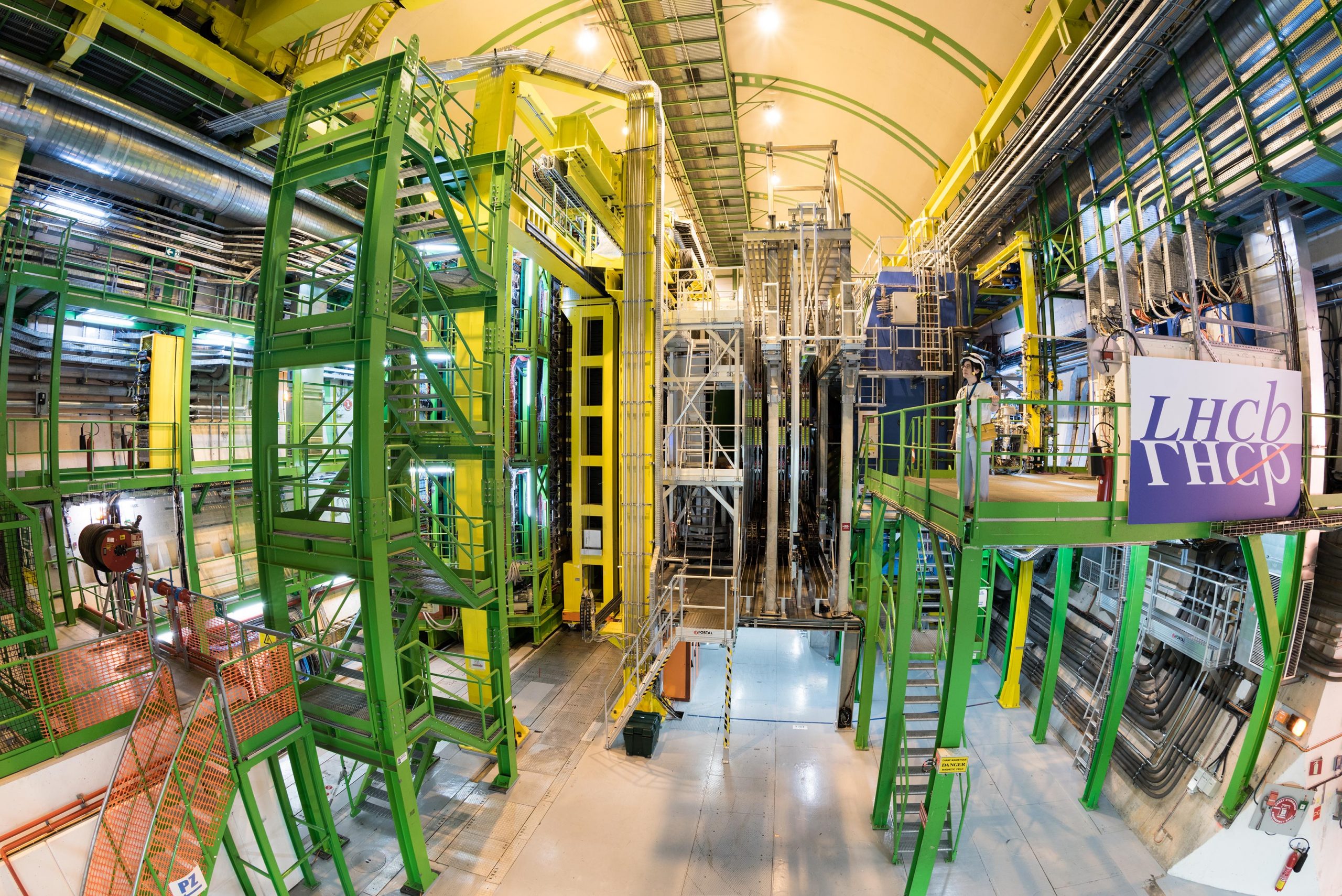
    LHCb Experiment Cavern
    The LHCb experiment at CERN. Credit: CERN

    New LHCb analysis still sees previous intriguing result: The new analysis continues to find tension with the Standard Model, but more data are needed to identify its cause.

    At a seminar today at CERN, the LHCb collaboration presented a new analysis of data from a specific transformation, or “decay”, that a particle called B0 meson can undergo. The analysis is based on twice as many B0 decays as previous LHCb analyses, which had disclosed some tension with the Standard Model of particle physics. The tension is still present in the new analysis, but more data are needed to identify its nature.

    The decay in question is the decay of a B0 meson, which is made up of a bottom quark and a down quark, into a K* meson (containing a strange quark and down quark) and a pair of muons. It is a rare process: The Standard Model predicts only one such decay for every million B0 decays. In many theories that extend the Standard Model, new unknown particles can also contribute to the decay, resulting in a change of the rate at which the decay should occur. In addition, the distribution of the angles of the B0 decay products with respect to the parent B0 – that is, of the muons and the kaon and pion from the K* decay – can also be affected by the presence of new particles.

    In previous studies of this decay, the LHCb team analyzed data from the first run of the Large Hadron Collider and found a deviation from Standard Model predictions in one parameter calculated from the angular distributions, technically known as P5‘. In the new study, the LHCb team has added LHC data from the machine’s second run to their analysis and still sees a deviation from Standard Model calculations in P5‘ as well as other parameters. However, the old and new results have a statistical significance of about 3 standard deviations, whereas 5 standard deviations are the gold standard in particle physics. It is therefore too soon to tell whether the deviation is statistically significant and, if so, whether it is caused by a new particle or an unknown experimental or theoretical effect.

    “This is a very exciting time to be doing what we call flavor physics,” said Mat Charles, LHCb’s Physics Coordinator. “Here and in other related analyses, we keep seeing moderate tensions with the Standard Model. We still don’t know how this mystery will turn out – nothing has yet reached the level of solid proof – but we’re very much looking forward to the next round of results using the full LHCb data, which will roughly double the number of events again.”

    Never miss a breakthrough: Join the SciTechDaily newsletter.
    Follow us on Google and Google News.

    CERN Particle Physics Popular
    Share. Facebook Twitter Pinterest LinkedIn Email Reddit

    Related Articles

    Intriguing New Result From the Large Hadron Collider May Signal a Crack in the Standard Model

    New CERN Study Suggests Subatomic Particles Could Defy the Standard Model

    CERN Antimatter Experiment Produces First Beam of Antihydrogen

    New Results Indicate That Particle Discovered at LHC Is a Higgs Boson

    CERN to Announce the Latest Results from ATLAS and CMS

    ICARUS Experiment Claims Neutrinos Aren’t Faster Than Light

    More Data of Elusive Higgs Boson from Defunct US Tevatron Collider

    Possible Mistakes Found in Faster Than Light Neutrino Measurement

    Higgs Boson Signals Gain Strength at Large Hadron Collider

    2 Comments

    1. ziane on July 6, 2020 1:49 am

      Hi thanks .

      Reply
    2. ziane.ziane on July 6, 2020 2:06 am

      thanks for the helpful information shared.

      Reply
    Leave A Reply Cancel Reply

    • Facebook
    • Twitter
    • Pinterest
    • YouTube

    Don't Miss a Discovery

    Subscribe for the Latest in Science & Tech!

    Trending News

    The Universe Is Expanding Too Fast and Scientists Can’t Explain Why

    “Like Liquid Metal”: Scientists Create Strange Shape-Shifting Material

    Early Warning Signals of Esophageal Cancer May Be Hiding in Plain Sight

    Common Blood Pressure Drug Shows Surprising Power Against Deadly Antibiotic-Resistant Superbug

    Scientists Uncover Dangerous Connection Between Serotonin and Heart Valve Disease

    Scientists Discover a “Protector” Protein That Could Help Reverse Hair Loss

    Bone-Strengthening Discovery Could Reverse Osteoporosis

    Scientists Uncover Hidden Trigger Behind Stem Cell Aging

    Follow SciTechDaily
    • Facebook
    • Twitter
    • YouTube
    • Pinterest
    • Newsletter
    • RSS
    SciTech News
    • Biology News
    • Chemistry News
    • Earth News
    • Health News
    • Physics News
    • Science News
    • Space News
    • Technology News
    Recent Posts
    • A Common Diabetes Drug May Hold the Key to Stopping HIV From Coming Back
    • Ancient “Syphilis-Like” Disease in Vietnam Challenges Key Scientific Assumptions
    • Drinking Alcohol To Cope in Your 20s Could Damage Your Brain for Life
    • Scientists Crack Alfalfa’s Chromosome Mystery After Decades of Debate
    • Ancient Ant-Plant Alliance Collapses As Predatory Wasps Move In
    Copyright © 1998 - 2026 SciTechDaily. All Rights Reserved.
    • Science News
    • About
    • Contact
    • Editorial Board
    • Privacy Policy
    • Terms of Use

    Type above and press Enter to search. Press Esc to cancel.