
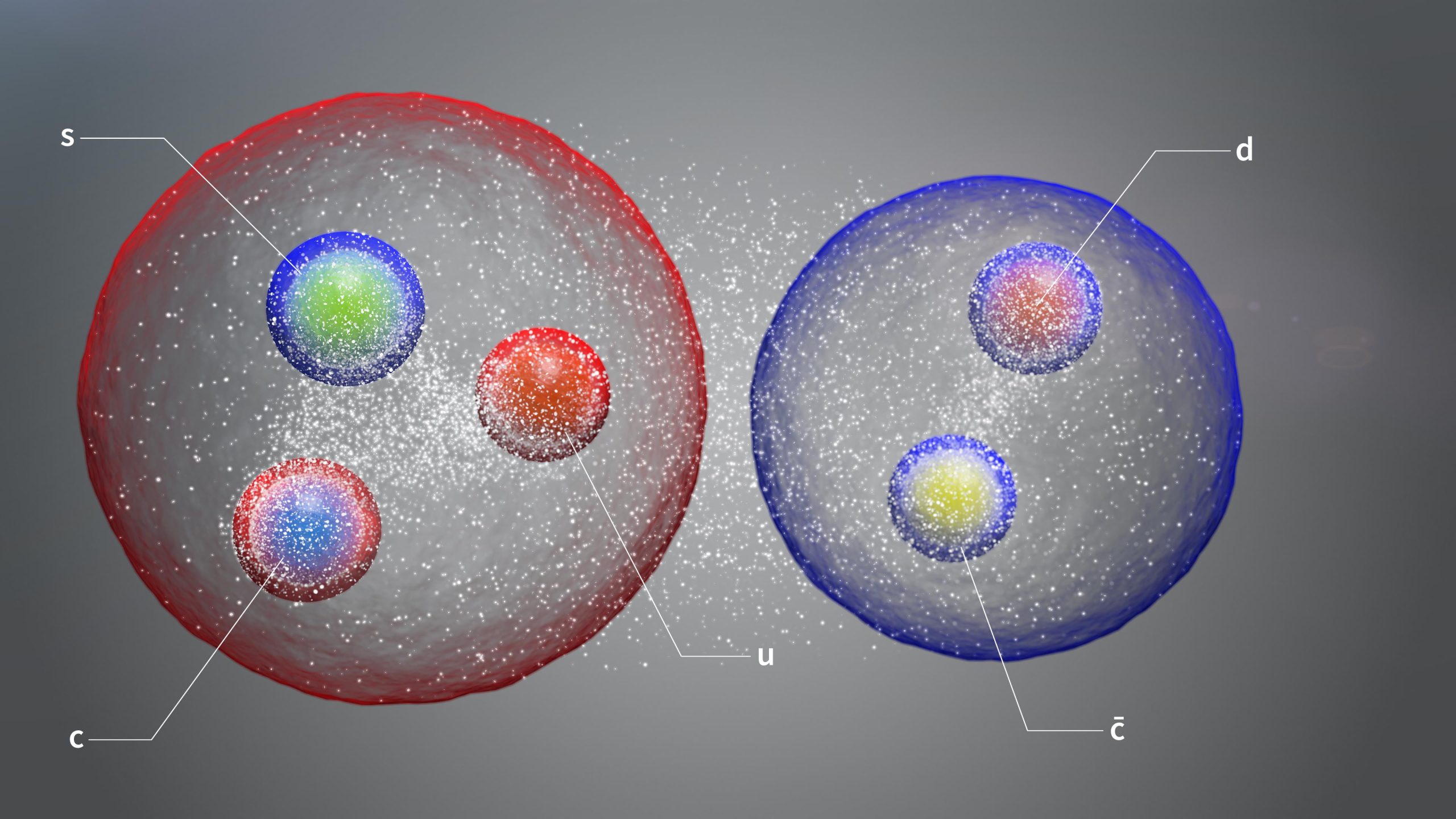
The Large Hadron Collider has detected three new particles, including a new pentaquark and the first pair of tetraquarks.
Three never-before-seen particles have been observed by the international Large Hadron Collider beauty (LHCb) collaboration at the Large Hadron Collider (LHC). The discovery includes a new kind of “pentaquark” and the first-ever pair of “tetraquarks,” which includes a new type of tetraquark.
The findings, presented at a CERN seminar today (July 5, 2022), add three new exotic members to the growing list of new hadrons found at the LHC. They will help physicists better understand how quarks bind together into these composite particles.
Quarks are elementary particles and can be classified in six flavors: up, down, charm, strange, top, and bottom. They usually combine together in groups of twos and threes to form hadrons such as the protons and neutrons that comprise atomic nuclei. However, on rare occasions, they can also combine into four-quark and five-quark particles, known as “tetraquarks” and “pentaquarks.” These exotic hadrons were predicted by theorists about six decades ago, at the same time as conventional hadrons, but only relatively recently, in the past 20 years, have they been detected by LHCb and other experiments.
The majority of exotic hadrons discovered in the past two decades are tetraquarks or pentaquarks containing a charm quark and a charm antiquark, with the remaining two or three quarks being an up, down or strange quark or their antiquarks. However, over the last two years, LHCb has discovered different kinds of exotic hadrons. Two years ago, the collaboration discovered a tetraquark made up of two charm quarks and two charm antiquarks, and two “open-charm” tetraquarks consisting of a charm antiquark, an up quark, a down quark, and a strange antiquark. And last year it found the first-ever instance of a “double open-charm” tetraquark with two charm quarks and an up and a down antiquark. Open charm means that the particle contains a charm quark without an equivalent antiquark.
The Latest Pentaquark and Tetraquark Discoveries
The discoveries announced today by the LHCb collaboration include new kinds of exotic hadrons. The first kind, observed in an analysis of “decays” of negatively charged B mesons, is a pentaquark made up of a charm quark and a charm antiquark and an up, a down and a strange quark. It is the first pentaquark found to contain a strange quark. The finding has a whopping statistical significance of 15 standard deviations, far beyond the 5 standard deviations that are required to claim the observation of a particle in particle physics.
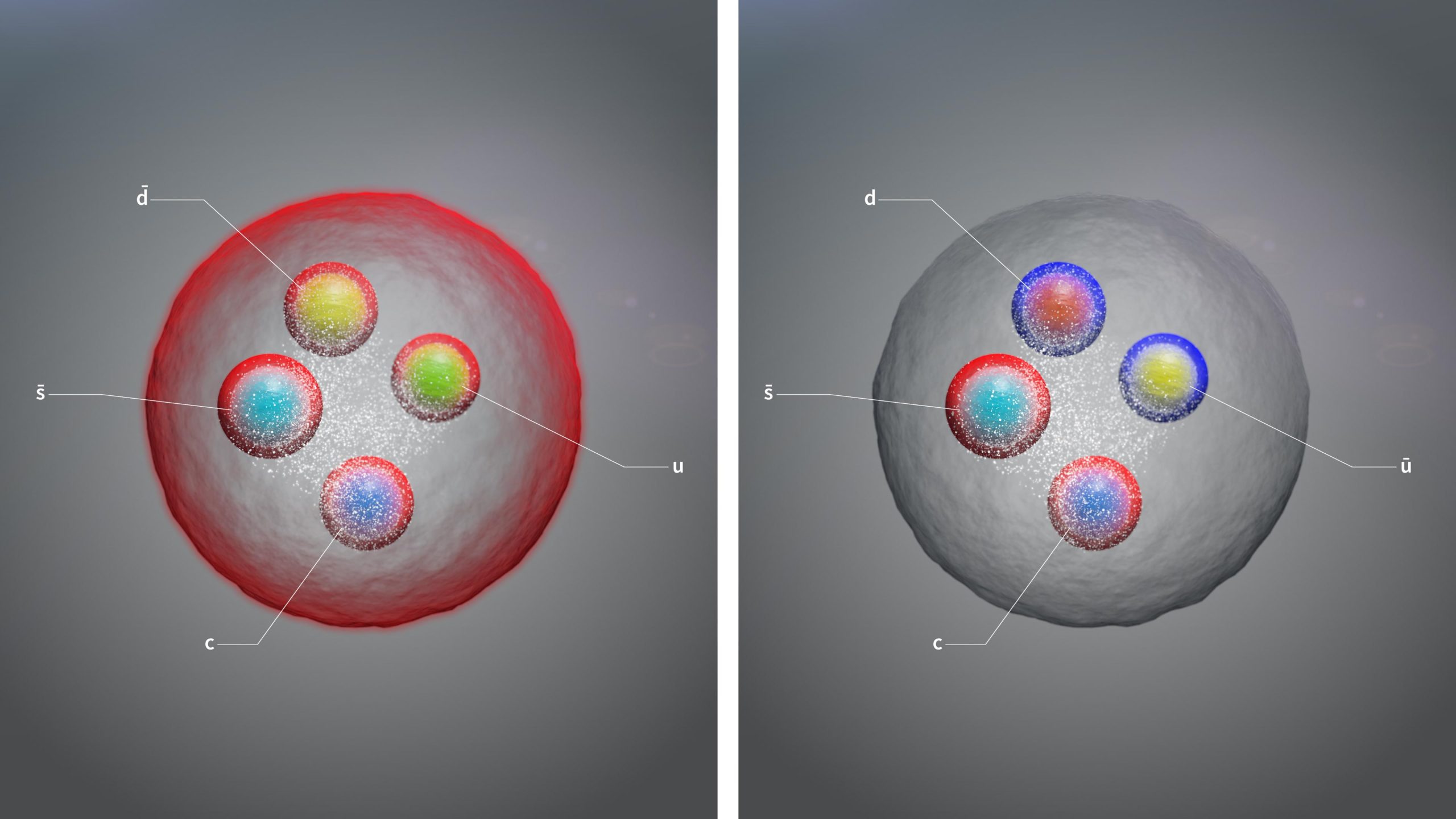
The second kind is a doubly electrically charged tetraquark. It is an open-charm tetraquark composed of a charm quark, a strange antiquark, and an up quark and a down antiquark, and it was spotted together with its neutral counterpart in a joint analysis of decays of positively charged and neutral B mesons. The new tetraquarks, observed with a statistical significance of 6.5 (doubly charged particle) and 8 (neutral particle) standard deviations, represent the first time a pair of tetraquarks has been observed.
“The more analyses we perform, the more kinds of exotic hadrons we find,” says LHCb physics coordinator Niels Tuning. “We’re witnessing a period of discovery similar to the 1950s, when a ‘particle zoo’ of hadrons started being discovered and ultimately led to the quark model of conventional hadrons in the 1960s. We’re creating ‘particle zoo 2.0’.”
Theoretical Models of Exotic Hadrons
“Finding new kinds of tetraquarks and pentaquarks and measuring their properties will help theorists develop a unified model of exotic hadrons, the exact nature of which is largely unknown,” says LHCb spokesperson Chris Parkes. “It will also help to better understand conventional hadrons.”
While some theoretical models describe exotic hadrons as single units of tightly bound quarks, other models envisage them as pairs of standard hadrons loosely bound in a molecule-like structure. Only time and more studies of exotic hadrons will tell if these particles are one, the other, or both.
Never miss a breakthrough: Join the SciTechDaily newsletter.
Follow us on Google and Google News.