

Nuclear physicists are trying to understand how particles called quarks and gluons combine to form hadrons, composite particles made of two or three quarks. To study this process, called hadronization, a team of nuclear physicists used the STAR detector at the Relativistic Heavy Ion Collider—a U.S. Department of Energy Office of Science user facility for nuclear physics research at DOE’s Brookhaven National Laboratory—to measure the relative abundance of certain two- and three-quark hadrons created in energetic collisions of gold nuclei. The collisions momentarily “melt” the boundaries between the individual protons and neutrons that make up the gold nuclei so scientists can study how their inner building blocks, the quarks and gluons, recombine.
The STAR physicists studied particles containing heavy “charm” quarks, which are easier to track than lighter particles, to see how the measurements matched up with predictions from different explanations of hadronization. The measurements, published in Physical Review Letters, revealed many more three-quark hadrons than would have been expected by a widely accepted explanation of hadronization known as fragmentation. The results suggest that, instead, quarks in the dense particle soup created at RHIC recombine more directly through a mechanism known as coalescence.
“Hadrons made of two or three quarks are the building blocks of visible matter in our world—including the protons and neutrons that make up the nuclei of atoms. But we never see their inner building blocks—the quarks and gluons—as free objects because quarks are always ‘confined’ within composite particles,” said Xin Dong, a physicist at DOE’s Lawrence Berkeley National Laboratory (LBNL) and a leader of this analysis for the STAR Collaboration.
RHIC’s heavy ion collisions create a state of matter known as quark-gluon plasma (QGP), a hot particle soup that mimics what the early universe was like, in which quarks are “deconfined,” or set free, from their ordinary bounds within composite particles called hadrons.
“By tracking the particles that stream out of RHIC’s collisions we can explore the mechanism of hadronization and how the strong nuclear force keeps quarks confined in ordinary matter,” said Helen Caines, a professor at Yale University and co-spokesperson of the STAR Collaboration.
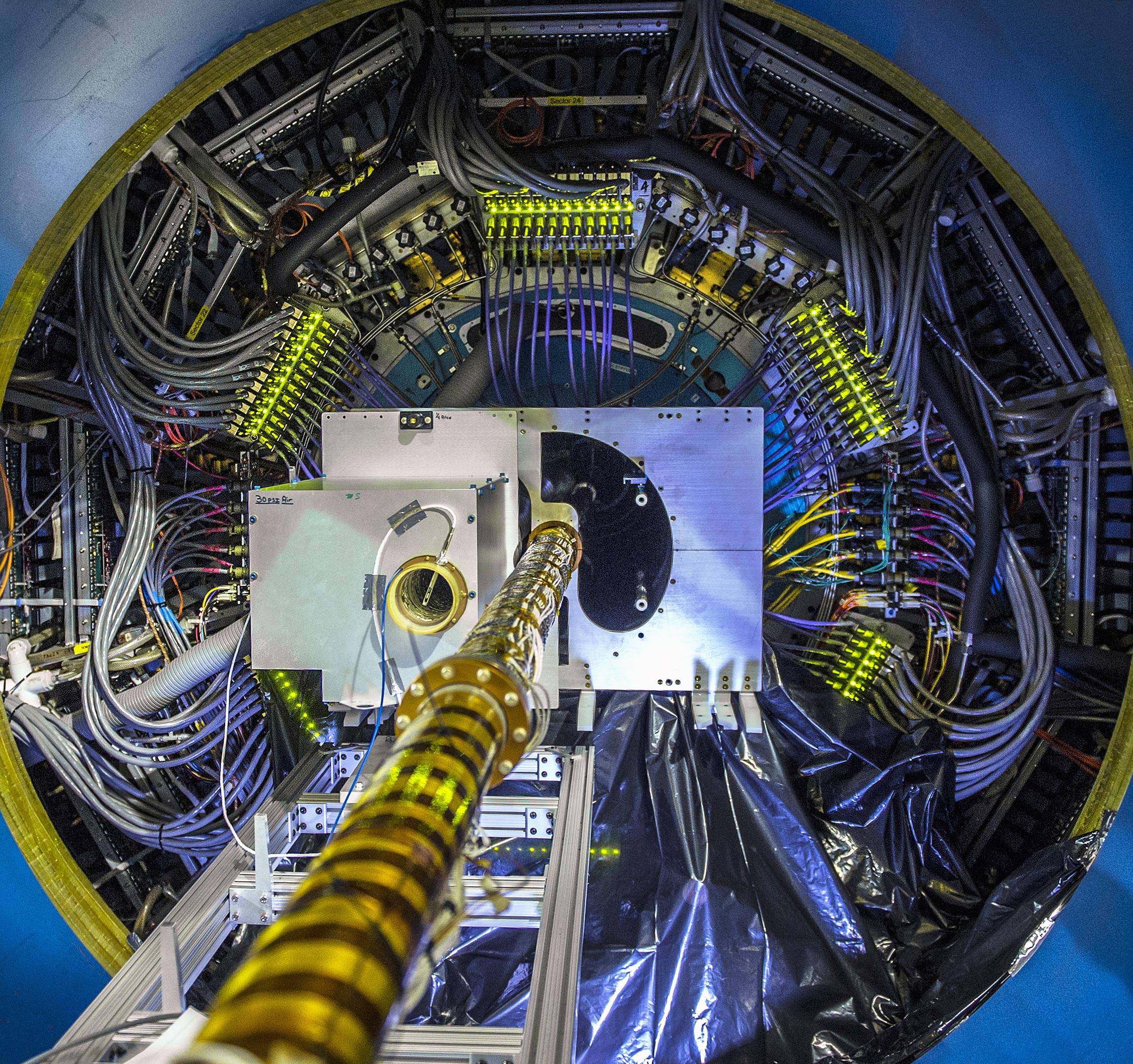
The STAR physicists measured charmed hadrons (hadrons containing heavy “charm” quarks) using the high-resolution Heavy Flavor Tracker (HFT) installed at the center of the 4-meter-wide Time Projection Chamber of RHIC’s STAR detector.
“The HFT ‘zooms in’ on particles such as the three-quark charmed lambda, which decays less than 0.1 millimeter from the center of the collision,” said Brookhaven Lab physicist Flemming Videbaek, the STAR HFT project manager.
Combining “hits” in the HFT with measurements of the decay products farther out in the STAR detector, physicists can count up how many three-quark charmed lambdas vs. two-quark charmed “D-zero” (D0) particles emerge from the QGP.
“We used a supervised machine learning technique to suppress the large background for the detection of charmed lambda particles,” said Sooraj Radhakrishnann, a postdoctoral fellow from Kent State University and Berkeley Lab who conducted the main analysis.
The results from STAR counted charmed lambdas and D0 particles in nearly equal numbers. That was far more charmed lambdas than had been predicted by a well-accepted mechanism of hadronization known as fragmentation.
“Fragmentation accurately describes many experimental results from high-energy particle physics experiments,” Dong said. The mechanism involves energetic quarks or gluons “exciting” the vacuum and “splitting” to form quark-antiquark pairs. As the splitting process progresses, it creates an abundant pool of quarks and antiquarks that can combine to form two- and three-quark hadrons, he explained.
But the fragmentation explanation predicts that fewer charmed lambda particles than D0 particles should emerge from heavy ion collisions in the momentum range measured at RHIC. STAR’s observation of “charmed baryon enhancement” (resulting in nearly equal numbers of charmed lambda and D0 particles) supports an alternate mechanism for hadronization. Known as coalescence, this explanation posits that the density of RHIC’s QGP particle soup brings quarks into close enough proximity to allow them to recombine into composite particles directly.
“The STAR results suggest that coalescence plays an important role in charm quark hadronization in heavy-ion collisions, at least in the momentum range measured in this experiment,” Dong said.
Understanding the mechanism of coalescence may offer new insights that help reveal how quarks and gluons become confined within hadrons to build up the structure of atomic nuclei—the heart of the matter that makes up everything visible in our world.
Reference: “First Measurement of Λc Baryon Production in Au+Au Collisions at √sNN=200 GeV” by J. Adam et al. (STAR Collaboration), 1 May 2020, Physical Review Letters.
DOI: 10.1103/PhysRevLett.124.172301
This work was supported in part by the U.S. DOE Office of Science, the U.S. National Science Foundation, the Ministry of Education and Science of the Russian Federation, National Natural Science Foundation of China, Chinese Academy of Science, the Ministry of Science and Technology of China and the Chinese Ministry of Education, the National Research Foundation of Korea, Czech Science Foundation and Ministry of Education, Youth and Sports of the Czech Republic, Hungarian National Research, Development and Innovation Office, New National Excellency Programme of the Hungarian Ministry of Human Capacities, Department of Atomic Energy and Department of Science and Technology of the Government of India, the National Science Centre of Poland, the Ministry of Science, Education and Sports of the Republic of Croatia, RosAtom of Russia and German Bundesministerium fur Bildung, Wissenschaft, Forschung and Technologie (BMBF) and the Helmholtz Association.
Never miss a breakthrough: Join the SciTechDaily newsletter.
Follow us on Google and Google News.
2 Comments
Thanks for the share this post,i really love this table online pool ball game pool 8 ball hack this is awesome and such a beautiful amazing game.
You’re getting ‘hits’ all right, but exactly of what are the detectors made? And the signal they supply go through what electronics packages? – that you get your hit – that, by the way, you imagine to then reify the thought-images you have been thinking – ? – hmm?