
Close Menu
    Facebook X (Twitter) Instagram
    SciTechDaily
    • Biology
    • Chemistry
    • Earth
    • Health
    • Physics
    • Science
    • Space
    • Technology
    Facebook X (Twitter) Pinterest YouTube RSS
    SciTechDaily
    Home»Technology»Remarkable New Fabric Efficiently Transfers Heat – Could Help Keep You Cool Even Without A/C
    Technology

    Remarkable New Fabric Efficiently Transfers Heat – Could Help Keep You Cool Even Without A/C

    By American Chemical SocietyJuly 30, 20201 Comment2 Mins Read
    Facebook Twitter Pinterest Telegram LinkedIn WhatsApp Email Reddit
    Share
    Facebook Twitter LinkedIn Pinterest Telegram Email Reddit
    Cooling Fabric
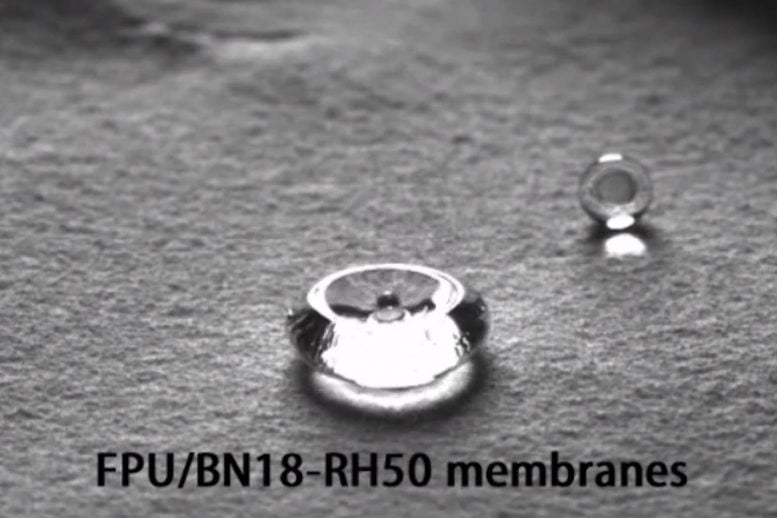
    Researchers have developed a material that cools the wearer without using any electricity. The fabric transfers heat, allows moisture to evaporate from the skin and repels water.

    Air conditioning and other space cooling methods account for about 10% of all electricity consumption in the U.S., according to the U.S. Energy Information Administration. Now, researchers reporting in ACS Applied Materials & Interfaces have developed a material that cools the wearer without using any electricity. The fabric transfers heat, allows moisture to evaporate from the skin and repels water.

    Cooling off a person’s body is much more efficient than cooling an entire room or building. Various clothing and textiles have been designed to do just that, but most have disadvantages, such as poor cooling capacity; large electricity consumption; complex, time-consuming manufacturing; and/or high cost. Yang Si, Bin Ding, and colleagues wanted to develop a personal cooling fabric that could efficiently transfer heat away from the body, while also being breathable, water-repellent, and easy to make.

    The researchers made the new material by electrospinning a polymer (polyurethane), a water-repelling version of the polymer (fluorinated polyurethane) and a thermally conductive filler (boron nitride nanosheets) into nanofibrous membranes. These membranes repelled water from the outside, but they had large enough pores to allow sweat to evaporate from the skin and air to circulate. The boron nitride nanosheets coated the polymer nanofibers, forming a network that conducted heat from an inside source to the outside air.

    In tests, the thermal conductivity was higher than that of many other conventional or high-tech fabrics. The membrane could be useful not only for personal cooling, but also for solar energy collection, seawater desalination, and thermal management of electronic devices, the researchers say.

    Reference: “Thermoconductive, Moisture-Permeable, and Superhydrophobic Nanofibrous Membranes with Interpenetrated Boron Nitride Network for Personal Cooling Fabrics” by Xi Yu, Yang Li, Xianfeng Wang, Yang Si, Jianyong Yu and Bin Ding, 1 July 2020, ACS Applied Materials & Interfaces.
    DOI: 10.1021/acsami.0c04486

    The authors acknowledge funding from the National Natural Science Foundation of China, the Interdisciplinary Studies Program for the Central Universities and the Fundamental Research Funds for the Central Universities.

    Never miss a breakthrough: Join the SciTechDaily newsletter.
    Follow us on Google and Google News.

    American Chemical Society Biotechnology Materials Science Nanotechnology Polymers
    Share. Facebook Twitter Pinterest LinkedIn Email Reddit

    Related Articles

    Bacteria-Sized Metallic Robots Take On Microplastics – And Win by Breaking Them Down

    New Hydrogel Can Cool Down Electronic Devices and Convert Waste Heat Into Electricity

    Switchable Optical Nanoantennas Made From a Conducting Polymer

    Tubulane Inspired Ultrahard Polymers Are Full of Holes, but Stop Bullets Better Than Solid Materials

    Large Scale Integrated Circuits Produced in Printing Press Based on Organic Electrochemical Transistors

    Bio-Circuitry Mimics Synapses and Neurons – Accelerates Routes to Brain-Like Computing

    New Nanofiber Dressings Dramatically Accelerate Healing and Tissue Regeneration

    New Laser-Induced Graphene Technique Opens Door for Edible Electronics

    Scientists Develop a New Nanobiocomposite Material

    1 Comment

    1. Ron McCune on July 30, 2020 9:29 pm

      Can it be put on walls, furniture, beds, car seats and other things and do any good for us.

      Reply
    Leave A Reply Cancel Reply

    • Facebook
    • Twitter
    • Pinterest
    • YouTube

    Don't Miss a Discovery

    Subscribe for the Latest in Science & Tech!

    Trending News

    Even Occasional Binge Drinking May Triple Liver Damage Risk

    Liftoff! NASA’s Artemis II Launch Sends Astronauts Around the Moon for First Time in 50 Years

    Scientists Discover New Way To Eliminate “Zombie Cells” Driving Aging

    This New Quantum Theory Could Change Everything We Know About the Big Bang

    This One Vitamin May Help Protect Your Brain From Dementia Years Later

    Stopping Weight-Loss Drugs Like Ozempic Can Quickly Erase Heart Benefits

    A 500-Million-Year-Old Surprise Is Forcing Scientists to Rethink Spider Evolution

    Coffee and Blood Pressure: What You Need To Know Before Your Next Cup

    Follow SciTechDaily
    • Facebook
    • Twitter
    • YouTube
    • Pinterest
    • Newsletter
    • RSS
    SciTech News
    • Biology News
    • Chemistry News
    • Earth News
    • Health News
    • Physics News
    • Science News
    • Space News
    • Technology News
    Recent Posts
    • Childhood Junk Food May Rewire the Brain for Life
    • NIH Scientists Discover Powerful New Opioid That Relieves Pain Without Dangerous Side Effects
    • Breakthrough Study Reveals Why Damaged Nerves Struggle To Heal
    • 20-Year Study Reveals Cholera’s Surprising Weakness
    • $220 Billion Problem: Scientists Uncover the Secret Weapon Bacteria Use To Take Over Crops
    Copyright © 1998 - 2026 SciTechDaily. All Rights Reserved.
    • Science News
    • About
    • Contact
    • Editorial Board
    • Privacy Policy
    • Terms of Use

    Type above and press Enter to search. Press Esc to cancel.