
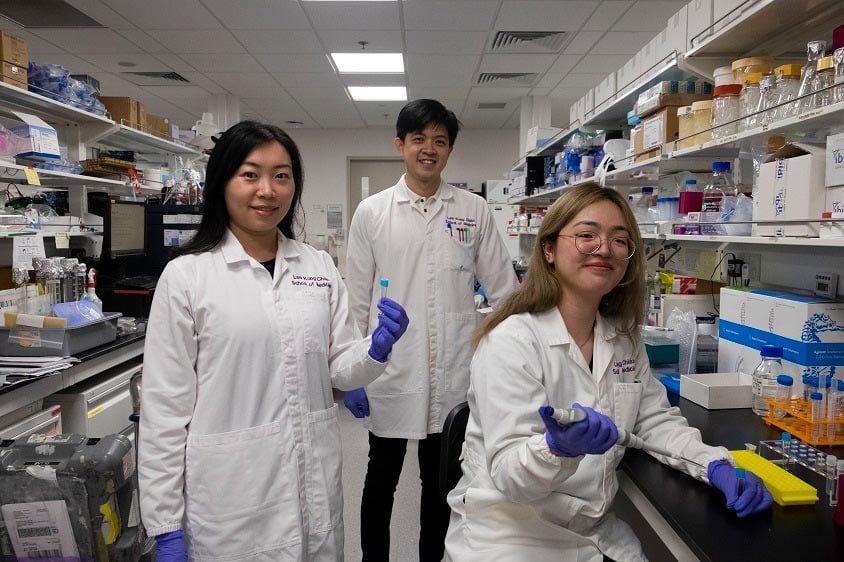
People who have recovered from COVID-19, especially those with pre-existing cardiovascular conditions, may be at risk of developing blood clots due to a lingering and overactive immune response, according to a study led by Nanyang Technological University, Singapore (NTU) scientists.
The team of researchers, led by NTU Assistant Professor Christine Cheung, investigated the possible link between COVID-19 and an increased risk of blood clot formation, shedding new light on “long-haul COVID” — the name given to the medium- and long-term health consequences of COVID-19.
The findings may help to explain why some people who have recovered from COVID-19 exhibit symptoms of blood clotting complications after their initial recovery. In some cases, they are at increased risk of heart attack, stroke or organ failure when blood clots block major arteries to vital organs.
The team, comprising researchers from NTU, Agency for Science, Technology and Research’s (A*STAR) Singapore Immunology Network (SIgN), and the National Centre of Infectious Diseases, Singapore (NCID), collected and analyzed blood samples from 30 COVID-19 patients a month after they had recovered from the infection and were discharged from hospital. They found that all recovered COVID-19 patients had signs of blood vessel damage, possibly from a lingering immune response, which may trigger the formation of blood clots.
Their findings were published on March 23, 2021, in the peer-reviewed scientific journal eLife.
“With more people recovering from COVID-19, we started hearing from clinicians about patients returning with blood clotting issues after they had been discharged and cleared of the virus,” said Asst Prof Christine Cheung from NTU’s Lee Kong Chian School of Medicine. “This makes a strong case for the close monitoring of recovered COVID-19 patients, especially those with pre-existing cardiovascular conditions like hypertension and diabetes who have weakened blood vessels.”
Blood Vessel Damage Due to Post-Recovery Overactive Immune System
The team found that recovered COVID-19 patients had twice the normal number of circulating endothelial cells (CECs) that had been shed from damaged blood vessel walls. The elevated levels of CECs indicate that blood vessel injury is still apparent after recovering from viral infection.
The researchers also found that recovered COVID-19 patients continued to produce high levels of cytokines — proteins produced by immune cells that activate the immune response against pathogens — even in the absence of the virus.
Unusually high numbers of immune cells, known as T cells, that attack and destroy viruses were also present in the blood of recovered COVID-19 patients.
The presence of both cytokines and higher levels of immune cells suggests that the immune systems of recovered COVID-19 patients remained activated even once the virus was gone.
The researchers hypothesize that these persistently activated immune responses may attack the blood vessels of recovered COVID-19 patients, causing even more damage and increasing the risk of blood clot formation further.
The study’s first author Florence Chioh, a Research Assistant at NTU’s Lee Kong Chian School of Medicine, said: “While COVID-19 is mainly a respiratory infection, the virus may also attack the linings of blood vessels, causing inflammation and damage. Leakage from these damaged vessels triggers the formation of blood clots that may result in the sort of complications seen in the patients during hospitalization.”
One of the co-authors of the paper, Professor Lisa Ng, Executive Director of A*STAR Infectious Diseases Labs and previously Senior Principal Investigator at SIgN, said: “We assessed the levels of immune mediators in these patients, which revealed several proinflammatory and activated T lymphocyte-associated cytokines sustained from infection to recovery phase. This correlated positively with CEC measure, implying cytokine-driven vessel damage. We found that COVID-19 patients with vascular complications have a higher frequency of T cells, which may in turn attack the blood vessels. Preventive therapy may be needed for these patients.”
Emphasizing Post-Hospitalization Care for At-Risk COVID-19 Patients
The study’s key findings can help inform guidelines for post-hospitalization care of COVID-19 patients who might be susceptible to ‘long-haul COVID’ symptoms, said the research team.
In January this year, the World Health Organisation (WHO) released a recommendation in their revised clinical management guidelines, targeted at the risk of blood clot formation. For hospitalized patients, WHO recommended the use of low dose anticoagulants for preventing the blood clots forming in blood vessels.
Asst Prof Cheung added: “Those with cardiovascular conditions need to be more cautious since their underlying conditions already weaken their vascular systems. It’s a double blow with COVID-19. As we gain greater understanding of complications COVID ‘long-haulers’ face, there is hope to encourage vaccine take-up rate to protect oneself from both the virus and its long-term complications.”
Moving forward, the team is investigating the longer-term effects of COVID-19 in patients who have recovered from the infection for at least six months or longer.
Reference: “Convalescent COVID-19 patients are susceptible to endothelial dysfunction due to persistent immune activation” by Florence WJ Chioh, Siew-Wai Fong, Barnaby E Young, Kan-Xing Wu, Anthony Siau, Shuba Krishnan, Yi-Hao Chan, Guillaume Carissimo, Louis LY Teo, Fei Gao, Ru San Tan, Liang Zhong, Angela S Koh, Seow-Yen Tan, Paul A Tambyah, Laurent Renia, Lisa FP Ng, David C Lye and Christine Cheung, 23 March 2021, eLife.
DOI: 10.7554/eLife.64909
Never miss a breakthrough: Join the SciTechDaily newsletter.
Follow us on Google and Google News.