
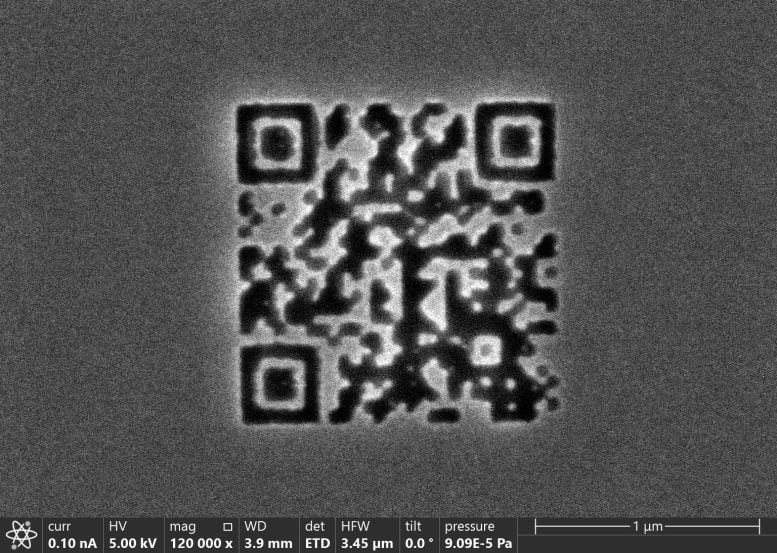
A 1.98-square-micrometer QR code, etched into ceramic thin film and verified by Guinness, showcases a new approach to ultra-dense, long-term data storage.
How small can a QR code actually be? Researchers have now pushed the limits so far that the code can only be detected with an electron microscope. A team at TU Wien, working in partnership with data storage company Cerabyte, created a QR code covering only 1.98 square micrometers, an area smaller than most bacteria. The achievement has been officially confirmed and entered into the Guinness Book of Records.
Beyond setting a size record, the project points to a solution for one of the digital age’s most difficult challenges. Traditional magnetic and electronic storage devices typically last only a few years before degrading. By contrast, encoding information directly into ceramic materials could allow data to survive for hundreds or even thousands of years.
Atomic Precision Meets Long-Term Stability
“The structure we have created here is so fine that it cannot be seen with optical microscopes at all,” says Prof. Paul Mayrhofer from the Institute of Materials Science and Technology at TU Wien. “But that is not even the truly remarkable part. Structures on the micrometer scale are nothing unusual today—it is even possible to fabricate patterns made of individual atoms. However, that alone does not result in a stable, readable code.”
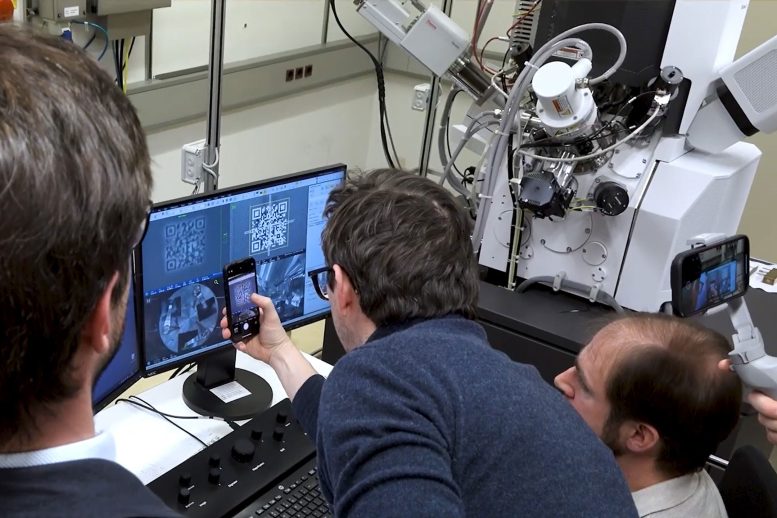
At minuscule scales, atoms can shift position or spread into neighboring spaces, which can gradually erase stored information. “What we have done is something fundamentally different,” Mayrhofer explains. “We have created a tiny, but stable and repeatedly readable QR code.”
Ceramic Thin Films Enable Ultra-Dense Data Storage
Material choice proved critical to the success of the project. “We conduct research on thin ceramic films, such as those used for coating high-performance cutting tools,” explain Erwin Peck and Balint Hajas, who were central to achieving the record. “For high-performance tools, it is essential that materials remain stable and durable even under extreme conditions. And that is exactly what makes these materials ideal for data storage as well.”
The researchers used focused ion beams to carve the QR code into a thin ceramic layer. Each pixel measures just 49 nanometers, about ten times smaller than the wavelength of visible light. As a result, the pattern cannot be seen with standard optical microscopes, similar to how Braille cannot be detected through the thick sole of an elephant’s foot. Under an electron microscope, however, the code can be clearly and reliably read.
This technique allows for exceptionally high data density. More than 2 terabytes of information could theoretically fit onto an area the size of a single A4 sheet of paper. Unlike conventional storage technologies, ceramic media can remain stable for extremely long periods and do not require a continuous energy supply to preserve data.
Sustainable, Energy-Free Long-Term Data Preservation
“We live in the information age, yet we store our knowledge in media that are astonishingly short-lived,” says Alexander Kirnbauer. Many magnetic and electronic storage systems begin losing data after only a few years. Without ongoing power, cooling, and regular data transfers to new systems, valuable information can disappear. In contrast, ancient civilizations carved records into stone, leaving messages that have endured for millennia.
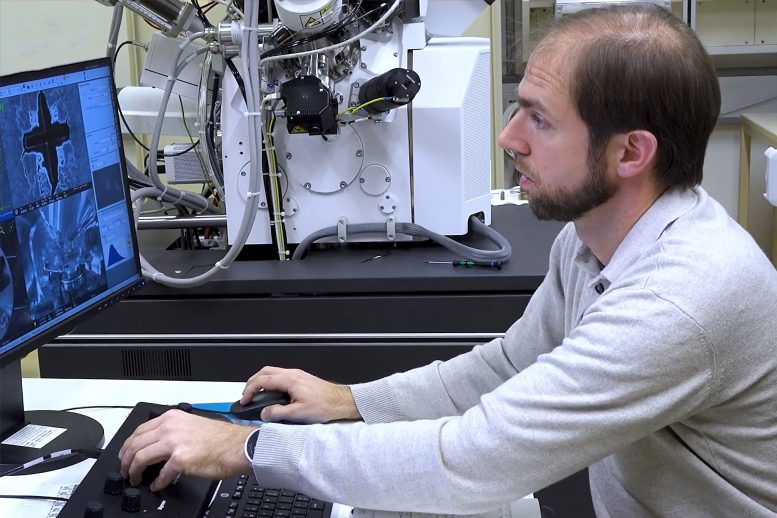
“With ceramic storage media, we are pursuing a similar approach to that of ancient cultures, whose inscriptions we can still read today,” says Alexander Kirnbauer. “We write information into stable, inert materials that can withstand the passage of time and remain fully accessible to future generations.”
Another major advantage is that ceramic-based storage does not depend on electricity or cooling systems. Modern data centers consume vast amounts of power and contribute significantly to global CO₂ emissions, making energy-free storage an attractive alternative.
Guinness World Record and Future of Ceramic Data Storage
The record-setting demonstration, including the electron microscope readout, was conducted jointly by TU Wien and Cerabyte in front of witnesses and independently verified by the University of Vienna. TU Wien provided advanced materials science laboratories as well as access to the high-performance electron microscopes at USTEM, the university’s microscopy center. Guinness has now officially recognized the achievement, noting that the new QR code measures just 37 percent of the size of the previous record holder.
“The now confirmed world record marks just the beginning of a very promising development,” says Alexander Kirnbauer. “We now aim to use other materials, increase writing speeds, and develop scalable manufacturing processes so that ceramic data storage can be used not only in laboratories but also in industrial applications. At the same time, we are investigating how more complex data structures—far beyond simple QR codes—can be written robustly, quickly, and energy-efficiently into ceramic thin films and read out reliably.”
By demonstrating that information can be permanently stored in durable ceramic materials, this work points toward a future in which data is preserved securely, sustainably, and with minimal energy consumption.
Never miss a breakthrough: Join the SciTechDaily newsletter.
Follow us on Google and Google News.