

MXene, a nanomaterial used in battery technology and as a high-performance lubricant, was previously difficult and hazardous to produce. However, researchers at TU Wien have now developed new, safer methods for its production.
One of the most groundbreaking trends in materials science is the study of two-dimensional (2D) materials, substances composed of a single layer of atoms. These materials often exhibit entirely different properties than their bulk counterparts made of the same elements. This research area gained momentum with the discovery of graphene, which later earned a Nobel Prize.
Today, attention is turning to a new class of 2D materials known as MXenes (pronounced “Maxenes”), composed primarily of titanium and carbon. Researchers at TU Wien (Vienna University of Technology), in collaboration with the companies CEST and AC2T, are exploring the potential of these materials.
MXenes offer an impressive range of properties. They show promise in applications such as electromagnetic shielding, energy storage, and advanced sensing technologies. Remarkably, TU Wien researchers have also discovered that MXenes function exceptionally well as solid lubricants, even under extreme conditions like those found in space.
However, one major obstacle has been the hazardous and toxic nature of conventional MXene production methods, which typically rely on strong acids. That challenge has now been overcome. A team at TU Wien has developed a safer, electricity-based synthesis process that eliminates the need for toxic chemicals. This breakthrough has been published in the prestigious journal Small.
No more toxic hydrofluoric acid
“To produce MXenes, you first need so-called MAX phases. These are materials that can consist, for example, of layers of aluminum, titanium, and carbon”, explains Pierluigi Bilotto from the Research unit of Tribology at the Institute of Engineering Design and Product Development at TU Wien. “Until now, hydrofluoric acid was used to etch away the aluminum in the MAX, which then resulted in a system of atomically thin layers that can slide against each other with very little resistance. This makes these MXenes a great lubricant.”
But handling hydrofluoric acid is no easy task. It is toxic and harmful to the environment, and there are strict regulations on how to handle this chemical. You need special, expensive laboratory equipment for it, and you get waste products that have to be disposed of in a costly way.
“This is why MXenes have not yet made a major breakthrough in industry,” says Pierluigi Bilotto. “It’s hard to build up such a process on an industrial scale, and many companies understandably shy away from taking this step.”
So Pierluigi Bilotto set out to find a better method – together with Prof. Carsten Gachot and Prof. Markus Valtiner from TU Wien, Dr. Markus Ostermann from CEST in Wiener Neustadt, Marko Pjlievic from AC2T and others.
Electrochemistry
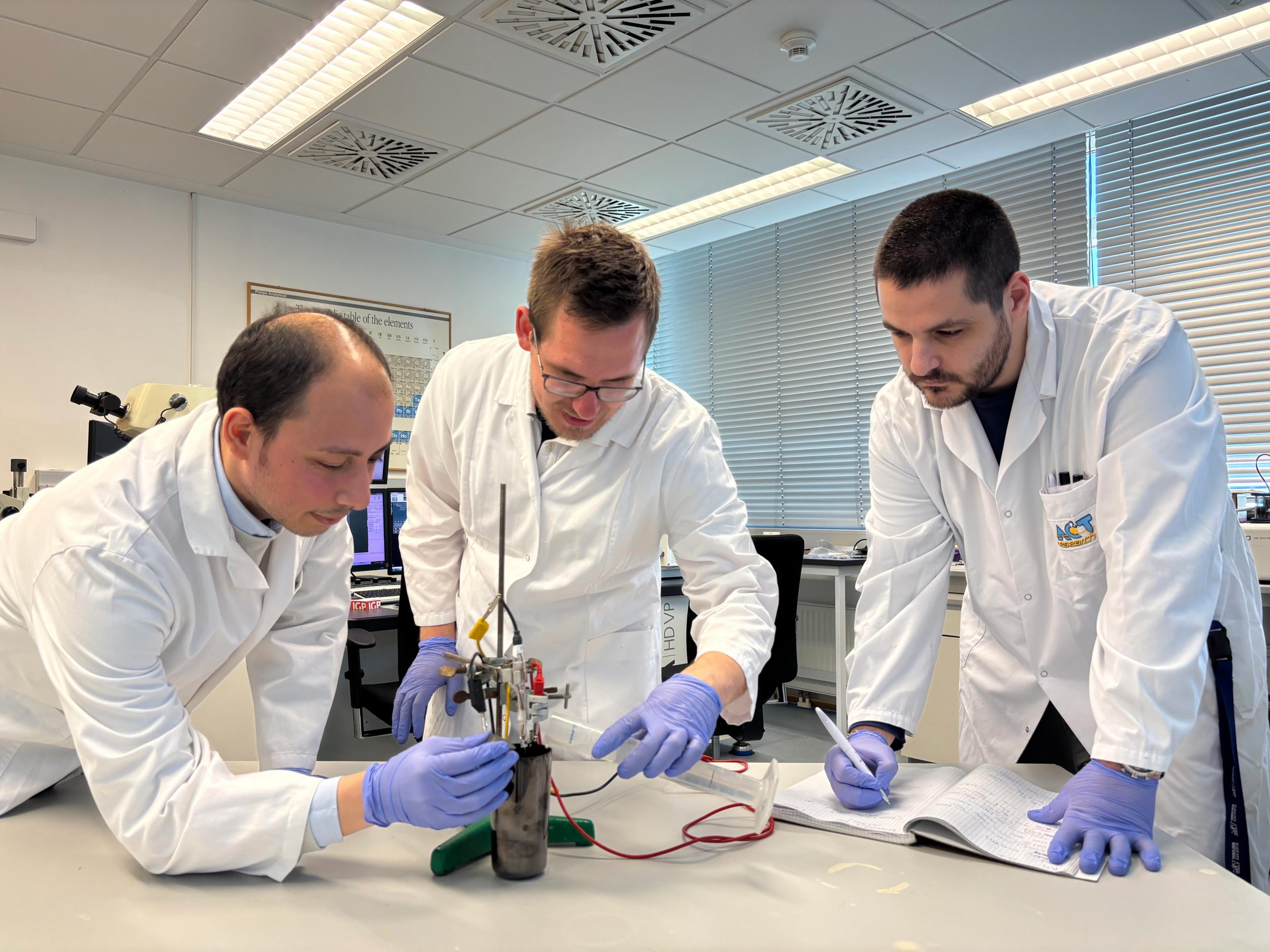
“Electrochemistry offers an alternative route to break the aluminum bonds in the MAX phase, ” says Pierluigi Bilotto. “When an electrical voltage is applied, the MAX phase experiences an electric current that initiates reactions at its interfaces. By precisely selecting the voltage, we are able to tune the reactions in a way that only Aluminium atoms are removed, leaving as product electrochemical MXenes (EC-MXenes).
The team found that a very specific electrochemical technique can be used to improve the electrochemical etching and EC-MXene’s overall quality: well-dosed pulses of current. While the reactivity of the surface often drops quickly with other methods, short current pulses cause small hydrogen bubbles to form on the MAX phase materials, cleaning and reactivating the surface. This allows the electrochemical reaction to be sustained for longer periods of time and a large quantity of EC-MXenes to be produced.
The product obtained was then analyzed with advanced techniques such as Atomic Force Microscopy, Scanning and Transmission Electron Microscopy, Raman and X-ray Photoelectron spectroscopy, and Low Energy Ion Scattering. – its properties are at least as good as those of MXenes previously produced using hydrofluoric acid. “My goal is to make the synthesis of MXene extremely simple. It should be possible in any kitchen”, says Pierluigi Bilotto. “And we are very close to that.”
Reference: “Pulsed Electrochemical Exfoliation for an HF-Free Sustainable MXene Synthesis” by Markus Ostermann, Marko Piljević, Elahe Akbari, Prathamesh Patil, Veronika Zahorodna, Ivan Baginskiy, Oleksiy Gogotsi, Carsten Gachot, Manel Rodríguez Ripoll, Markus Valtiner and Pierluigi Bilotto, 30 March 2025, Small.
DOI: 10.1002/smll.202500807
Never miss a breakthrough: Join the SciTechDaily newsletter.
Follow us on Google and Google News.
2 Comments
Note 2504161534_Source1. Analyzing【
1.
Scientists have revealed safer electrochemical methods to make “miracle material” MXene.
Researchers at TU Wien have developed a safer and more non-toxic electrochemical method to produce MXene, an outstanding two-dimensional material that can be applied to energy storage, sensors, and solid lubrication. This innovative technology is expected to eliminate the need for harmful hydrofluoric acid (HF), thereby enabling production on an industrial scale.
MXene, a nanomaterial used in battery technology and high-performance lubricants, was previously difficult and dangerous to produce. However, the researchers have now developed a new and safe way to produce MXene.
1-1.
One of the most groundbreaking trends in material science is the study of two-dimensional (2D) materials consisting of single atomic layers. These materials often exhibit completely different properties from bulk materials composed of the same elements. The field of research was further developed with the subsequent discovery of the Nobel Prize-winning graphene.
Today, a new 2D material called MXene (pronounced “Max N”), which is mainly composed of titanium and carbon, is attracting attention.
_[1-2] Is mcell a solid particle lubricant? Uh-huh.
_】2qqvixer is a type of two vixers that slide. This could be a lubricant that gently transports the liquefaction of dark energy to dark matter. Uh-huh.
[2-2] Simulation data network science is a more advanced method than electrochemistry. In order to obtain a perfect result value magicsum in the form of combinations on a cosmic scale, example 1. should be applied.
View 1.
sample 1.vix.a’6//vixx.a(b1,g3,k3,o5,n6)
b0acfd|~ |0000e0
000ac0|~|f00bde
0c0fab|~ |000e0d
e00d0c|~|0b0fa0
f000e0|~ |b0dac0
d0f000|~ |cae0b0
0b000f|~ |0ead0c
0deb00|~|ac000f
ced0ba|~|00f000
a0b00e|~|0dc0f0
0ace00|~|df000b
0f00d0|~|e0bc0a
≈≈≈=========
Source 1.
https://scitechdaily.com/scientists-unveil-safer-way-to-make-miracle-material-mxene/
1-2.
MXene offers a variety of amazing properties. It shows promising potential in fields such as electromagnetic shielding, energy storage, and advanced sensing technologies.
Surprisingly, the researchers found that [MXene functions very effectively as a solid lubricant even in extreme environments such as space].
However, the main obstacle was that conventional MXene production methods, which rely on strong acid, were dangerous and highly toxic. Now those issues have been resolved. The research team at TU Wien has developed a safer, electric-based synthesis process that does not use toxic chemicals. The breakthrough technology was published in the prestigious journal Small.
2. No more toxic hydrofluoric acid
To produce MXene, you first need the so-called MAX phase. The phase is a material that can consist of layers of aluminum, titanium, and carbon, for example. Hydrofluoric acid has been used to etch aluminum in the MAX so far, resulting in a system in which thin layers slide and move with little resistance to each other at the atomic level. This is why MXene is a great lubricant.
2-1.
However, dealing with hydrofluoric acid is not an easy task. There are strict regulations on the handling of these chemicals, which are toxic and harmful to the environment. Special and expensive laboratory equipment is required, and waste disposal is also expensive.
This was why MXene has not yet made great progress in the industry. It is natural that many companies are reluctant to take these steps because it is difficult to build such a process on an industrial scale.
2-2.
So the team started looking for a better way. [It’s electrochemistry]
Electrochemicals provide an alternative way to break the aluminum bond on the MAX. When a voltage is applied, a current flows on the MAX, and this current starts the reaction at the interface. By precisely adjusting the voltage, only aluminum atoms are removed and the reaction may be adjusted so that electrochemical MXene (EC-MXene) is produced.
3.
The research team has found that a very specific electrochemical technique can be used to improve the overall quality of electrochemical etching and EC-MXene. It is an appropriate amount of current pulse. Using other methods, the surface reactivity rapidly decreases, while the short current pulse forms a small hydrogen bubble in the MAX phase material to clean and reactivate the surface. This allows the electrochemical reaction to last longer and produce a large amount of EC-MXene.
The obtained products were analyzed using advanced techniques such as atomic force microscopy, scanning and transmission electron microscopy, Raman and X-ray photoelectron spectroscopy, and low-energy ion scattering. Its properties are as good as those of MXene previously produced using hydrofluoric acid. Pierluigi Bilotto said, “My goal is to make the synthesis of MXene very simple. It would be possible in any kitchen. And we were very close to that goal.
ㅡㅡㅡㅡㅡㅡㅡㅡㅡㅡ
a related article
Kitchen Temperature Superconductivity Using 2D Laminated Materials
Try Twist: Using Curved Surface to Create 2D Quantum Materials
Stack and Twist: Physicists Accelerate Innovative New Material Exploration
Faster electrons in flatter graphene
Create custom lighting using artificial structures of 2D materials
Precise measurement of wrinkle structure of 2D material silicene
A new state zoo previously unobserved in twisted bilayer graphene
Incredible new material converts heat into electricity at world record speed
“Patterned regeneration” could give rise to graphene-based circuits
So…If they have been successful creating the 2D substance , where is a useful version , to use with production , of some valued electronics , of viable products ?
Their thesis/discovery didn’t fully respond , to viable products, that would be helped with this orocess/compound of nano parts…or treatments of electronics .
Would like to see actual specific uses , and products…,Such as will it help with super efficient mproom temp super magnets ? Possibly among the highest use cases….Also , will it be useful , as a coating for spaceships or even better rocket engines ?