
Close Menu
    Facebook X (Twitter) Instagram
    SciTechDaily
    • Biology
    • Chemistry
    • Earth
    • Health
    • Physics
    • Science
    • Space
    • Technology
    Facebook X (Twitter) Pinterest YouTube RSS
    SciTechDaily
    Home»Technology»Faster Electrons From Flatter Graphene
    Technology

    Faster Electrons From Flatter Graphene

    By Swiss Nanoscience Institute, University of BaselApril 20, 2020No Comments2 Mins Read
    Facebook Twitter Pinterest Telegram LinkedIn WhatsApp Email Reddit
    Share
    Facebook Twitter LinkedIn Pinterest Telegram Email Reddit
    Flatter Graphene Faster Electrons
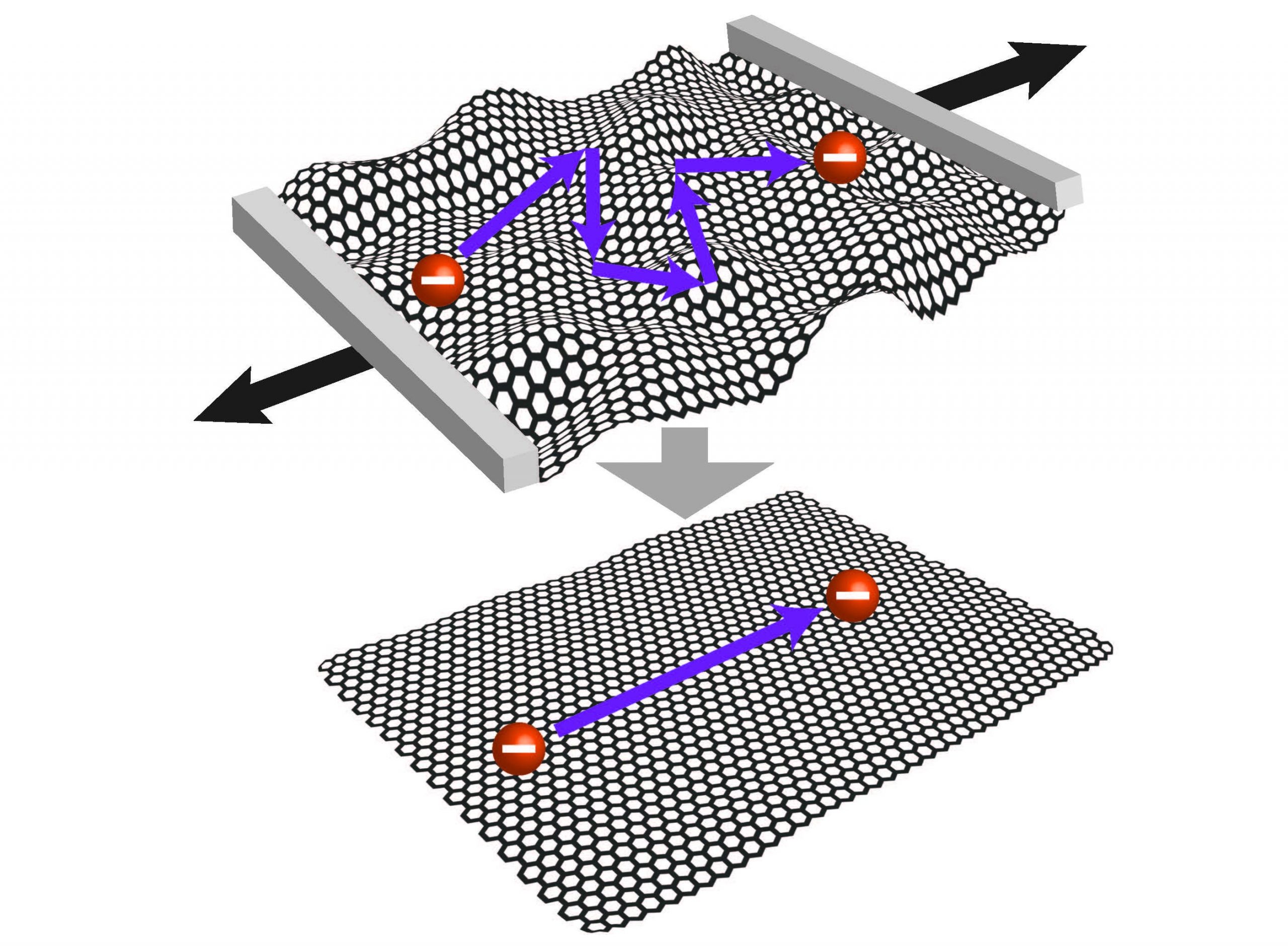
    Corrugations in graphene slow down the pace of traveling electrons. By pulling on the graphene sheet on two opposite sides, it is flattened and smoothed, and electron transport is improved. Credit: Swiss Nanoscience Institute

    Bumps on a road slow down our pace, so do corrugations in graphene to traveling electrons. By flattening the corrugations out, we help electrons move effectively faster through a graphene sheet.

    Limits because of microscopic distortions

    The sample quality of graphene has been improved significantly since its discovery. One factor that limited further improvements has not been investigated directly so far, namely corrugations in the graphene sheet, i.e. microscopic distortions that form even when placed on atomically flat surfaces. Such corrugations can scatter the electrons when moving through an electronic device.

    The team of professor Christian Schönenberger of the Swiss Nanoscience Institute and Department of Physics at the University of Basel has developed a technique to pull the graphene sheet on two opposite sides and thereby flattening and smoothing it. “It is similar to pulling on a piece of crumpled paper which irons out wrinkles and folds,” says Dr. Lujun Wang, first author of the study. “After this process, the electrons travel effectively faster through the graphene sheet, their “mobility” increases, demonstrating an improved sample quality,” his supervisor Dr. Andreas Baumgartner adds.

    These findings not only help us to further understand the electron transport in graphene but also provide instructions for studying other two-dimensional materials.

    Reference: “Mobility Enhancement in Graphene by in situ Reduction of Random Strain Fluctuations” by Lujun Wang, Péter Makk, Simon Zihlmann, Andreas Baumgartner, David I. Indolese, Kenji Watanabe, Takashi Taniguchi and Christian Schönenberger, 15 April 2020, Physical Review Letters.
    DOI: 10.1103/PhysRevLett.124.157701

    Never miss a breakthrough: Join the SciTechDaily newsletter.
    Follow us on Google and Google News.

    2D Materials Graphene Materials Science Nanotechnology Swiss Nanoscience Institute University of Basel
    Share. Facebook Twitter Pinterest LinkedIn Email Reddit

    Related Articles

    Ultrathin Semiconductors Equipped With Superconducting Contacts for the First Time

    Terahertz Imaging of Graphene Paves the Way to Optimization and Industrialization

    Findings to Help Achieve Holy Grail of 2D Materials – Superfast Electronic Devices

    The New SQUID: A Tiny Instrument to Measure the Faintest Magnetic Fields

    Stack and Twist: Physicists Accelerate the Hunt for Revolutionary New Materials

    Semiconducting Graphene Ribbons Developed for Electronics and Quantum Computing

    Corrugated Structure of 2D Material Silicene Precisely Measured

    New Zoo of Previously Unobserved States in Twisted Bi-Layer Graphene

    “Patterned Regrowth” May Lead to Graphene-Based Circuits

    Leave A Reply Cancel Reply

    • Facebook
    • Twitter
    • Pinterest
    • YouTube

    Don't Miss a Discovery

    Subscribe for the Latest in Science & Tech!

    Trending News

    Artificial Sweeteners May Harm Future Generations, Study Suggests

    Splashdown! NASA Artemis II Returns From Record-Breaking Moon Mission

    What If Consciousness Exists Beyond Your Brain

    Scientists Finally Crack the 100-Million-Year Evolutionary Mystery of Squid and Cuttlefish

    Beyond “Safe Levels”: Study Challenges What We Know About Pesticides and Cancer

    Researchers Have Found a Dietary Compound That Increases Longevity

    Scientists Baffled by Bizarre “Living Fossil” From 275 Million Years Ago

    Your IQ at 23 Could Predict Your Wealth at 27, Study Finds

    Follow SciTechDaily
    • Facebook
    • Twitter
    • YouTube
    • Pinterest
    • Newsletter
    • RSS
    SciTech News
    • Biology News
    • Chemistry News
    • Earth News
    • Health News
    • Physics News
    • Science News
    • Space News
    • Technology News
    Recent Posts
    • What if Dark Matter Has Two Forms? Bold New Hypothesis Could Explain a Cosmic Mystery
    • Researchers Expose Hidden Chemistry of “Ore-Forming” Elements in Biology
    • Geologists Reveal the Americas Collided Earlier Than We Thought
    • 20x Difference: Study Reveals True Source of Airborne Microplastics
    • Scientists Uncover Hidden Force Powering Yellowstone’s Supervolcano
    Copyright © 1998 - 2026 SciTechDaily. All Rights Reserved.
    • Science News
    • About
    • Contact
    • Editorial Board
    • Privacy Policy
    • Terms of Use

    Type above and press Enter to search. Press Esc to cancel.