
Close Menu
    Facebook X (Twitter) Instagram
    SciTechDaily
    • Biology
    • Chemistry
    • Earth
    • Health
    • Physics
    • Science
    • Space
    • Technology
    Facebook X (Twitter) Pinterest YouTube RSS
    SciTechDaily
    Home»Technology»Corrugated Structure of 2D Material Silicene Precisely Measured
    Technology

    Corrugated Structure of 2D Material Silicene Precisely Measured

    By University of BaselDecember 30, 2019No Comments3 Mins Read
    Facebook Twitter Pinterest Telegram LinkedIn WhatsApp Email Reddit
    Share
    Facebook Twitter LinkedIn Pinterest Telegram Email Reddit
    Quantitative Measurement of Forces Between Sample and Tip
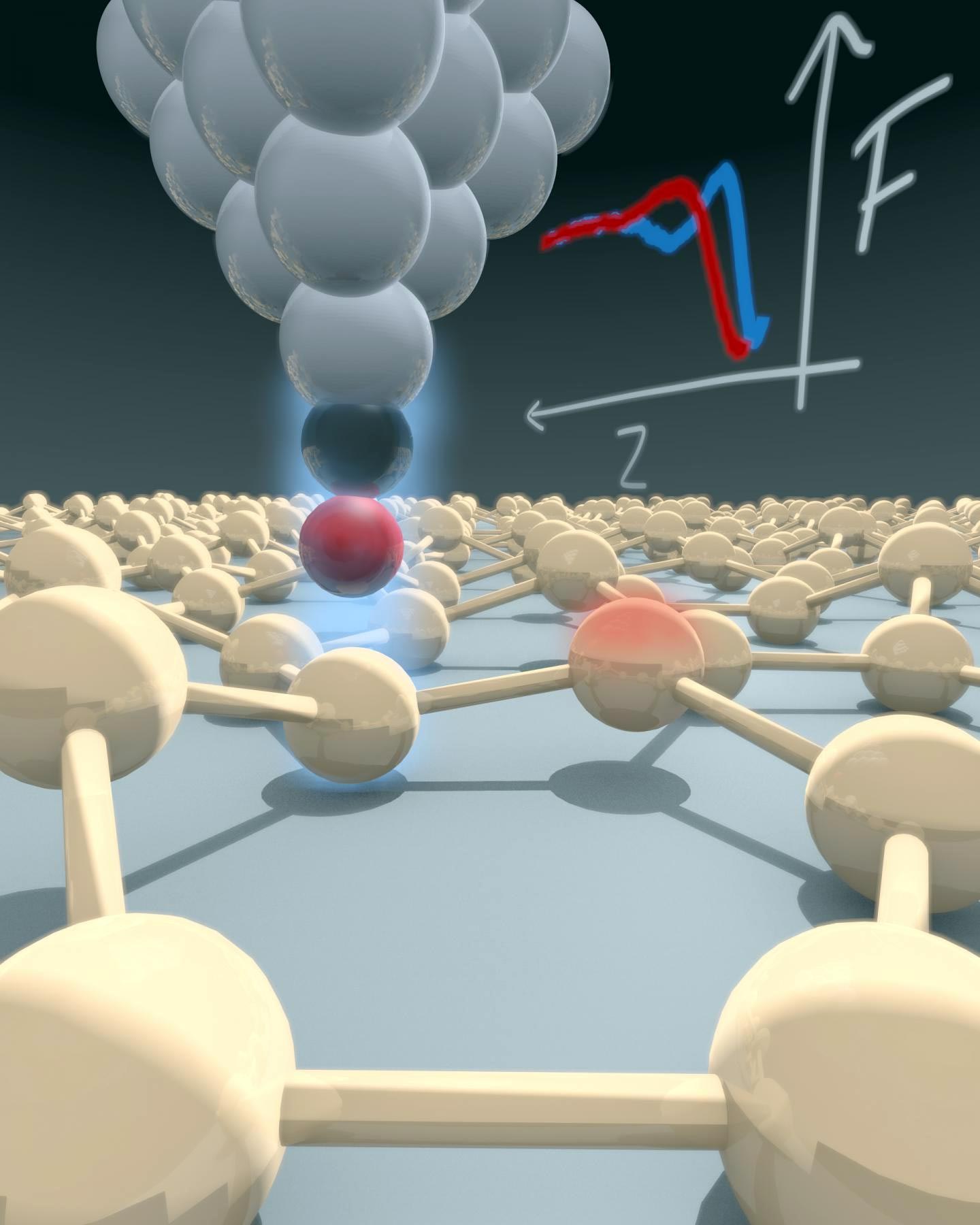
    A low-temperature atomic force microscope with a single carbon atom at the tip allows quantitative measurement of forces between sample and tip. With two-dimensional silicon (silicene), surface buckling can be quantitatively determined. Credit: University of Basel, Department of Physics

    Silicene consists of a single layer of silicon atoms. In contrast to the ultra-flat material graphene, which is made of carbon, silicene shows surface irregularities that influence its electronic properties. Now, physicists from the University of Basel have been able to precisely determine this corrugated structure. As they report in the journal PNAS, their method is also suitable for analyzing other two-dimensional materials.

    Since the experimental production of graphene, two-dimensional materials have been at the heart of materials research. Similar to carbon, a single layer of honeycombed atoms can be made from silicon. This material, known as silicene, has an atomic roughness, in contrast to graphene, since some atoms are at a higher level than others.

    Silicene not completely flat

    Now, the research team, led by Professor Ernst Meyer of the Department of Physics and the Swiss Nanoscience Institute of the University of Basel, has succeeded in quantitatively representing these tiny height differences and detecting the different arrangement of atoms moving in a range of less than one angstrom — that is, less than a 10-millionth of a millimeter.

    “We use low-temperature atomic force microscopy with a carbon monoxide tip,” explains Dr. Rémy Pawlak, who played a leading role in the experiments. Force spectroscopy allows the quantitative determination of forces between the sample and the tip. Thus, the height in relation to the surface can be detected and individual atoms can be chemically identified. The measurements show excellent agreement with simulations carried out by partners at the Instituto de Ciencia de Materiales de Madrid (ICMM).

    Different electronic properties

    This unevenness, known as buckling, influences the electronic properties of the material. Unlike graphene, which is known to be an excellent conductor, on a silver surface silicene behaves more like a semiconductor. “In silicene, the perfect honeycomb structure is disrupted. This is not necessarily a disadvantage, as it could lead to the emergence of interesting quantum phenomena, such as the quantum spin hall effect,” says Meyer.

    The method developed by the researchers in Basel offers new insights into the world of two-dimensional materials and the relationship between structure and electronic properties.

    Reference: “Quantitative determination of atomic buckling of silicene by atomic force microscopy” by Rémy Pawlak, Carl Drechsel, Philipp D’Astolfo, Marcin Kisiel, Ernst Meyer and Jorge Iribas Cerda, 23 December 2019, Proceedings of the National Academy of Sciences.
    DOI: 10.1073/pnas.1913489117

    Never miss a breakthrough: Join the SciTechDaily newsletter.
    Follow us on Google and Google News.

    2D Materials Materials Science Nanotechnology University of Basel
    Share. Facebook Twitter Pinterest LinkedIn Email Reddit

    Related Articles

    Kitchen Temperature Superconductivity From Stacked 2D Materials

    Do the Twist: Making 2D Quantum Materials Using Curved Surfaces

    The New SQUID: A Tiny Instrument to Measure the Faintest Magnetic Fields

    Stack and Twist: Physicists Accelerate the Hunt for Revolutionary New Materials

    Semiconducting Graphene Ribbons Developed for Electronics and Quantum Computing

    Faster Electrons From Flatter Graphene

    Creating Custom Light Using Artificial Structures of 2D Materials

    New Zoo of Previously Unobserved States in Twisted Bi-Layer Graphene

    “Patterned Regrowth” May Lead to Graphene-Based Circuits

    Leave A Reply Cancel Reply

    • Facebook
    • Twitter
    • Pinterest
    • YouTube

    Don't Miss a Discovery

    Subscribe for the Latest in Science & Tech!

    Trending News

    Popular Sugar-Free Sweetener Linked to Liver Disease, Study Warns

    What Is Hantavirus? The Deadly Disease Raising Alarm Worldwide

    Scientists Just Discovered How the Universe Builds Monster Black Holes

    Scientists Unveil New Treatment Strategy That Could Outsmart Cancer

    A Simple Vitamin May Hold the Key to Treating Rare Genetic Diseases

    Scientists Think the Real Fountain of Youth May Be Hiding in Your Gut

    Ravens Don’t Follow Wolves, They Predict Them

    This Common Knee Surgery May Be Doing More Harm Than Good

    Follow SciTechDaily
    • Facebook
    • Twitter
    • YouTube
    • Pinterest
    • Newsletter
    • RSS
    SciTech News
    • Biology News
    • Chemistry News
    • Earth News
    • Health News
    • Physics News
    • Science News
    • Space News
    • Technology News
    Recent Posts
    • Scientists May Have Found a Way To Repair Nerve Damage in Multiple Sclerosis
    • GLP-1 Weight Loss Linked To Dramatically Lower Risk of Sleep Apnea, Kidney Disease and More
    • Scientists Uncover the Surprising Source of Strange Clouds Near the Milky Way’s Supermassive Black Hole
    • This Dazzling Green Snake Was Hiding in Plain Sight for Decades
    • Scientists Discover That a Single Dose of Psilocybin Changes the Human Brain
    Copyright © 1998 - 2026 SciTechDaily. All Rights Reserved.
    • Science News
    • About
    • Contact
    • Editorial Board
    • Privacy Policy
    • Terms of Use

    Type above and press Enter to search. Press Esc to cancel.