
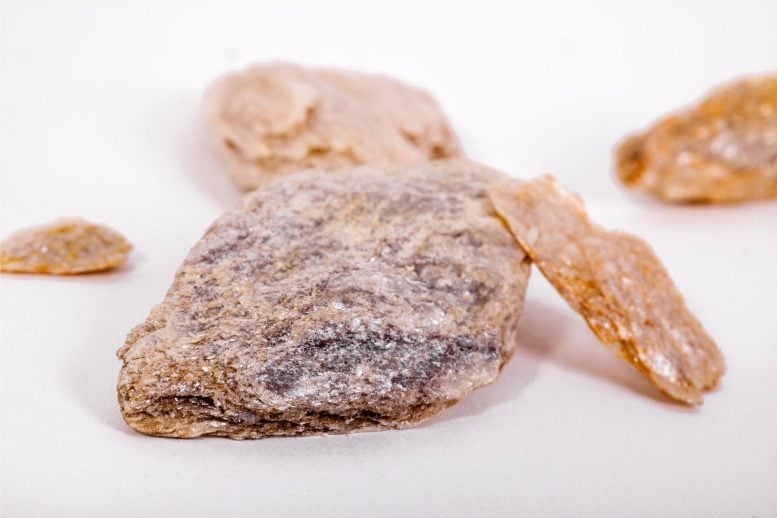
A well-known mineral is once again the center of attention thanks to applications in electronics: the Vienna University of Technology shows that mica still possesses some surprises.
At first glance, mica appears to be quite ordinary: it is a prevalent mineral found in materials like granite and has undergone extensive examination from geological, chemical, and technical standpoints.
At first, it may seem that there’s nothing groundbreaking that can be uncovered about such a commonplace material. However, a team from the Vienna University of Technology has recently published a study in Nature Communications, in which it was possible to explain the distribution of potassium ions on the mica surface. This marks the first time that the physical surface characteristics of mica have been studied at an atomic level, which holds significance for research in the field of electronics utilizing 2D materials.
Atomically Thin Layers
Atomically thin layers 2D materials are currently one of the most researched topics in materials science: Certain materials, such as graphene and molybdenum disulfide, consist of only one or a few layers of atoms, which frequently leads to unusual properties.
In a sense, mica is a naturally occurring 2D material: It consists of atomically thin layers that can contain different atoms depending on the type of mica: oxygen is always present, often silicon, often potassium or aluminum as well. The layer structure of the mica is also the reason for its characteristic sheen – you can often see a spectrum of colors, similar to a thin layer of oil on a puddle of water.
Potassium Ions in Ultra-High Vacuum
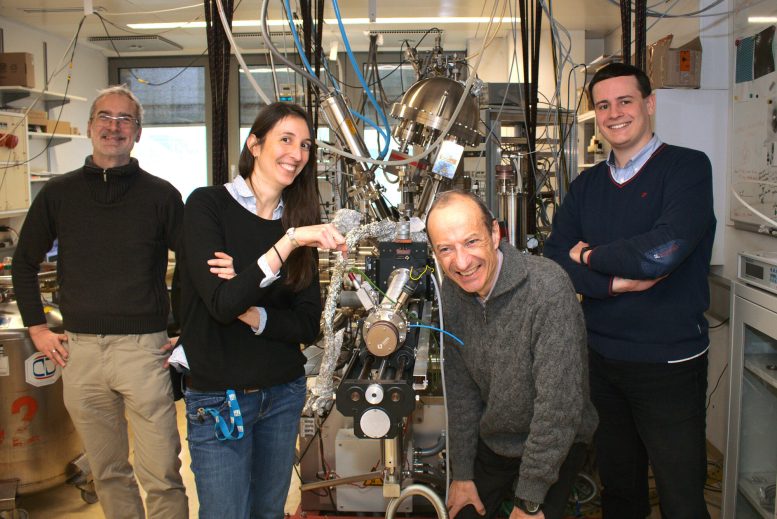
The outermost layer of mica is difficult to examine because it is quickly contaminated by atoms and molecules from the air. It has now been possible to image the surface of mica in ultra-high vacuum, however, using a new type of atomic force microscope at the Vienna University of Technology. “We were able to see how the potassium ions are distributed on the surface,” says Giada Franceschi, the first author of the current paper, who works in Prof. Ulrike Diebold’s team. “We were also able to gain insights into the positions of the aluminum ions under the surface layer – this is a particularly difficult task experimentally.”
The images from the Vienna University of Technology show that the potassium ions are not randomly distributed on the surface, as previously assumed, but are arranged in tiny patterns. These distributions could also be calculated with the help of computer simulations.
Matching Insulator for 2D Electronics
This work could be important, among other things, for attempts to use 2D materials such as graphene for electronic circuits. One also needs suitable insulators for this – and mica is a very obvious candidate. “The surface properties of mica will play a crucial role in such electronic components,” says Giada Franceschi.
Reference: “Resolving the intrinsic short-range ordering of K+ ions on cleaved muscovite mica” by Giada Franceschi, Pavel Kocán, Andrea Conti, Sebastian Brandstetter, Jan Balajka, Igor Sokolović, Markus Valtiner, Florian Mittendorfer, Michael Schmid, Martin Setvín and Ulrike Diebold, 13 January 2023, Nature Communications.
DOI: 10.1038/s41467-023-35872-y
Never miss a breakthrough: Join the SciTechDaily newsletter.
Follow us on Google and Google News.
3 Comments
Love learning about nature
Thank you for sharing. Many of the Mexican pyramids have layers of Mica under certain roads and rooms. Teotihuacan near Mexico City, has Mica from Brazil. We still do not know who were the original builders. When the Aztec found the city, it was empty. The presence of thick mica sheets between the two upper parts elicits attention. “Two 9 m² mica sheets were unearthed during excavations conducted by Viking Foundation. Analyses on the composition of this mica revealed that it did not come from this region. In fact, the nearest source of mica composed of iron, magnesium, lithium, manganese and titanium is in Brazil – 4000 kilometres from the Teotihuacan site.” What drove the builders to use mica between the summit and the base of the building and thus turn the pyramid of Teotihuacan into the largest condenser ever built in the world? Also under the main avenue between two of the largest pyramids of the site.
This distance rules out the suggestion that mica was used for ornamental purposes. Moreover, the mica was discovered between the two upper parts of the pyramid, which likewise refutes this hypotheses.
Mica is nowadays found in the form of rigid sheets (ISO-therm ‘M’) and in the form of flexible foil (ISO-foil ‘R’). It is used for electrical and thermal insulation.
If I’m not mistaken condensers hold an electrical charge and so it reaches a certain point many times more powerful than what was put into it could this be a source of power generated by ancient aliens possibly. It has been hypothesized that the pyramid of Giza was a giant producer of energy that was beamed up into the cosmos possibly to energize or re-energize spaceships I don’t know just my two cents worth.. but if the ancients did power up this planet having a condenser that big would do a lot for sending the power on its way it’s a long way around the planet. Maybe checklist Tesla’s Tower for free energy for the whole planet was just a new take on a very old idea