
Close Menu
    Facebook X (Twitter) Instagram
    SciTechDaily
    • Biology
    • Chemistry
    • Earth
    • Health
    • Physics
    • Science
    • Space
    • Technology
    Facebook X (Twitter) Pinterest YouTube RSS
    SciTechDaily
    Home»Space»ISS Astronauts Complete First Roll-Out Solar Array Installation During 6+ Hour Spacewalk
    Space

    ISS Astronauts Complete First Roll-Out Solar Array Installation During 6+ Hour Spacewalk

    By NASAJune 21, 20211 Comment4 Mins Read
    Facebook Twitter Pinterest Telegram LinkedIn WhatsApp Email Reddit
    Share
    Facebook Twitter LinkedIn Pinterest Telegram Email Reddit
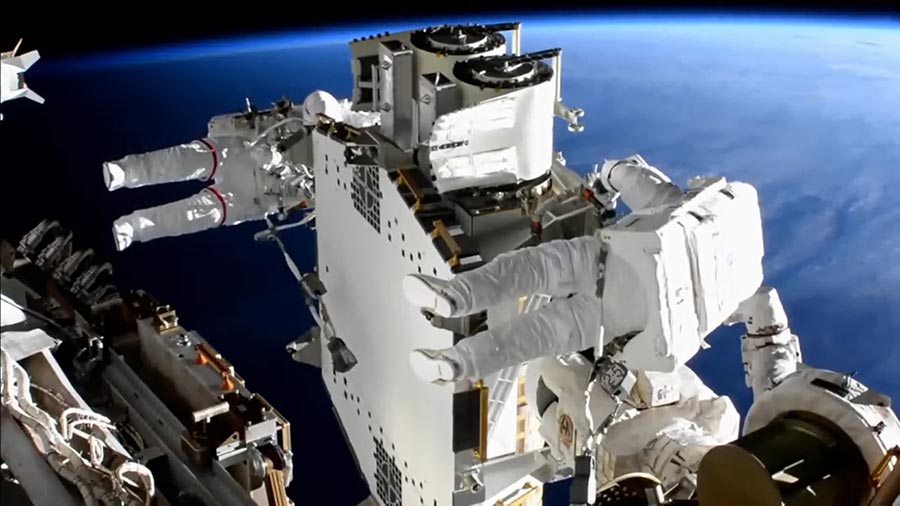
    Spacewalkers Prepare Roll Out Solar Array
    Spacewalkers Shane Kimbrough (foreground) and Thomas Pesquet work to prepare the second roll out solar array ready for installation an upcoming spacewalk. Credit: NASA

    NASA astronaut Shane Kimbrough and ESA (European Space Agency) astronaut Thomas Pesquet concluded their spacewalk at 2:10 p.m. EDT, after 6 hours and 28 minutes. In the eighth spacewalk of the year outside the International Space Station, the two astronauts completed the deployment of a new ISS Roll-Out Solar Array (iROSA) on the far end of the left (port) side of the station’s backbone truss structure (P6).

    Kimbrough and Pesquet successfully unfolded the solar array, bolted it into place, and connected cables to the station’s power supply to complete deployment. Additionally, the astronauts removed and stowed hardware in preparation for releasing the second iROSA from the flight support structure for installation. The pair will work toward the second solar array upgrade – this one on the P6 truss’ 4B power channel – during another spacewalk, tentatively scheduled for June 25.
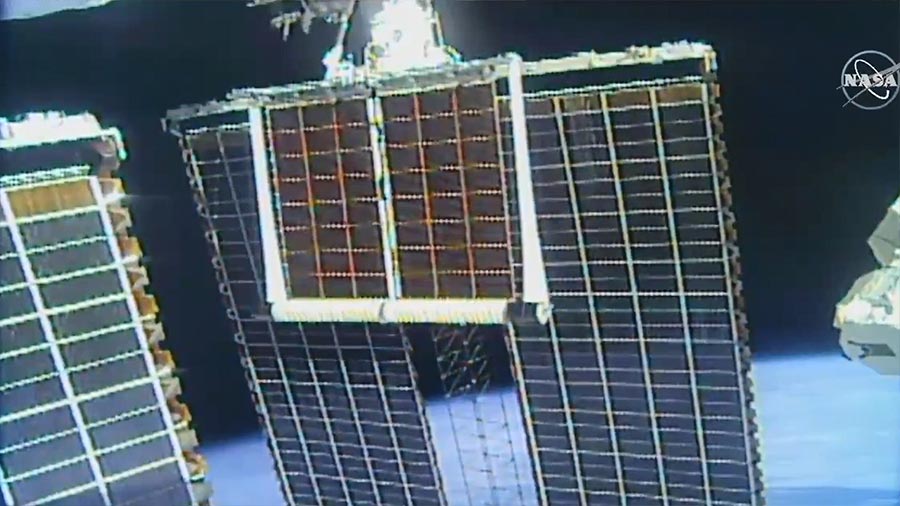
    Roll Out Solar Arrays
    The 60-foot-long roll out solar arrays are seen deploying as the space station soared over the United States in a process that took about 6 minutes. Credit: NASA

    NASA is augmenting six of the eight existing power channels of the space station with new solar arrays to ensure a sufficient power supply is maintained for NASA’s exploration technology demonstrations for Artemis and beyond as well as utilization and commercialization.

    The new solar arrays are being positioned in front of current arrays, which are functioning well but have begun to show signs of expected degradation as they have operated beyond their designed 15-year service life. The first pair of legacy solar arrays were deployed in December 2000 and have been powering the station for more than 20 years.

    The new solar array is positioned in front of the current solar array on the same plane and rotary joints, but not directly on top of the primary solar arrays. The new arrays are 60 feet long by 20 feet wide (18.2 meters by 6 meters) and will shade a little more than half of the original array, which is 112 feet (34 meters) long by 39 feet (12 meters) wide. Each new iROSA will produce more than 20 kilowatts of electricity, while the current arrays generate, on average, 17 to 23 kilowatts each.
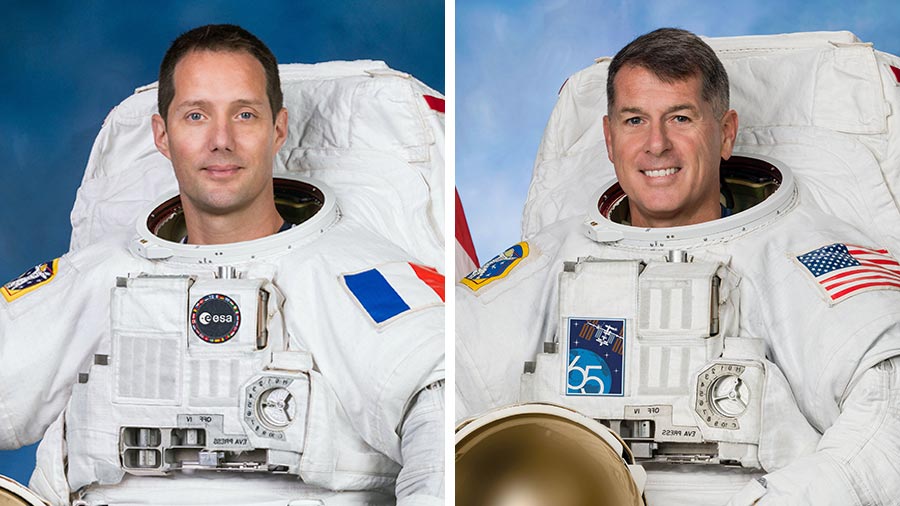
    Thomas Pesquet and Shane Kimbrough
    Veteran astronauts (from left) Thomas Pesquet and Shane Kimbrough are conducting their fourth spacewalk together today. Their first two spacewalks together were during Expedition 50 on 2017. Credit: NASA

    This was the eighth spacewalk for Kimbrough, the fourth for Pesquet, and the fourth they have conducted together. Kimbrough has now spent a total of 52 hours and 43 minutes spacewalking, and Pesquet’s total spacewalking time is 26 hours and 15 minutes.

    Boeing, NASA’s prime contractor for space station operations, its subsidiary Spectrolab, and major supplier Deployable Space Systems (DSS) provided the new arrays. The technology was developed and proven by NASA’s Space Technology Mission Directorate during a demonstration on the space station in 2017, and the same solar array design will be used to power elements of the agency’s Gateway lunar outpost.

    Space station crew members have conducted 240 spacewalks in support of assembly and maintenance of the orbiting laboratory. Spacewalkers have now spent a total of 63 days and 56 minutes working outside the station.

    In November 2020, the International Space Station surpassed its 20-year milestone of continuous human presence, providing opportunities for unique research and technological demonstrations that help prepare for long-duration missions to the Moon and Mars and also improve life on Earth. In that time, 244 people from 19 countries have visited the orbiting laboratory that has hosted nearly 3,000 research investigations from researchers in 108 countries and areas.

    Never miss a breakthrough: Join the SciTechDaily newsletter.
    Follow us on Google and Google News.

    Astronaut International Space Station NASA Popular
    Share. Facebook Twitter Pinterest LinkedIn Email Reddit

    Related Articles

    Safe on Earth! NASA’s SpaceX Crew-5 Splash Down Near Florida Coast

    Incredible Image of NASA Astronaut Nicole Mann Refracted Through a Sphere of Water Flying Weightlessly in Microgravity

    Russia Sending Spacecraft To Rescue Crew From ISS After Damaged Soyuz Ruled “Not Viable”

    Splashdown! NASA’s SpaceX Crew-4 Safely Returns to Earth

    NASA’s SpaceX Crew-5 Picture-Perfect Launch to International Space Station

    Splashdown! NASA SpaceX Crew-3 Astronauts Safely Return to Earth

    LIFTOFF! NASA SpaceX Crew-4 Astronauts Begin Their Journey to the Space Station

    Axiom Mission 1 Private Astronaut Crew Safely Splashes Down Near Florida

    Dragon Endeavour Departs Space Station – Axiom Astronauts Finally Returning to Earth

    1 Comment

    1. JY on June 21, 2021 7:41 pm

      They fixed that Fin in a swimming pool..lmbo CGI…nothing but liars

      Reply
    Leave A Reply Cancel Reply

    • Facebook
    • Twitter
    • Pinterest
    • YouTube

    Don't Miss a Discovery

    Subscribe for the Latest in Science & Tech!

    Trending News

    First-of-Its-Kind Discovery: Homer’s Iliad Found Embedded in a 1,600-Year-Old Egyptian Mummy

    Beyond Inflammation: Scientists Uncover New Cause of Persistent Rheumatoid Arthritis

    A Simple Molecule Could Unlock Safer, Easier Weight Loss

    Scientists Just Built a Quantum Battery That Charges Almost Instantly

    Researchers Unveil Groundbreaking Sustainable Solution to Vitamin B12 Deficiency

    Millions of People Have Osteopenia Without Realizing It – Here’s What You Need To Know

    Researchers Discover Boosting a Single Protein Helps the Brain Fight Alzheimer’s

    World-First Study Reveals Human Hearts Can Regenerate After a Heart Attack

    Follow SciTechDaily
    • Facebook
    • Twitter
    • YouTube
    • Pinterest
    • Newsletter
    • RSS
    SciTech News
    • Biology News
    • Chemistry News
    • Earth News
    • Health News
    • Physics News
    • Science News
    • Space News
    • Technology News
    Recent Posts
    • Stone Age Mystery: DNA Reveals Ancient Population Wipeout in France
    • Why Did the Neanderthals Disappear? Scientists Reveal Humans Had a Hidden Advantage
    • Unusually Warm Water Detected Creeping Toward Antarctica – and Scientists Are Alarmed
    • Scientists Uncover Hidden Property of Light That Twists Matter Sideways
    • Artemis II Just Proved NASA Is Closer Than Ever to Returning to the Moon
    Copyright © 1998 - 2026 SciTechDaily. All Rights Reserved.
    • Science News
    • About
    • Contact
    • Editorial Board
    • Privacy Policy
    • Terms of Use

    Type above and press Enter to search. Press Esc to cancel.