
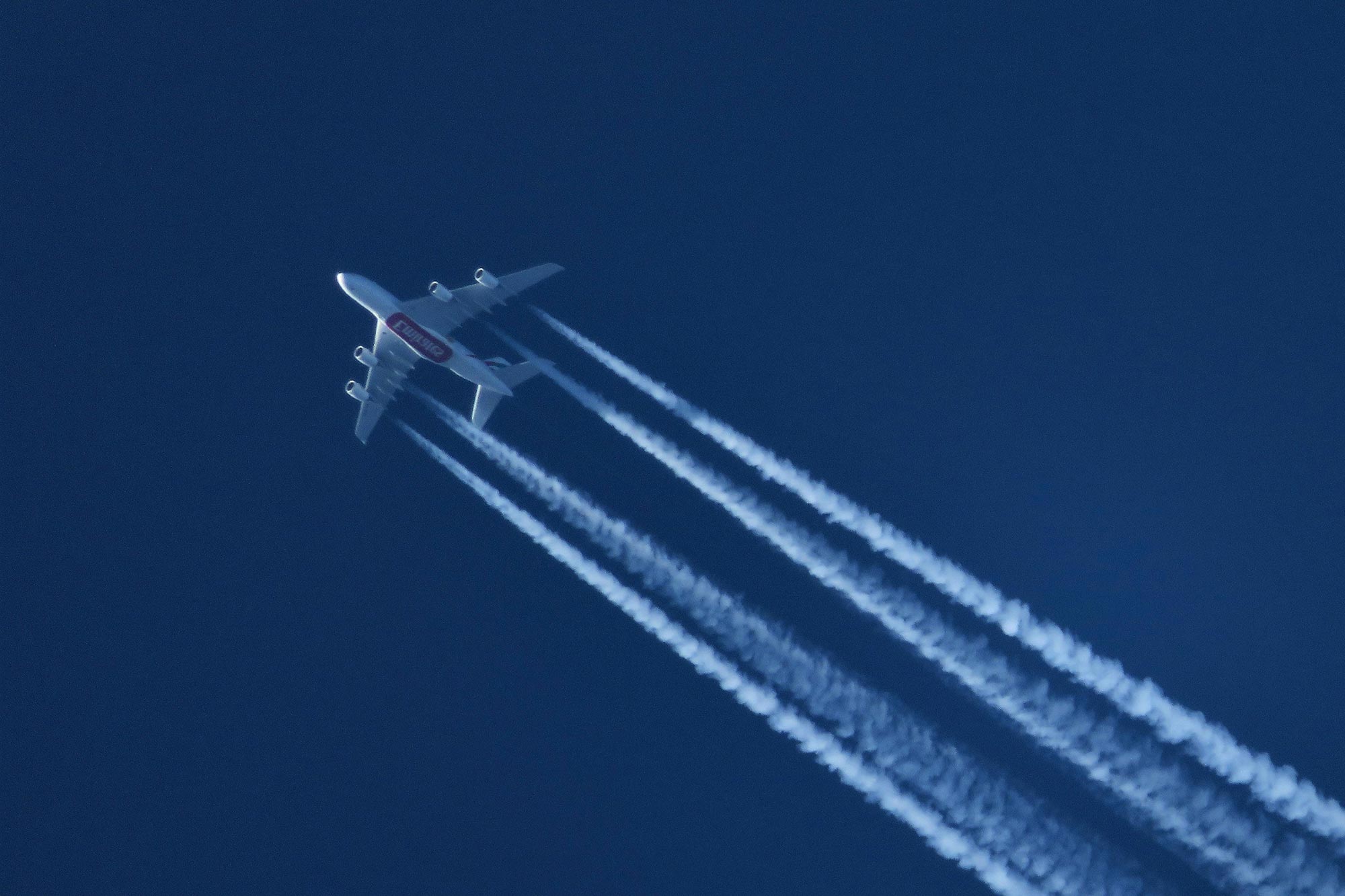
Small airplane altitude changes could cut contrail impact of flights by up to 59 percent.
Aircraft contrails – the white streaks aircraft leave in the sky – could be as bad for the climate as their carbon dioxide (CO2) emissions. Now, Imperial College London-led research has found that flight altitude changes of just 2,000 feet could lessen their effect.
“This new method could very quickly help to reduce the overall climate impact of the aviation industry.” Dr. Marc Stettler
This, the researchers say, combined with using cleaner aircraft engines, could reduce contrail-caused harm to the climate by up to 90 percent.
Lead author Dr. Marc Stettler, of Imperial’s Department of Civil and Environmental Engineering, said: “According to our study, changing the altitude of a small number of flights could significantly reduce the climate effects of aviation contrails. This new method could very quickly reduce the overall climate impact of the aviation industry.”
The research was published in Environmental Science & Technology on February 12, 2020.
Contrail conundrum
When hot exhaust gases from aircraft meet the cold, low-pressure air of the atmosphere, they produce white streaks in the sky called ‘condensation trails’, or contrails.
The contrail fumes include black carbon particles, which provide surfaces on which moisture condenses to form ice particles. We see this condensation as fluffy white streaks.
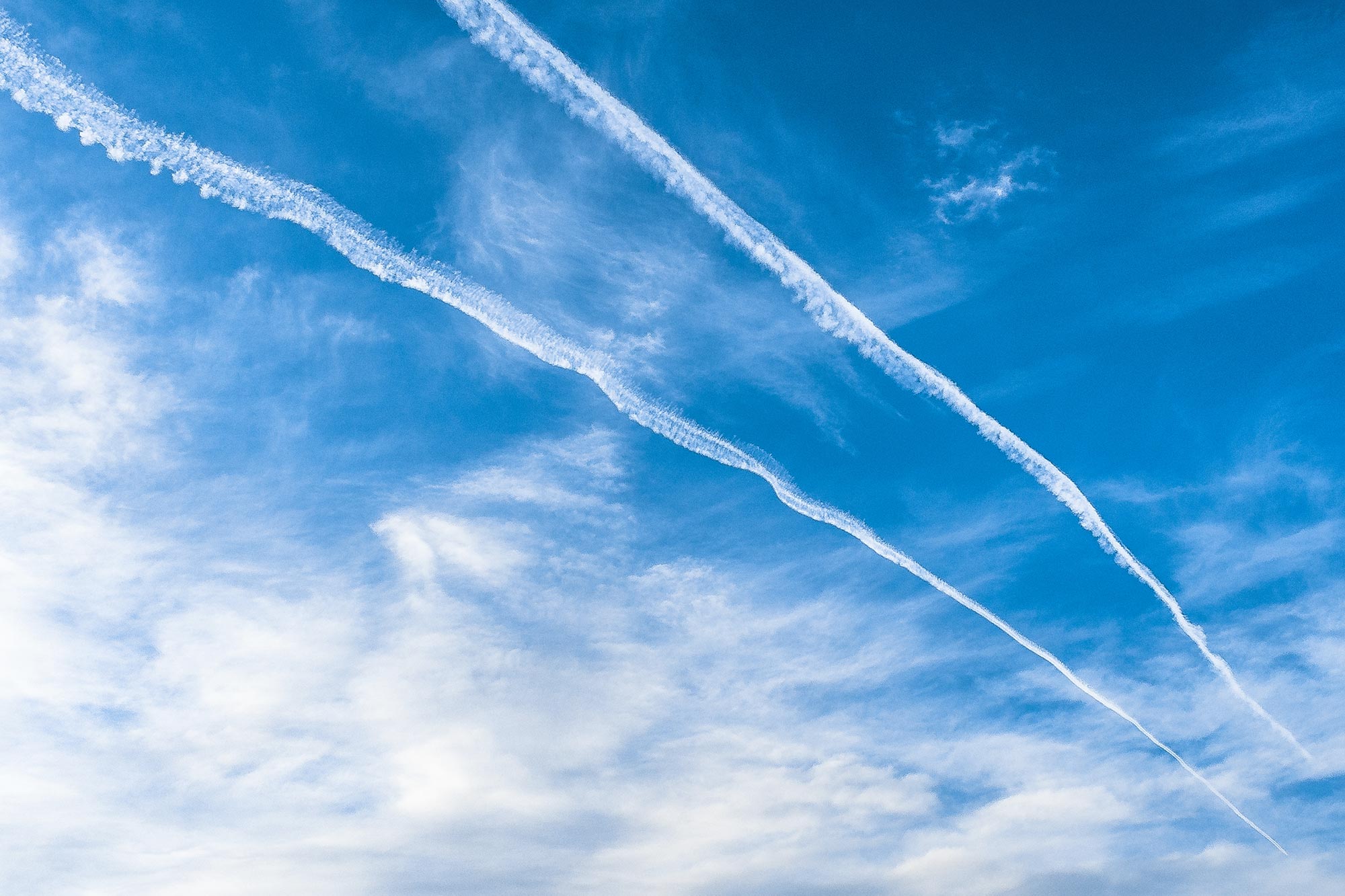
Most contrails last only a few minutes, but some spread and mix with other contrails and cirrus clouds, forming ‘contrail cirrus’ that linger for up to eighteen hours.
Previous research suggests that contrails and the clouds they help form have as much of a warming impact on the climate as aviation’s cumulative CO2 emissions, because of an effect known as ‘radiative forcing’. This is where the balance is disrupted between radiation coming to earth from the sun and heat emitted from the surface of the earth going out to space, forcing a change in the climate.
The key difference between CO2 and contrails, however, is that while CO2 will have an impact in the atmosphere for hundreds of years, the impact of contrails is short-lived and could therefore quickly be reduced.
Now, Dr. Stettler and colleagues have used computer simulations to predict how altering aircraft altitudes might reduce the number of contrails and how long they linger, which would reduce their warming impact. This is because contrails only form and persist in thin layers of the atmosphere that have very high humidity. Because these layers are thin, small changes to flight altitudes would mean that aircraft could avoid these regions, leading to fewer contrails forming.
Using data from Japan’s airspace, they found that just two percent of flights were responsible for 80 percent of radiation forcing within the airspace. Dr. Stettler said: “A really small proportion of flights are responsible for the vast majority of contrail climate impact, meaning we can focus our attention on them.”
Taking into account the congestion in the airspace above Japan, the team simulated these planes to fly either 2,000 feet higher or lower than their actual flight paths and found that the contrail climate forcing could be cut by 59 percent by altering the altitudes of 1.7 percent of flights.

The diversion in flight paths caused less than a tenth of a percent increase in fuel consumption – but, the researchers say, the reduced contrail formation more than offset the CO2 released by the extra fuel.
Dr. Stettler suggests that their method of targeting only the few flights that cause the most climate forcing is the best way to avoid hikes in CO2 emissions. He said: “We’re conscious that any additional CO2 released into the atmosphere will have a climate impact stretching centuries into the future, so we’ve also calculated that if we only target flights that wouldn’t emit extra CO2, we can still achieve a 20 percent reduction in contrail forcing.”
The study’s first author, Roger Teoh, also of Imperial’s Department of Civil and Environmental Engineering, said: “Our simulation shows that targeting the few flights that cause the most harmful contrails, as well as making only small altitude changes, could significantly reduce the effect of contrails on global warming.”
Industry impact
The researchers say aircraft engines themselves also play a part in how harmful contrails are. Black carbon particles are produced by incomplete fuel combustion, so new, more efficient engine combustion technology could help to reduce them by around 70 percent.
“Targeting the few flights that cause the most harmful contrails, as well as making only small altitude changes, could significantly reduce the effect of contrails on global warming.” Roger Teoh
This, combined with small altitude changes, could help reduce overall contrail harm by around 90 percent.
Next, the researchers will refine their simulations to more accurately predict the characteristics and impact of contrails, and to evaluate the wider effects and practicalities of contrail mitigation strategies such as altering flight paths.
Reference: “Mitigating the Climate Forcing of Aircraft Contrails by Small-Scale Diversions and Technology Adoption” by Roger Teoh, Ulrich Schumann, Arnab Majumdar and Marc E. J. Stettler, 12 February 2020, Environmental Science & Technology.
DOI: 10.1021/acs.est.9b05608
Flight data was obtained from the Electronic Navigation Research Institute, Japan.
Never miss a breakthrough: Join the SciTechDaily newsletter.
Follow us on Google and Google News.
6 Comments
ARE YOU SERIOUSSSSSSSSSSSSSSSSSSSSSSSSSSSS?
When I was young there were NEVER cloud formations from jets – EVER!
We NEVER see the BLUE SKIES we saw in the 60s!
From your comment it appears you are now only 13 year old.
shutup
Totally agree. Old enough to recall clear skies or beautiful cumulus clouds not ones resulting from contrails.
These planes are spraying poison. The bought and paid for scientists job is to discredit that.
Lol! Moronic sheeple.