
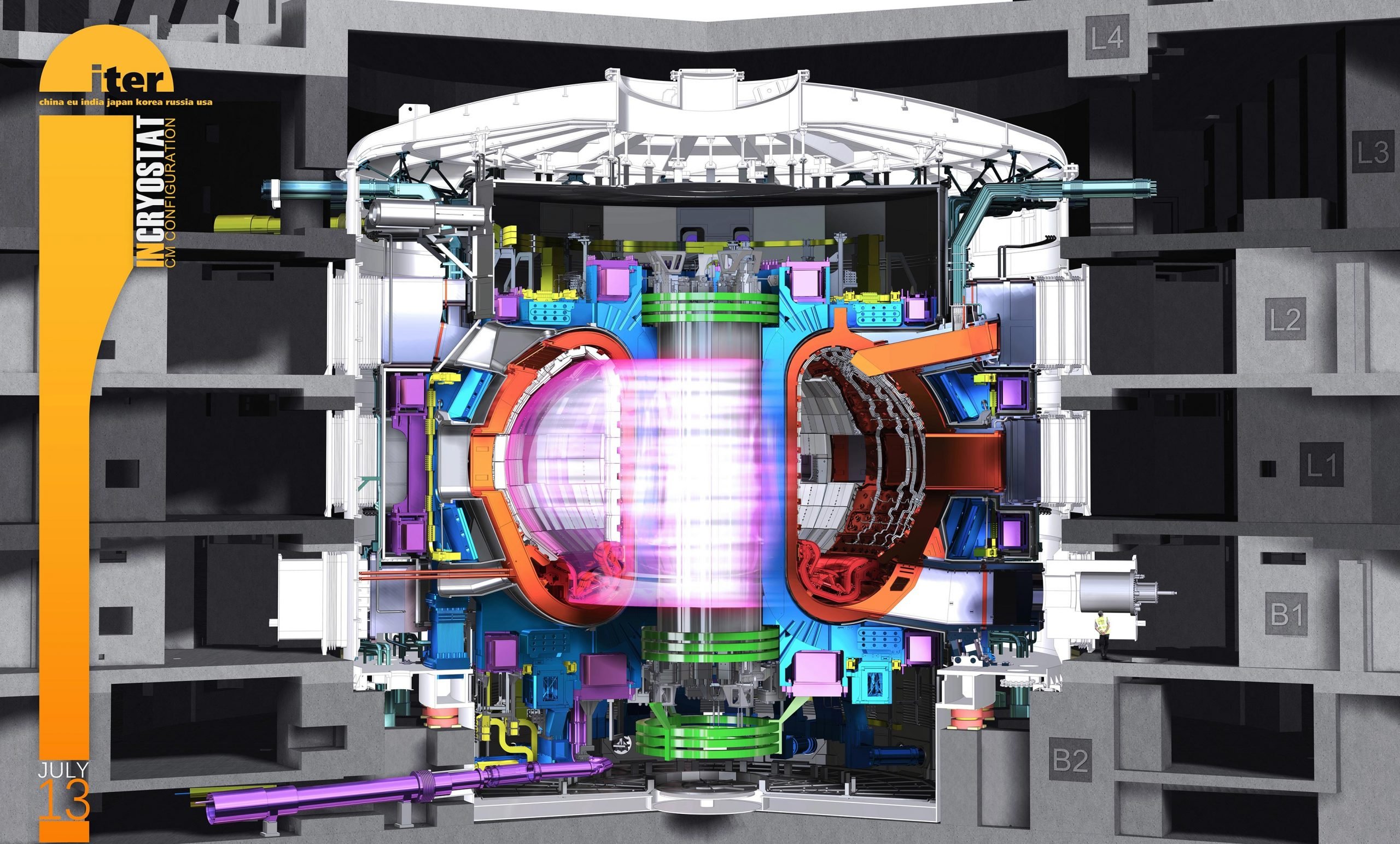
In a breakthrough for sustainable energy, the international ITER project has completed the components for the world’s largest superconducting magnet system, designed to confine a superheated plasma and generate ten times more energy than it consumes.
This “electromagnetic heart” of the Tokamak, created through cooperation among 30+ nations, is a triumph of both science and diplomacy.
ITER Achieves Milestone
In a major leap toward clean energy, the international ITER project has finished building the world’s largest and most powerful pulsed superconducting magnet system, designed to help unlock the same kind of energy that powers the sun.
ITER (pronounced “eater”) is a massive collaboration between more than 30 countries, all working together to prove that fusion energy can be a safe, limitless, and carbon-free power source for the planet.
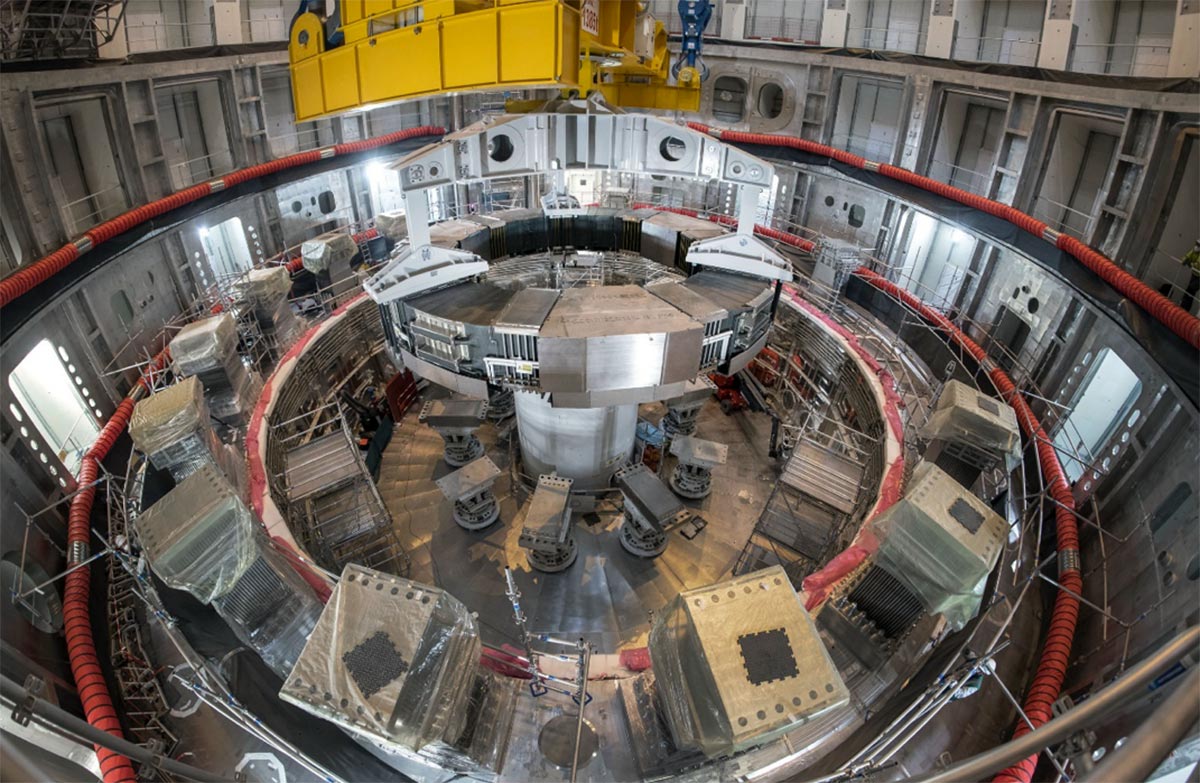
The final piece of the puzzle, a towering Central Solenoid magnet built and tested in the United States, is strong enough to lift an aircraft carrier. Once installed at the ITER facility in southern France, it will serve as the powerhouse of the fusion reactor, working alongside six giant ring-shaped magnets from Russia, Europe, and China.
Altogether, the magnet system will weigh nearly 3,000 tons. It forms the electromagnetic heart of ITER’s Tokamak, a futuristic, donut-shaped reactor that aims to replicate the energy of the stars here on Earth.
How Does This Pulsed Superconducting Electromagnet System Work?
Step 1. A few grams of hydrogen fuel—deuterium and tritium gas—are injected into ITER’s gigantic Tokamak chamber.
Step 2. The pulsed magnet system sends an electrical current to ionize the hydrogen gas, creating a plasma, a cloud of charged particles.
Step 3. The magnets create an “invisible cage” that confines and shapes the ionized plasma.
Step 4. External heating systems raise the plasma temperature to 150 million degrees Celsius, ten times hotter than the core of the sun.
Step 5. At this temperature, the atomic nuclei of plasma particles combine and fuse, releasing massive heat energy.

Fusion’s Massive Energy Payoff
At full operation, ITER is expected to produce 500 megawatts of fusion power from only 50 megawatts of input heating power, a tenfold gain. At this level of efficiency, the fusion reaction largely self-heats, becoming a “burning plasma.”
By integrating all the systems needed for fusion at industrial scale, ITER is serving as a massive, complex research laboratory for its 30-plus member countries, providing the knowledge and data needed to optimize commercial fusion power.
A Symbol of Global Unity
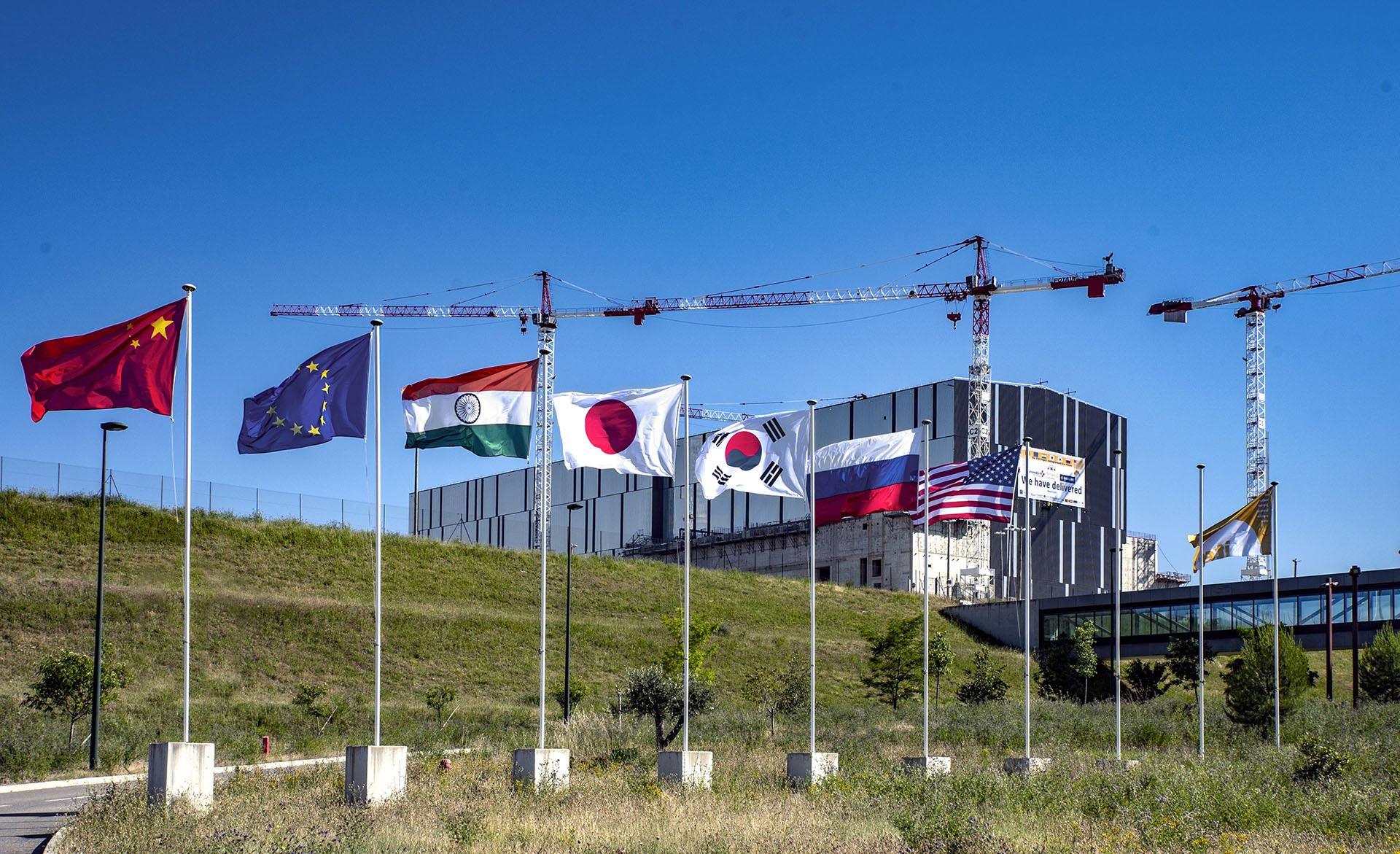
ITER’s geopolitical achievement is also remarkable: the sustained collaboration of ITER’s seven members—China, Europe, India, Japan, Korea, Russia, and the United States. Thousands of scientists and engineers have contributed components from hundreds of factories on three continents to build a single machine.
Pietro Barabaschi, ITER Director-General, says, “What makes ITER unique is not only its technical complexity but the framework of international cooperation that has sustained it through changing political landscapes.”
“This achievement proves that when humanity faces existential challenges like climate change and energy security, we can overcome national differences to advance solutions.”
“The ITER Project is the embodiment of hope. With ITER, we show that a sustainable energy future and a peaceful path forward are possible.”
Strategic Knowledge Transfer Initiatives
In 2024, ITER reached 100 percent of its construction targets. With most of the major components delivered, the ITER Tokamak is now in assembly phase. In April 2025, the first vacuum vessel sector module was inserted into the Tokamak Pit, about 3 weeks ahead of schedule.
Extending collaboration to the private sector
The past five years have witnessed a surge in private sector investment in fusion energy R&D. In November 2023, the ITER Council recognized the value and opportunity represented by this trend.
They encouraged the ITER Organization and its Domestic Agencies to actively engage with the private sector, to transfer ITER’s accumulated knowledge to accelerate progress toward making fusion a reality.
In 2024, ITER launched a private sector fusion engagement project, with multiple channels for sharing knowledge, documentation, data, and expertise, as well as collaboration on R&D. This tech transfer initiative includes sharing information on ITER’s global fusion supply chain, another way to return value to Member governments and their companies.
In April 2025, ITER hosted a public-private workshop to collaborate on the best technological innovation to solve fusion’s remaining challenges.
The ITER experiment under construction in southern France. The tokamak building is the mirrored structure at center. Courtesy ITER Organization/EJF Riche.
Coordinated Contributions From Member Nations
Under the ITER Agreement, Members contribute most of the cost of building ITER in the form of building and supplying components. This arrangement means that financing from each Member goes primarily to their own companies, to manufacture ITER’s challenging technology. In doing so, these companies also drive innovation and gain expertise, creating a global fusion supply chain.
Europe, as the Host Member, contributes 45 percent of the cost of the ITER Tokamak and its support systems. China, India, Japan, Korea, Russia, and the United States each contribute 9 percent, but all Members get access to 100 percent of the intellectual property.
United States
The United States has built the Central Solenoid, made of six modules, plus a spare.
The U.S. has also delivered to ITER the “exoskeleton” support structure that will enable the Central Solenoid to withstand the extreme forces it will generate. The exoskeleton is comprised of more than 9,000 individual parts, manufactured by eight U.S. suppliers.
Additionally, the U.S. has fabricated about 8 percent of the Niobium-Tin (Nb3Sn) superconductors used in ITER’s Toroidal Field magnets.
Russia
Russia has delivered the 9-meter-diameter ring-shaped Poloidal Field magnet that will crown the top of the ITER Tokamak.
Working closely with Europe, Russia has also produced approximately 120 tonnes of Niobium-Titanium (NbTi) superconductors, comprising about 40 percent of the total required for ITER’s Poloidal Field magnets.
Additionally, Russia has produced about 20 percent of the Niobium-Tin (Nb3Sn) superconductors for ITER’s Toroidal Field magnets.
And Russia has manufactured the giant busbars that will deliver power to the magnets at the required voltage and amperage, as well as the upper port plugs for ITER’s vacuum vessel sectors.
Europe
Europe has manufactured four of the ring-shaped Poloidal Field magnets onsite in France, ranging from 17 to 24 meters in diameter.
Europe has worked closely with Russia to manufacture the Niobium-Titanium (NbTi) superconductors used in PF magnets 1 and 6.
Europe has also delivered 10 of ITER’s Toroidal Field magnets and has produced a substantial portion of the Niobium-Tin (Nb3Sn) superconductors used in these TF magnets.
And Europe is creating five of the nine sectors of the Tokamak vacuum vessel, the donut-shaped chamber where fusion will take place.
China
China, under an arrangement with Europe, has manufactured a 10-metre Poloidal Field magnet. It has already been installed at the bottom of the partially assembled ITER Tokamak.
China has also contributed the Niobium-Titanium (NbTi) superconductors for PF magnets 2, 3, 4, and 5, about 65 percent of the PF magnet total—plus about 8 percent of the Toroidal Field magnet superconductors.
Additionally, China is contributing 18 superconducting Correction Coil magnets, positioned around the Tokamak to fine-tune the plasma reactions.
China has delivered the 31 magnet feeders, the multi-lane thruways that will deliver the electricity to power ITER’s electromagnets as well as the liquid helium to cool the magnets to -269 degrees Celsius, the temperature needed for superconductivity.
Japan
Japan has produced and sent to the United States the 43 kilometers of Niobium-Tin (Nb3Sn) superconductor strand that was used to create the Central Solenoid modules.
Japan has also produced 8 of the 18 Toroidal Field (TF) magnets, plus a spare—as well as all the casing structures for the TF magnets.
Japan also produced 25 percent of the Niobium-Tin (Nb3Sn) superconductors that went into the Toroidal Field magnets.
Korea
Korea has produced the tooling used to pre-assemble ITER’s largest components, enabling ITER to fit the Toroidal Field coils and thermal shields to the vacuum vessel sectors with millimetric precision.
Korea has also manufactured 20 percent of the Niobium-Tin (Nb3Sn) superconductors for the Toroidal Field magnets.
Additionally, Korea has manufactured the thermal shields that provide a physical barrier between the ultra-hot fusion plasma and the ultra-cold magnets.
And Korea has delivered four of the nine sectors of the Tokamak vacuum vessel.
India
India has fabricated the ITER Cryostat, the 30-metre high, 30-metre diameter thermos that houses the entire ITER Tokamak.
India has also provided the cryolines that distribute the liquid helium to cool ITER’s magnets.
Additionally, India has been responsible for delivering ITER’s cooling water system, the in-wall shielding of the Tokamak, and multiple parts of the external plasma heating systems.
In total, ITER’s magnet systems will comprise 10,000 tons of superconducting magnets, with a combined stored magnetic energy of 51 Gigajoules. The raw material to fabricate these magnets consisted of more than 100,000 kilometers of superconducting strand, fabricated in 9 factories in six countries.
What are the technical specifications for each of ITER’s magnet systems?
Central Solenoid (cylindrical magnet)
Height: 18 meters (59 feet)
Diameter: 4.25 meters (14 feet)
Weight: ~1,000 tonnes
Magnetic field strength: 13 Tesla (280,000 times stronger than the Earth’s magnetic field)
Stored magnetic energy: 6.4 Gigajoules
Will initiate and sustain a plasma current of 15 MA for 300-500 second pulses
Fabricated in the United States
Material: Niobium-tin (Nb₃Sn) superconducting strand produced in Japan
Cooling: operated at 4.5 Kelvin (-269°C) using liquid helium cryogenics to maintain superconductivity
Structure (exoskeleton): built to withstand 100 MN (meganewtons) of force—equivalent to twice the thrust of a space shuttle launch.
Poloidal Field Magnets (ring-shaped magnets)
Diameters: varying in range from 9 meters (PF1) to 10 meters (PF6) to 17 meters (PF2, PF5) to 25 meters (PF3, PF4)
Weight: from 160 to 400 tonnes
Fabricated in Russia, Europe (France) and China
Material: niobium-titanium (NbTi) superconducting strand produced in Europe, China, and Russia
Cooling: operated at 4.5 Kelvin (-269°C) using liquid helium cryogenics to maintain superconductivity
Toroidal Field Coils (D-shaped magnets, completed in late 2023)
Each coil: 17 meters high × 9 meters wide
Weight: ~360 tonnes each
Fabricated in Europe (Italy) and Japan
Material: niobium-tin (Nb3Sn) superconducting strand produced in Europe, Korea, Russia, and the United States
Cooling: operated at 4.5 Kelvin (-269°C) using liquid helium to maintain superconductivity
Correction Coils and Magnet Feeders
Correction Coils: manufactured by China; critical for fine plasma stability adjustments.
Magnet Feeders: deliver cryogenics, electrical power, and instrumentation signals to the magnets; also produced by China.
Never miss a breakthrough: Join the SciTechDaily newsletter.
Follow us on Google and Google News.
4 Comments
thank you for this
The magnet was built by General Atomics Corp. in Poway, California.
A hell of a way to boil water! How much has it all cost and how will it effect delivery of electricity to the average punter who has to pay the power bill each month?
The fuel for this type of a reactor comes from sea water. And there is enough fuel there to last us for the lifetime of the sun. The fuel is therefore free. (Power bill has other costs, though – e.g., maintenance)
This energy generation also doesn’t add carbon dioxide to the atmosphere.