
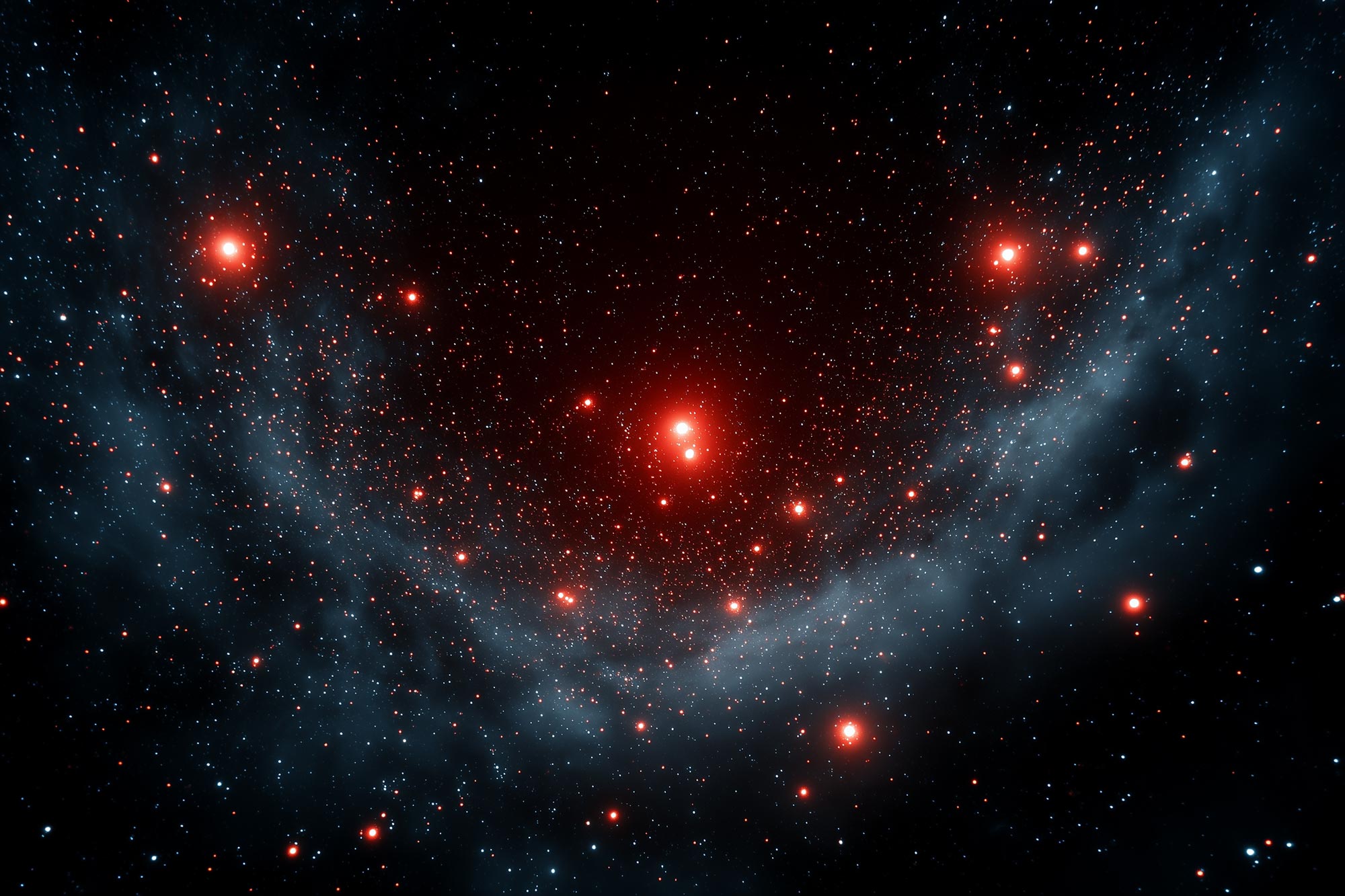
For years, small red points of light in James Webb images puzzled scientists. New research shows they are young black holes buried inside dense gas clouds, glowing as they consume material.
Since the James Webb Space Telescope (JWST) began operating, astronomers have been intrigued by small red points appearing in its images of the distant universe. Scientists at the University of Copenhagen have now identified what these objects are, uncovering evidence of some of the most extreme activity in the cosmos hidden inside clouds of ionized gas. Their results were published in Nature on January 14.
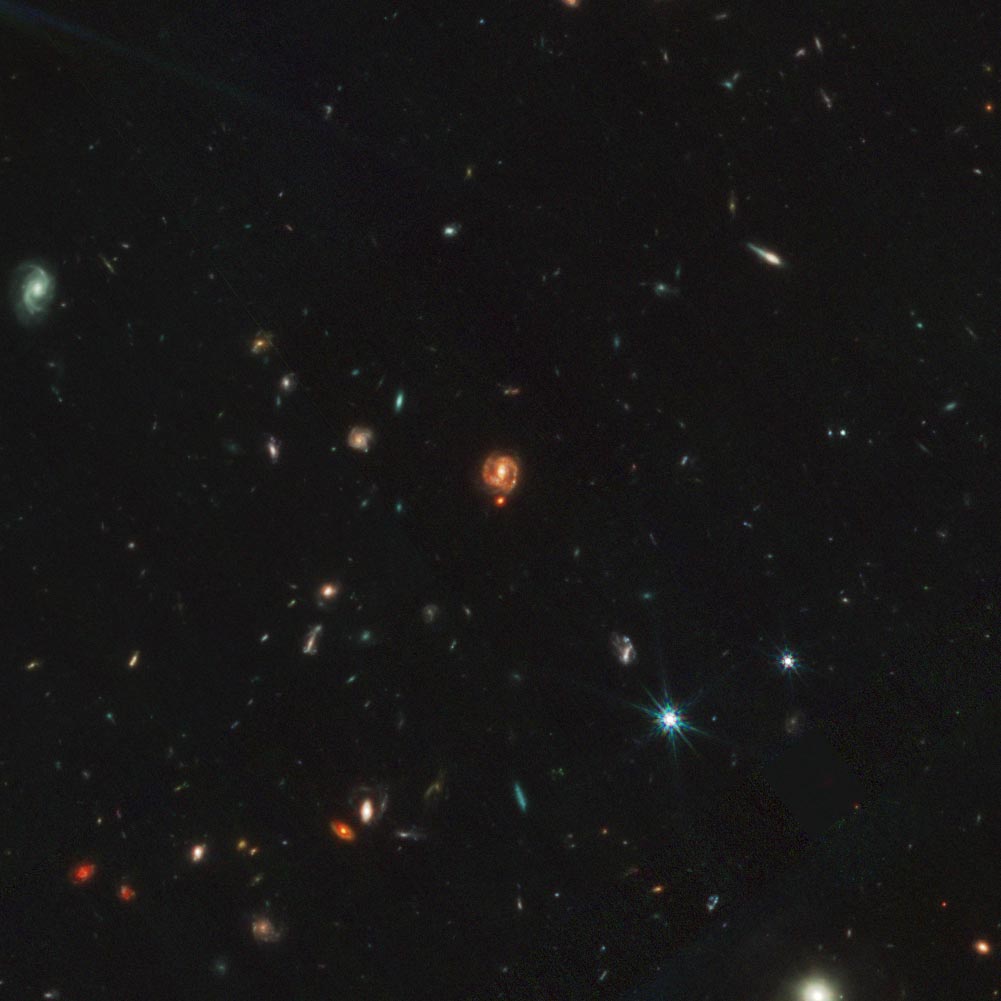
When the James Webb telescope captured its first observations in December 2021 from about 1.5 million kilometers from Earth, researchers quickly noticed something unusual. Mixed among familiar stars and galaxies were faint red dots that did not match anything previously seen in observations of the early universe.
A Puzzle From the Young Universe
These objects, often referred to as “little red dots,” appear at a time when the universe was only a few hundred million years old. About a billion years later, they seem to fade from view entirely. Their brief appearance raised a major question about what kind of objects could shine so brightly and then disappear.
One proposed explanation suggested they were extremely large galaxies that James Webb was able to detect across roughly 13 billion years of cosmic history. However, that idea conflicted with current understanding of how galaxies evolve. Such massive galaxies are thought to have formed much later after the Big Bang, making this scenario unlikely.
Black Holes Behind the Red Glow
After two years of careful study of Webb images, researchers at the Niels Bohr Institute’s Cosmic Dawn Centre reached a different conclusion. The mysterious red dots are powered by black holes, the most energetic objects known in the universe. These observations provide new insight into how the very first black holes formed.
“The little red dots are young black holes, a hundred times less massive than previously believed, enshrouded in a cocoon of gas, which they are consuming in order to grow larger. This process generates enormous heat, which shines through the cocoon. This radiation through the cocoon is what gives little red dots their unique red color,” says Professor Darach Watson, one of the main researchers behind the study.
‘“They are far less massive than people previously believed, so we do not need to invoke completely new types of events to explain them.”
The importance of the findings placed the Cosmic Dawn Centre team on the front page of Nature, one of the world’s leading scientific journals.

Why Black Holes Are “Messy Eaters”
Astronomers have now identified hundreds of these little red dots, all of which are young black holes. While they rank among the smallest black holes ever observed, they are still enormous, with masses reaching up to 10 million times that of the Sun and diameters of about ten million km.
Black holes grow by pulling in gas and other material from their surroundings. Because the region around a black hole is relatively small, gas falling inward heats up to extreme temperatures and glows intensely. This process releases more energy than almost any other known phenomenon. The powerful radiation pushes much of the incoming material away before it can be swallowed.
“When gas falls towards a black hole, it spirals down into a kind of disk or funnel towards surface of the black hole. It ends up going so fast and is squeezed so densely that it generates temperatures of millions of degrees and lights up brightly. But only a very small amount of the gas is swallowed by the black hole. Most of it is blown back out from the poles as the black hole rotates. That’s why we call black holes ‘messy eaters’,” explains Darach Watson.
Clues to Rapid Black Hole Growth
At the center of the Milky Way sits a supermassive black hole with a mass about four million times greater than the Sun, and similar objects are found in all large galaxies. Despite their prevalence, many details about how black holes form and grow remain unclear.
The new research helps answer one of the biggest questions in astronomy: how supermassive black holes could already exist just 700 million years after the Big Bang, some weighing up to a billion times more than the Sun. By observing these young black holes during a brief but intense growth phase, scientists are seeing a stage that has never been directly observed before.
“We have captured the young black holes in the middle of their growth spurt at a stage that we have not observed before. The dense cocoon of gas around them provides the fuel they need to grow very quickly,” says Darach Watson.
Reference: “Little red dots as young supermassive black holes in dense ionized cocoons” by V. Rusakov, D. Watson, G. P. Nikopoulos, G. Brammer, R. Gottumukkala, T. Harvey, K. E. Heintz, R. Damgaard, S. A. Sim, A. Sneppen, A. P. Vijayan, N. Adams, D. Austin, C. J. Conselice, C. M. Goolsby, S. Toft and J. Witstok, 14 January 2026, Nature.
DOI: 10.1038/s41586-025-09900-4
The study is authored by V. Rusakov, Darach. Watson, G. P. Nikopoulos, Gabriel Brammer, R. Gottumukkala, T. Harvey, Kasper Elm Heintz, R. Damgaard, S. A. Sim, Albert. Sneppen, A. P. Vijayan, N. Adams, D. Austin, C. J. Conselice, C.M. Goolsby, Sune. Toft, J. Witstok.
Never miss a breakthrough: Join the SciTechDaily newsletter.
Follow us on Google and Google News.
3 Comments
The whole of our cosmology depends on the single assumption that light follows a straight line path. The possibility of a closed path having a very slight curvature caused by gravity has never been considered.
As a layman doing research in theoretical physics, I propose that light follows a closed path having a radius of curvature approximately 2.25 billion light years.
So, light rays are convergent and light from distant objects are magnified millions of times compared to straight line path.
So, the little red dots are earliest galaxies which are only as bright as the present day galaxies.
May I ask, how are you thinking 2.25 Billion light years?
Well, light probably does go in circles but not because of gravity