
Close Menu
    Facebook X (Twitter) Instagram
    SciTechDaily
    • Biology
    • Chemistry
    • Earth
    • Health
    • Physics
    • Science
    • Space
    • Technology
    Facebook X (Twitter) Pinterest YouTube RSS
    SciTechDaily
    Home»Chemistry»Japanese Chemists Have Synthesized Unique Polymers With an Unprecedented Structure
    Chemistry

    Japanese Chemists Have Synthesized Unique Polymers With an Unprecedented Structure

    By Ehime UniversityJanuary 18, 20253 Comments3 Mins Read
    Facebook Twitter Pinterest Telegram LinkedIn WhatsApp Email Reddit
    Share
    Facebook Twitter LinkedIn Pinterest Telegram Email Reddit
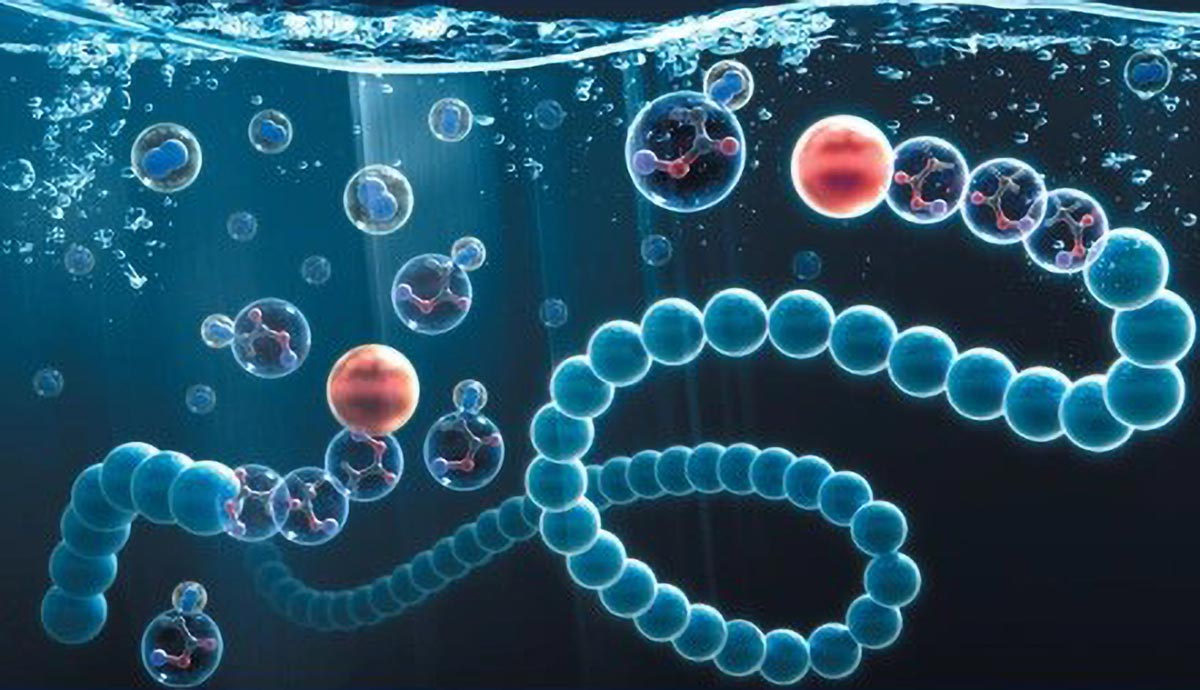
    C1 Polymer Formation
    This illustration shows the C1 polymer formation, where the Pd-catalyst (red spere) is linearly combining a number of diazoacetate monomers (transparent sphere) to form the polymer main chain. Credit: Springer Nature

    The development of polymer synthesis methods utilizing diazocarbonyl compounds as monomers.

    For over 20 years, the Ihara research group at Ehime University has specialized in developing innovative methods for polymer synthesis using diazocarbonyl compounds as monomers.

    They discovered that diazoacetate can be polymerized using a palladium (Pd)-based initiator to produce carbon–carbon (C–C) main-chain polymers, with each carbon atom in the backbone bonded to an alkoxycarbonyl (ester) group. Unlike traditional vinyl polymerization—where the polymer backbone is built from two-carbon units of vinyl monomers like ethylene and styrene—diazoacetate polymerization creates the C–C main chain from single-carbon units. This unique process, known as C1 polymerization, is a distinctive and significant feature of this synthesis method.
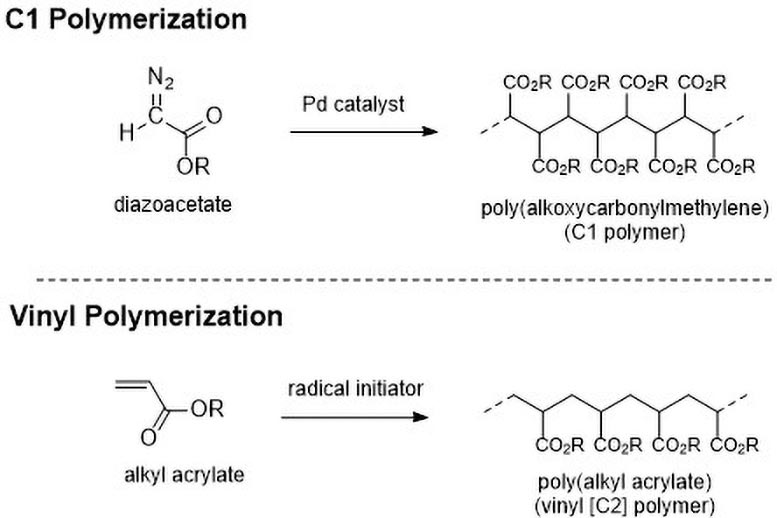
    C1 Polymerization of Diazoacetate and Vinyl Polymerization of Alkyl Acrylate

    While the product of vinyl polymerization of alkyl acrylate has the substituent on every other main chain carbon atom, the product of C1 polymerization has the same substituent on every main chain carbon atom. The structural difference is expected to bring about unique physical properties and functionalities for the latter products. Credit: Eiji IharaThe products of C1 polymerization are expected to possess enhanced physical properties and functionalities. Following the first publication on this C1 polymerization project (E. Ihara, et al., Macromolecules, 36, 36 (2003)), intensive efforts have been devoted to this C1 polymerization by many groups around the world.

    Enhanced Properties of C1 Polymers

    A structure of the Pd-based initiators was devised leading to success in improving their activity for C1 polymerization. For example, it is now possible to prepare high molecular weight polymers (molecular weight > 50000), to control the stereo-structure (tacticity) of the C-C main chain, and to quantitatively incorporate a functional group at one end of the polymer chain.

    Examples of Bisdiazocarbonyl Compounds Employed for the Polycondensation
    Utilizing unique reactivities of the diazocarbonyl groups on these compounds, a variety of new polymers with an unprecedented chemical structure have been prepared. Credit: Eiji Ihara

    In addition, utilizing the unique structures of the C1 polymers, success was made in preparing C1 polymers with enhanced acidity and much higher melting points, up to 130 °C, compared to their vinyl polymer counterparts with the same substituents. Also, it was found that the C1 polymers can be effectively degraded into low molecular weight compounds under mildly basic conditions, which is very important considering their potential as environmentally friendly polymeric materials.

    Meanwhile, it was demonstrated that bis(diazocarbonyl) compounds bearing two diazocarbonyl groups in a molecule, can be used as a monomer for polycondensation, yielding a variety of new polymers with an unprecedented chemical structure. For the polycondensation, unique reactivities of diazocarbonyl groups were employed, such as O-H and N-H insertion and C=C bond formation. On the basis of this new polycondensation, it was possible to prepare polymers with facile degradability under mildly acidic conditions and electrochromic properties (reversible color change with the application of voltage in a film state). These results have stimulated research around the world in a similar project following the first publication on this polycondensation project (E. Ihara, et al., Macromolecules, 43, 4589 (2010)).

    Reference: “Development of polymer syntheses using diazocarbonyl compounds as monomers” by Eiji Ihara, 10 October 2024, Polymer Journal.
    DOI: 10.1038/s41428-024-00954-1

    Never miss a breakthrough: Join the SciTechDaily newsletter.
    Follow us on Google and Google News.

    Ehime University Materials Science Polymers
    Share. Facebook Twitter Pinterest LinkedIn Email Reddit

    Related Articles

    Incredible New Polymer Fibers Are Ultra Light and Super Strong

    Scientists Turn Plastic Waste Into Valuable Chemicals With Sunlight

    Forget ‘Super’ Glue, Scientists Develop New ‘Hyper’ Glue

    Material Synthesized That Can Increase/Decrease Volume by 100x Controlled by Electrical Signal

    US Army Synthetic Biology Research Advances Toward New Class of High-Performance Materials

    Unique Particles – With Stickiness of Gecko Feet – Formed by Harnessing Chaos

    Super Durable, Flexible, Water-Repelling Material Inspired by Porcupinefish

    Storing Secret Messages in Light-Sensitive Polymers

    MIT Researchers Develop New Strategy for Stronger Polymers

    3 Comments

    1. Spoorthi on January 21, 2025 7:17 am

      Very good contribution well done inspirational and interesting concept

      Reply
    2. Pharm on January 21, 2025 11:08 pm

      What can it be used for?

      Reply
    3. Spoorthi B E on January 22, 2025 4:37 am

      It’s an amazing dissertation it’s also a great contribution and good idea to upcoming scientists

      Reply
    Leave A Reply Cancel Reply

    • Facebook
    • Twitter
    • Pinterest
    • YouTube

    Don't Miss a Discovery

    Subscribe for the Latest in Science & Tech!

    Trending News

    New Pill Lowers Stubborn Blood Pressure and Protects the Kidneys

    Humans May Have Hidden Regenerative Powers, New Study Suggests

    Scientists Just Solved the Mystery of Why Crabs Walk Sideways

    Doctors Are Surprised by What This Vaccine Is Doing to the Heart

    This Popular Supplement May Boost Your Brain, Not Just Your Muscles

    Scientists Say This Simple Supplement May Actually Reverse Heart Disease

    Warming Oceans Could Trigger a Dangerous Methane Surge

    This Simple Movement Could Be Secretly Cleaning Your Brain

    Follow SciTechDaily
    • Facebook
    • Twitter
    • YouTube
    • Pinterest
    • Newsletter
    • RSS
    SciTech News
    • Biology News
    • Chemistry News
    • Earth News
    • Health News
    • Physics News
    • Science News
    • Space News
    • Technology News
    Recent Posts
    • Researchers Discover Efficient New Way To Split Hydrogen From Water for Energy
    • This Korean Skincare Ingredient Could Help Fight Deadly Superbugs
    • Giant Squid Detected off Western Australia in Stunning Deep-Sea Discovery
    • Popular Sugar-Free Sweetener Linked to Liver Disease, Study Warns
    • Why Weight Loss Isn’t Enough for Everyone at Risk of Diabetes
    Copyright © 1998 - 2026 SciTechDaily. All Rights Reserved.
    • Science News
    • About
    • Contact
    • Editorial Board
    • Privacy Policy
    • Terms of Use

    Type above and press Enter to search. Press Esc to cancel.