
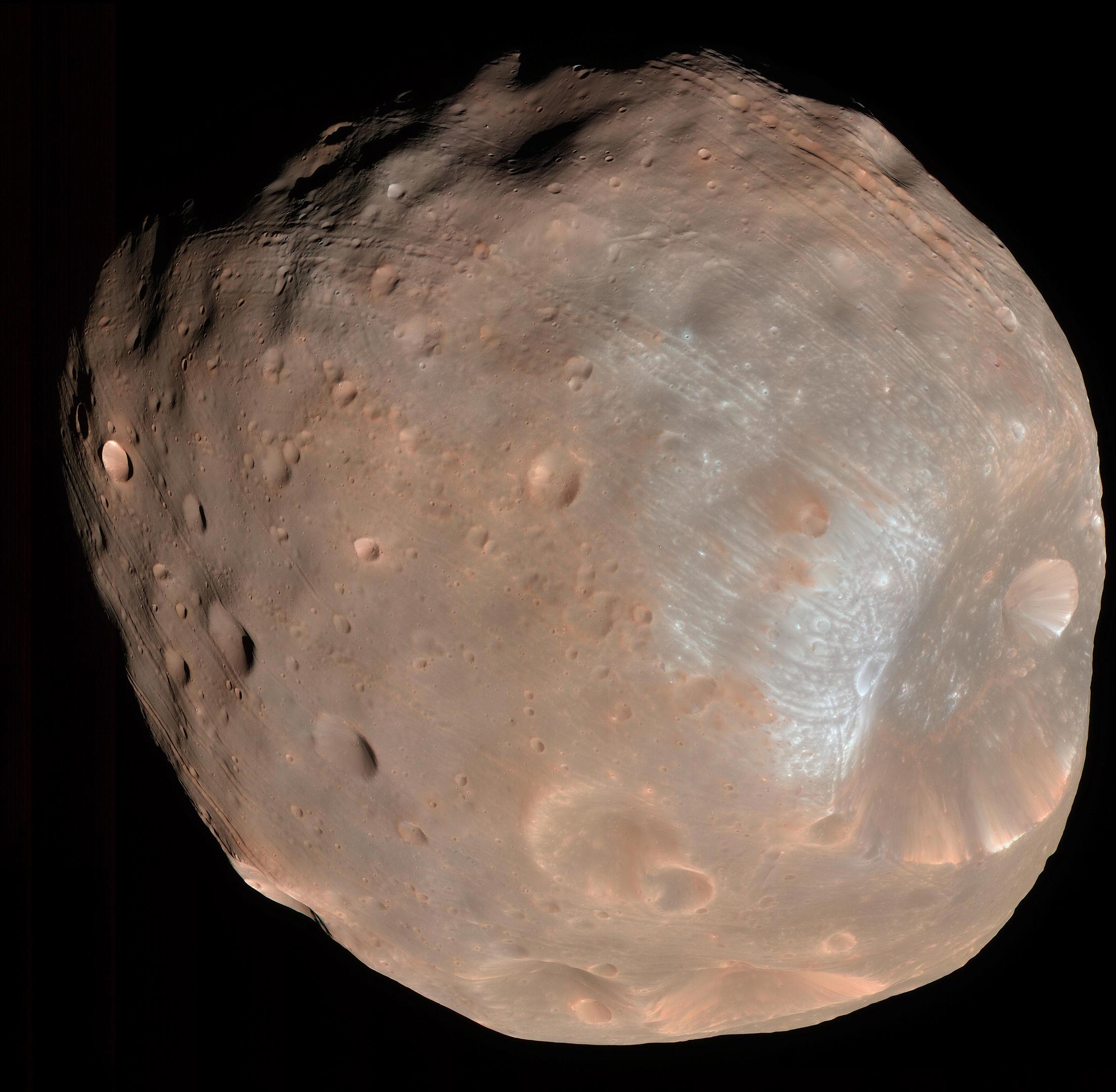
Japan’s MMX mission will collect Phobos soil to study Mars’ history and potential habitability.
Japan’s space agency (JAXA) is gearing up for its Martian Moons eXploration (MMX) mission, with plans to have a sample from Mars’ moon Phobos return to Earth by 2029. Mission scientists say they hope to find clues to the origins of Mars two moons, as well as Mars itself, and possibly even traces of past life.
“We think that the Martian moon, Phobos, is loaded with material lifted from Mars during meteorite impacts,” the MMX team said on Twitter. “By collecting this Phobos sample, MMX will help investigate traces of Martian life and the new era of Martian habitability exploration in the 2020s will begin.”
MMX currently has a planned launch in 2024, with the spacecraft reaching the Mars system by 2025, approximately one year after leaving Earth. Current plans for the mission include an orbiter, a lander that touches down on Phobos with sample collection and return capability, and perhaps even a rover.
A newly released overview of the MMX mission. Credit: JAXA
The orbiter will be placed in a so-called Quasi Satellite Orbit (QSO) around Phobos, to collect scientific data. After both orbital and in situ observations, and sample collection, the lander spacecraft will liftoff to return to Earth carrying the sample of material gathered from Phobos. Current plans are for the lander to collect 10 grams (0.35 ounce) of soil. In a news briefing this week, and reported by the Associated Press, JAXA scientists said that perhaps about 0.1% of the surface soil on Phobos came from Mars, and 10 grams could contain about 30 granules, depending on the consistency of the soil.
The team says their exploration of the Martian moons will help improve technology for future planet and satellite exploration. They say their mission will aid in advancements, for example, in the technology required to make round-trips between the Earth and Mars, enhanced sampling techniques, and optimal communication technology using the Deep Space Network ground stations.
The objectives of the MMX mission are:
- To investigate whether the Martian moons, Phobos and Deimos, are captured asteroids or fragments that coalesced after a giant impact with Mars, and to acquire new knowledge on the formation process of Mars and the terrestrial planets.
- To clarify the mechanisms controlling the surface evolution of the Martian moons and Mars, and to gain new insights into the history of the Mars Sphere, including that of the Martian moons.

Sending a mission to moons of Mars has long been on the wish list for mission planners and space enthusiasts, and for the past few years, JAXA engineers and scientists have been working on putting such a mission together.
Many scientists say that studying and landing on the moons of Mars would be the next best thing to going to Mars itself. Phobos and Deimos have been considered as places for a possible human base that would allow for easier access to Mars than going to the Red Planet directly, especially for the first human missions to the Mars system.
“Humans can realistically explore the surfaces of only a few objects and Phobos and Deimos are on that list,” NASA Chief Scientist, Jim Green said in 2020. “Their position orbiting about Mars may make them a prime target for humans to visit first before reaching the surface of the Red Planet, but that will only be possible after the results of the MMX mission have been completed.”
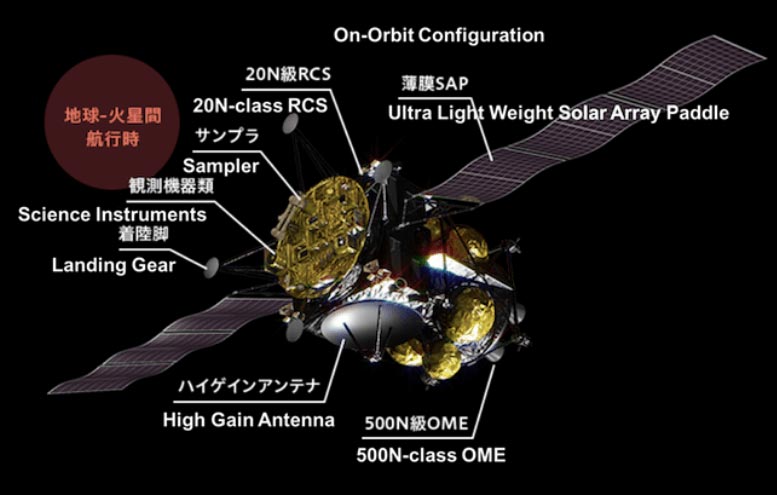
The mission will have international input, equipped with eleven instruments, four of which will be provided by international partners at NASA (USA), ESA (Europe), CNES (France) and DLR (Germany).
The JAXA-built instruments include a telescopic (narrow-angle) camera for observing detailed terrain, the wide-angle camera for identifying hydrated minerals and organic matter, the LIDAR laser altimeter, a dust monitor, and a mass spectrum analyzer, to study the charged ions around the moons, the sampling device and sample return capsule, and a radiation environment monitor.
NASA has signed on to contribute a gamma ray and neutron spectrometer to examine the elements that constitute the Martian moons, and also a pneumatic sampling device. CNES is building a near-infrared spectrometer that can identify mineral composition, and is working with DLR to design the rover, which could explore the surface of Phobos. ESA is listed as assisting with deep space communication equipment.
The quick turnaround time for MMX’s sample return would put Japan ahead of the United States and China in bringing back samples from the Mars system, even though they started later, said MMX project manager Yasuhiro Kawakatsu in this week’s news conference.
A new paper published by JAXA’s Institute of Space and Astronautical Research proposes that if Mars was once a habitable planet, with water on the surface, the water could have been ejected into space by gigantic Martian dust storms. They say that material collected by MMX from Phobos will help confirm if this theory might be true.
Adapted from an article originally published on Universe Today.
Never miss a breakthrough: Join the SciTechDaily newsletter.
Follow us on Google and Google News.