
Close Menu
    Facebook X (Twitter) Instagram
    SciTechDaily
    • Biology
    • Chemistry
    • Earth
    • Health
    • Physics
    • Science
    • Space
    • Technology
    Facebook X (Twitter) Pinterest YouTube RSS
    SciTechDaily
    Home»Space»From Earth to Phobos: MEGANE’s Journey To Decipher Martian Moons
    Space

    From Earth to Phobos: MEGANE’s Journey To Decipher Martian Moons

    By NASAApril 6, 2024No Comments3 Mins Read
    Facebook Twitter Pinterest Telegram LinkedIn WhatsApp Email Reddit
    Share
    Facebook Twitter LinkedIn Pinterest Telegram Email Reddit
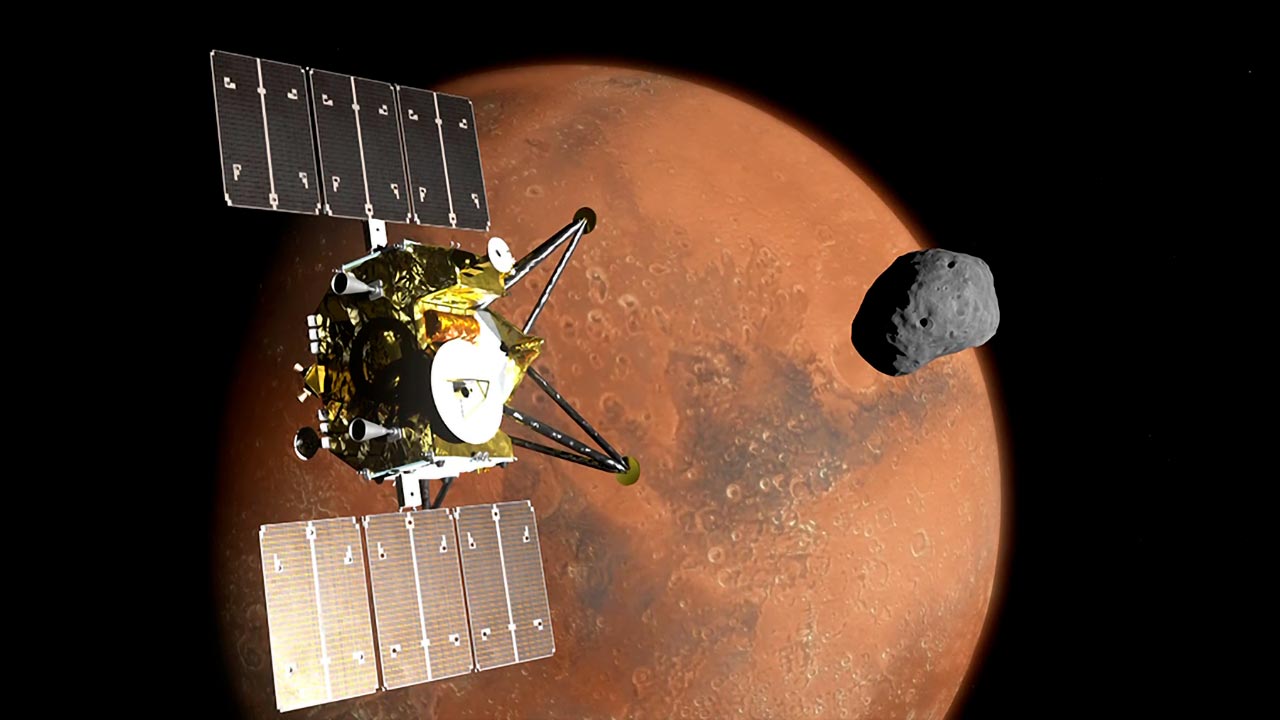
    JAXA Martian Moons eXploration (MMX)
    Martian Moons eXploration (MMX) Spacecraft. Credit: Japan Aerospace Exploration Agency (JAXA) /Japan Broadcasting Corporation (NHK)

    NASA’s MEGANE, developed for the MMX mission to study Mars’ moons, has been delivered to JAXA for integration, representing a milestone in space collaboration and scientific exploration.

    On March 14, NASA delivered its gamma-ray and neutron spectrometer instrument to JAXA (Japan Aerospace Exploration Agency) for integration onto JAXA’s MMX (Martian Moons eXploration) mission spacecraft and final system-level testing.

    NASA’s Mars-moon Exploration with Gamma Ray and Neutrons (MEGANE) instrument, developed by the Johns Hopkins Applied Physics Laboratory (APL) in Laurel, Maryland, in collaboration with colleagues from Lawrence Livermore National Laboratory (LLNL) in California, will play a major role in the MMX mission, which aims to characterize and determine the origin of Mars’ moons Phobos and Deimos and deliver a sample from Phobos to Earth.
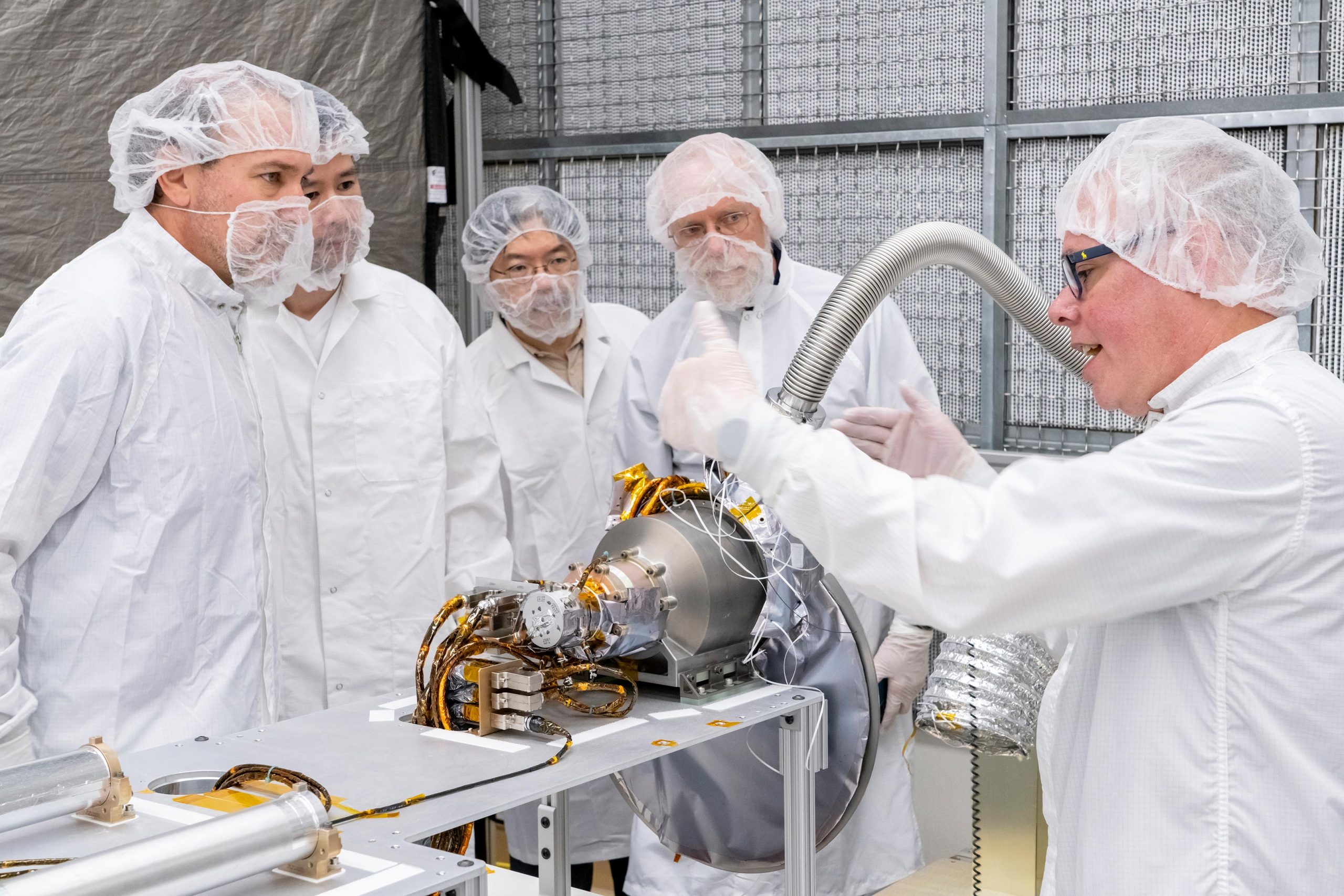
    Gamma Ray Spectrometer Portion of MEGANE Instrument
    U.S. and Japanese team members gather around and discuss the gamma-ray spectrometer portion of the MEGANE instrument during its development at Johns Hopkins APL. Credit: NASA/JAXA/Johns Hopkins APL/Ed Whitman

    Scientific Goals and Instrument Capabilities

    Scientists suspect the asteroid-sized bodies either are remnants of an ancient collision between Mars and a large impactor or are themselves asteroids captured by Mars’ gravity. By measuring the energies of neutrons and gamma rays emitted from the surface of Phobos, MEGANE will let MMX “see” the elemental composition of the moon’s surface and help peg the likely origin of the moon.

    “MEGANE will be a key instrument on MMX, making a big contribution toward the goal of understanding the origin of the Martian moons,” said Thomas Statler, MEGANE program scientist at NASA Headquarters in Washington. “NASA is glad to see MEGANE ready for integration, another step in NASA’s continuing collaboration with JAXA on this groundbreaking mission.”

    Instrument Development and Future Missions

    The instrument team received the green light last fall to ship MEGANE (pronounced meh-GAH-nay, the Japanese word for “eyeglasses”) after the project’s standing review board evaluated the device’s readiness. That milestone marked the end of a demanding 6-year design and development process, which met NASA’s cost and schedule constraints.

    “Passing the pre-ship review and delivering the hardware are significant steps for all those working on MEGANE,” said APL’s David Lawrence, the instrument’s principal investigator. “Like all spaceflight builds, we have had challenges getting to this point, but we are excited to see how MEGANE works with all the other spacecraft components for this exciting MMX mission.”

    With MEGANE now in Japan, the MMX team will begin integrating the scientific instruments, including MEGANE, with other spacecraft components, before putting the entire system through a series of tests in preparation for launch, which is scheduled for fiscal year 2026, aboard a JAXA H3 rocket.

    “For me personally, I’m looking forward to all the integration and test operations that are to come,” said Sarah Bucior, a space systems engineer in SES and the MEGANE I&T Lead Engineer. “I love rockets, so I’m really interested to see how they build their spacecraft and then follow it along to launch operations and liftoff.”

    MEGANE was developed under NASA’s Discovery Program, which provides low-cost access to space. The Discovery Program is managed by NASA’s Marshall Space Flight Center in Huntsville, Alabama for the Science Mission Directorate at NASA Headquarters in Washington. The instrument science team includes investigators from APL, LLNL, Marietta College, NASA’s Ames Research Center in California’s Silicon Valley, and JAXA.

    Never miss a breakthrough: Join the SciTechDaily newsletter.
    Follow us on Google and Google News.

    JAXA Mars Moons NASA
    Share. Facebook Twitter Pinterest LinkedIn Email Reddit

    Related Articles

    Mission to Martian Moons: NASA Handpicks 10 Scientists for JAXA’s MMX

    Incredible Video of Solar Eclipse on Mars – Captured by NASA’s Perseverance Rover

    Japan Space Agency: Why We’re Exploring the Moons of Mars

    Japan’s Mission to Mars’ Moon Phobos Will Bring a Sample Home by 2029

    Japan’s Martian Moons eXploration Mission Will Return a Sample From Mars’ Moon Phobos

    Could the Surface of the Martian Moon Phobos Reveal Secrets of Mars’ Past?

    Three Stunning New Views of Mars’ Moon Phobos Captured by NASA’s Odyssey Orbiter

    The Mars Rover Curiosity Planetary Protection Snafu

    NASA Curiosity Heads to Mars

    Leave A Reply Cancel Reply

    • Facebook
    • Twitter
    • Pinterest
    • YouTube

    Don't Miss a Discovery

    Subscribe for the Latest in Science & Tech!

    Trending News

    Millions Take These IBS Drugs, But a New Study Finds Serious Risks

    Scientists Unlock Hidden Secrets of 2,300-Year-Old Mummies Using Cutting-Edge CT Scanner

    Bread Might Be Making You Gain Weight Even Without Eating More Calories

    Scientists Discover Massive Magma Reservoir Beneath Tuscany

    Europe’s Most Active Volcano Just Got Stranger – Here’s Why Scientists Are Rethinking It

    Alzheimer’s Symptoms May Start Outside the Brain, Study Finds

    Millions Take This Popular Supplement – Scientists Discover a Concerning Link to Heart Failure

    The Universe Is Expanding Too Fast and Scientists Can’t Explain Why

    Follow SciTechDaily
    • Facebook
    • Twitter
    • YouTube
    • Pinterest
    • Newsletter
    • RSS
    SciTech News
    • Biology News
    • Chemistry News
    • Earth News
    • Health News
    • Physics News
    • Science News
    • Space News
    • Technology News
    Recent Posts
    • U.S. Waste Holds $5.7 Billion Worth of Crop Nutrients
    • Scientists Say a Hidden Structure May Exist Inside Earth’s Core
    • Doctors Surprised by the Power of a Simple Drug Against Colon Cancer
    • Why Popular Diabetes Drugs Like Ozempic Don’t Work for Everyone: The “Genetic Glitch”
    • Scientists Create Improved Insulin Cells That Reverse Diabetes in Mice
    Copyright © 1998 - 2026 SciTechDaily. All Rights Reserved.
    • Science News
    • About
    • Contact
    • Editorial Board
    • Privacy Policy
    • Terms of Use

    Type above and press Enter to search. Press Esc to cancel.