
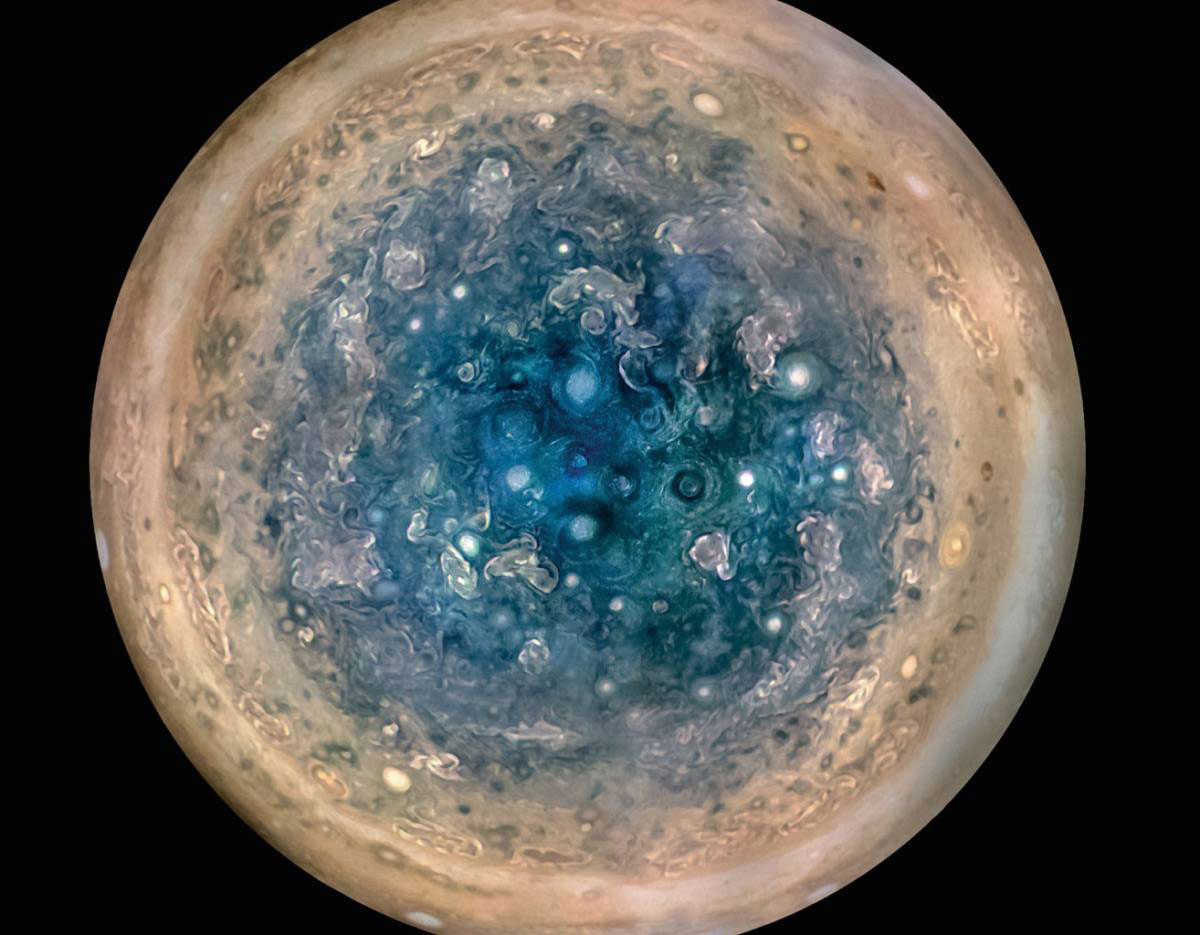
New results from the Juno Spacecraft show that Jupiter’s gravitational field is askew, with different patterns in its northern and southern hemispheres.
NASA’s Juno spacecraft has plumbed the depths of Jupiter, revealing that the planet’s famous bands of swirling winds extend thousands of kilometers down. The work is the sharpest glimpse yet into Jupiter’s interior.
Jupiter’s colorful stripes are atmospheric patterns composed of winds that flow alternately east and west. Until now, researchers haven’t been able to say whether those bands are confined to a shallow layer or reach deeper into the planet. “Determining this is one of the main goals of the Juno mission,” said team member Yohai Kaspi, a geophysicist at the Weizmann Institute of Science in Rehovot, Israel, on 18 October at the American Astronomical Society’s Division for Planetary Sciences meeting in Provo, Utah.
Juno arrived at Jupiter in July 2016 and has been looping around it once every 53 days. The mission has already revealed several mysterious phenomena, such as Jupiter’s patchy magnetic field and sets of cyclones that whirl around the planet’s north and south poles like dancers around a maypole.
By studying Jupiter’s gravitational field, researchers can probe thousands of kilometers into the planet. On each close fly-by, Juno measures the planet’s complex gravitational tug. These observations have already revealed that Jupiter has a small, ‘fuzzy’, poorly defined core.
Inner whirl
The latest results show that Jupiter’s gravitational field is askew, with different patterns in its northern and southern hemispheres, said Tristan Guillot, a planetary scientist at the Observatory of the Côte d’Azur in Nice, France. That suggests that its hydrogen-rich gas is flowing asymmetrically deep in the planet. “This is something that was not expected,” Guillot said at the meeting. “We were not sure at all whether we would be able to see that.”
Another clue to the structure of Jupiter’s interior came from how the gravity field varies with depth. Theoretical studies predict that the bigger the gravity signal, the stronger the flow of gas deep down. That information is important for teasing out whether all of Jupiter’s interior is rotating as a single solid body, or whether different layers spin separately from one another, like a set of nesting Russian dolls moving within each other.
Juno detected a gravity signal powerful enough to indicate that material is flowing as far down as 3,000 kilometers. “We’re just taking the clouds and the winds and extending them into the interior,” Kaspi said. Future work could help to pinpoint how strong the flow is at various depths, which could resolve whether Jupiter’s interior really resembles Russian dolls.
Juno scientists are now looking to see what else the gravity data will tell them, such as how far the famous storm called the Great Red Spot extends into the atmosphere. Another instrument aboard Juno has already hinted that the Great Red Spot’s roots may go hundreds of kilometers down, and it could go even deeper. “It’s not yet clear that it is so deep it will show up in gravity data,” said David Stevenson, a planetary scientist at the California Institute of Technology in Pasadena. “But we’re trying.”
Polar circles
Juno has also been peering into Jupiter’s depths in other ways. One big surprise from the mission was the clusters of cyclones at each pole, seen by Juno’s cameras in visible and infrared wavelengths. Scientists had not spotted the storms before because Juno is the first spacecraft to fly over Jupiter’s polar regions. There are eight cyclones around the north pole and five around the south pole — all are mysterious because computer modeling suggests that such small storms would not be stable in swirling polar winds.
The answer may lie in a quirky physics concept known as a vortex crystal, said Fachreddin Tabataba-Vakili, a planetary scientist at NASA’s Jet Propulsion Laboratory in Pasadena. Such crystals have been seen in a few Earth-based phenomena such as rotating superfluids; they are born when small vortices form and persist as the material in which they are embedded continues to flow.
Something about the flow around Jupiter’s poles may set up the same dynamics, Tabataba-Vakili said. Next up is to work out why there are eight cyclones at one pole and five at the other, he added.
Between Jupiter’s polar cyclones and its deep interior flows, Juno continues to tease out new surprises from the Solar System’s biggest planet. “It’s clear that giant planets have a lot of secrets,” Guillot said.
Never miss a breakthrough: Join the SciTechDaily newsletter.
Follow us on Google and Google News.