
Close Menu
    Facebook X (Twitter) Instagram
    SciTechDaily
    • Biology
    • Chemistry
    • Earth
    • Health
    • Physics
    • Science
    • Space
    • Technology
    Facebook X (Twitter) Pinterest YouTube RSS
    SciTechDaily
    Home»Biology»Just 2 Inches: Tiny Fossil Rewrites Our Understanding of Saber-Toothed Cats
    Biology

    Just 2 Inches: Tiny Fossil Rewrites Our Understanding of Saber-Toothed Cats

    By University of Texas at AustinJune 11, 2024No Comments5 Mins Read
    Facebook Twitter Pinterest Telegram LinkedIn WhatsApp Email Reddit
    Share
    Facebook Twitter LinkedIn Pinterest Telegram Email Reddit
    John Moretti Holding Skull
    Jackson School of Geosciences doctoral student John Moretti holds a skull of the saber-toothed cat Homotherium that is part of the Jackson School’s Vertebrate Paleontology Collections. Credit: Jackson School of Geosciences

    A small, “ugly” fossil unearthed in Texas has been identified as a Homotherium, expanding our understanding of this prehistoric cat’s geographic range and its ecological impact.

    Scientific discoveries don’t always come in the most spectacular forms. Sometimes, they are made from seemingly unremarkable objects, such as a small, nondescript rock. This was precisely the case with a 6-centimeter-wide (2.3 inches) mass of bone and teeth, which played a pivotal role in expanding the geographic knowledge of a large prehistoric cat. This fossil was studied by a team of researchers led by John Moretti, a doctoral student at the University of Texas at Austin, who revealed its significance. The research was recently published in The Anatomical Record.

    Homotherium serum Fossil
    In the fossil specimen that is the subject of this research paper, two teeth are visible breaking out at the bottom: an incisor, and the tip of a partially-erupted canine. The scale bar at the top right of the image is 1 centimeter. Credit: Sam Houston State University

    Unveiling Hidden Details

    “You can’t even tell what it is, let alone which animal it came from,” explained Moretti. “It’s like a geode. It’s ugly on the outside, and the treasure is all inside.”

    The fossil, appearing as a lumpy, rounded rock with a couple of exposed, worn teeth, had been shaped by its time on the Gulf of Mexico’s seabed before washing ashore. X-ray analysis at the Jackson School’s University of Texas Computed Tomography Lab exposed an additional, hidden canine tooth within the jawbone, unerupted and preserved.

    Homotherium Skull
    A skull from the saber-toothed cat Homotherium that is part of the Jackson School of Geosciences’ Vertebrate Paleontology Collections. Credit: Jackson School of Geosciences

    This crucial find allowed Moretti to identify the fossil as belonging to Homotherium, a genus of large cats that lived for millions of years across continents. Because this specific cat wasn’t fully grown when it died, its distinctive saber-like canine tooth had not fallen into its permanent position. Nestled inside the jaw, the tooth was protected from the elements.

    “Had that saber tooth been all the way erupted and fully in its adult form, and not some awkward teenage in-between stage, it would have just snapped right off,” Moretti said. “It wouldn’t have been there, and we wouldn’t have that to use as evidence.”
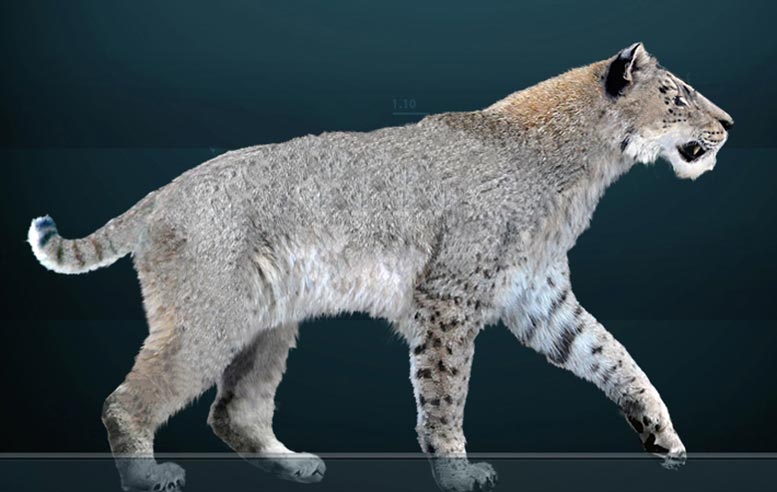
    Artist's Rendering of Homotherium serum
    An artist’s rendering of what a Homotherium could have looked like. Credit: Sergiodlarosa, Wikimedia Commons

    Insights into Prehistoric Ecology

    Homotherium spanned across habitats in Africa, Eurasia, and the Americas. It was a large, robust cat about the size of a jaguar, with an elongated face, lanky front legs, and a sloping back that ended in a bobtail. Their serrated canine teeth were covered by large gum flaps, similar to domestic dogs today.

    Their fossils have been found in several areas of Texas, but this fossil shows for the first time that the big cat roamed the now-submerged continental shelf that connects Texas and Florida. Scientists hypothesize that this stretch of land was a Neotropical corridor. Animals such as capybaras and giant armadillos that wouldn’t have ventured farther north used this strip of humid grassland to move from Mexico to Texas to Florida.

    Homotherium Canine Tooth
    A canine tooth belonging to the saber-toothed cat Homotherium that is part of the Jackson School of Geosciences’ Vertebrate Paleontology Collections. Credit: Jackson School of Geosciences

    The discovery that Homotherium lived along this corridor gives scientists a small glimpse into the ecology of this landscape during the Late Pleistocene, Moretti said. Big carnivores such as these cats helped shape the broader animal community, tamping down prey-animal populations and influencing regional biodiversity.

    Historical Contributions and Continuing Research

    The fossil specimen was discovered more than 60 years ago on McFaddin Beach, south of Beaumont, by Russell Long, a professor at Lamar University, but was donated by U.S. Rep. Brian Babin, a former student of Long’s who worked for 38 years as a dentist. Babin said that his training in paleontology and dentistry helped him recognize that what seems like a strange rock at first glance is actually an upper jaw bone and teeth.“Without question, my professional knowledge and what I’ve learned as a dentist helped me in that regard,” he said.
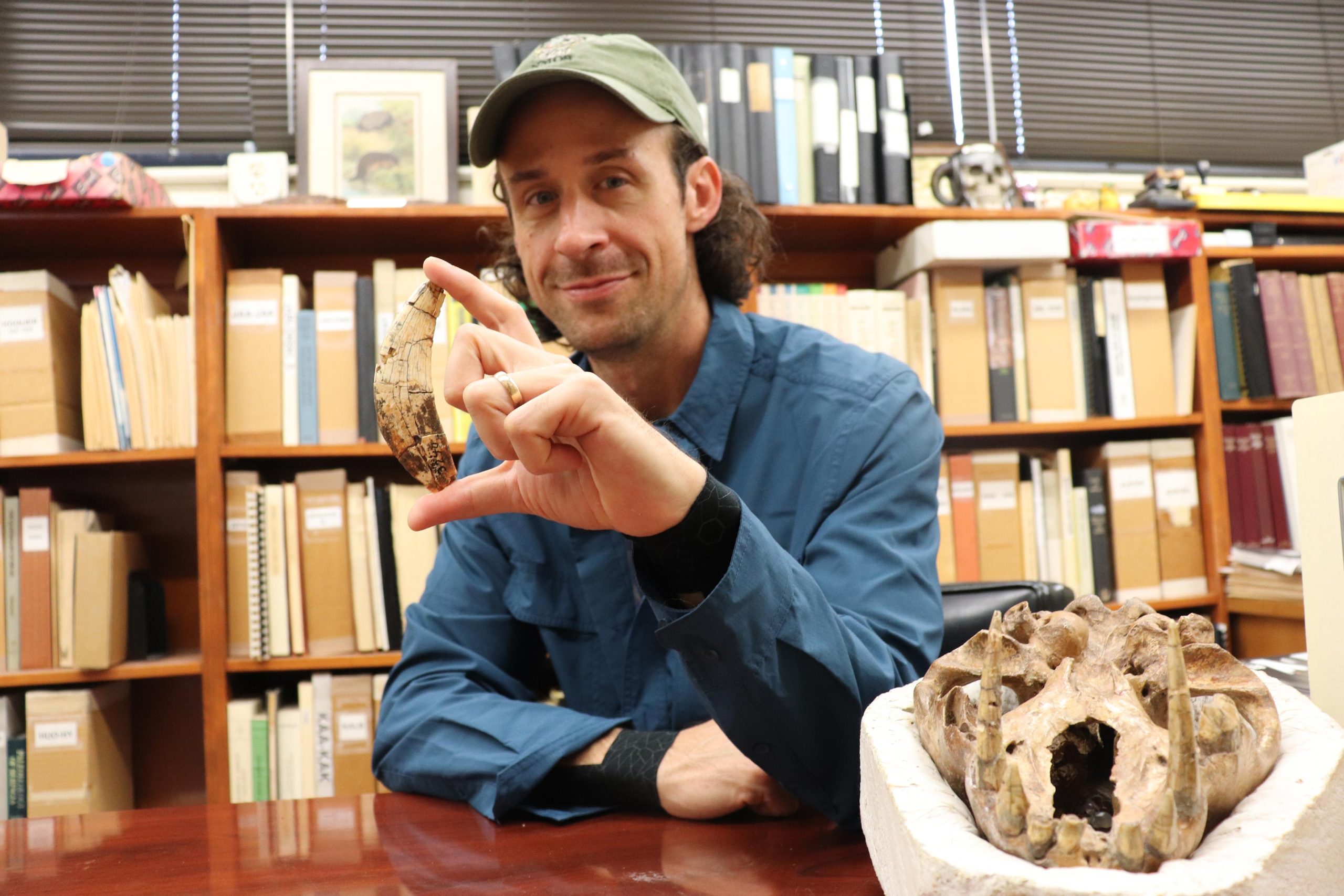
    John Moretti Holding Tooth
    Jackson School of Geosciences doctoral student John Moretti holds a canine tooth from the saber-toothed cat Homotherium that is part of the Jackson School’s Vertebrate Paleontology Collections. Credit: Jackson School of Geosciences

    The research is part of a larger initiative on McFaddin Beach fossils started in 2018 by William Godwin, curator at the Sam Houston State University Natural Science Museum and a co-author of the study. The research was funded by UT, Sam Houston State University, and North Carolina State University.

    Reference: “The scimitar-cat Homotherium from the submerged continental shelf of the Gulf Coast of Texas” by John A. Moretti, Deanna Flores, Christopher J. Bell, Will Godwin, Adam Hartstone-Rose and Patrick J. Lewis, 23 April 2024, The Anatomical Record.
    DOI: 10.1002/ar.25461

    Never miss a breakthrough: Join the SciTechDaily newsletter.
    Follow us on Google and Google News.

    Bones Extinction Fossils Paleontology Popular Teeth University of Texas at Austin
    Share. Facebook Twitter Pinterest LinkedIn Email Reddit

    Related Articles

    Great Whites May Have Contributed to Extinction of Megalodon Sharks

    Burnt Toast and Dinosaur Bones Have a Common Trait

    Paleontologists Discover First North American Co-occurrence of Hadrosaur and Therizinosaur Tracks

    Scientists Reveal the First Bird Beak, 3D Skull of Ichthyornis Dispar

    Newly Discovered Dinosaur (Mansourasaurus shahinae) Links Africa and Europe

    Pentecopterus – A Giant Sea Scorpion from the Prehistoric Seas

    New Species of Horned Dinosaur – Regaliceratops Peterhewsi

    Discovery of ‘Bird-Dinosaur’ Eosinopteryx Challenges Bird Evolution Theory

    Pegomastax Africanus, A Miniature Dinosaur That Thrived in Southern Africa

    Leave A Reply Cancel Reply

    • Facebook
    • Twitter
    • Pinterest
    • YouTube

    Don't Miss a Discovery

    Subscribe for the Latest in Science & Tech!

    Trending News

    AI Could Detect Early Signs of Alzheimer’s in Under a Minute – Far Before Traditional Tests

    What if Dark Matter Has Two Forms? Bold New Hypothesis Could Explain a Cosmic Mystery

    This Metal Melts in Your Hand – and Scientists Just Discovered Something Strange

    Beef vs. Chicken: Surprising Results From New Prediabetes Study

    Alzheimer’s Breakthrough: Scientists Discover Key Protein May Prevent Toxic Protein Clumps in the Brain

    Quantum Reality Gets Stranger: Physicists Put a Lump of Metal in Two Places at Once

    Scientists May Have Found the Key to Jupiter and Saturn’s Moon Mystery

    Scientists Uncover Brain Changes That Link Pain to Depression

    Follow SciTechDaily
    • Facebook
    • Twitter
    • YouTube
    • Pinterest
    • Newsletter
    • RSS
    SciTech News
    • Biology News
    • Chemistry News
    • Earth News
    • Health News
    • Physics News
    • Science News
    • Space News
    • Technology News
    Recent Posts
    • 250-Million-Year-Old Egg Solves One of Evolution’s Biggest Mysteries
    • Living With Roommates Might Be Changing Your Gut Microbiome Without You Knowing
    • Simple and Cheap Blood Test Could Detect Cancer and Other Diseases Before Symptoms Appear
    • Century-Old Cleaning Chemical Linked to 500% Increased Risk of Parkinson’s Disease
    • What if Your Memories Never Happened? Physicists Take a New Look at the Boltzmann Brain Paradox
    Copyright © 1998 - 2026 SciTechDaily. All Rights Reserved.
    • Science News
    • About
    • Contact
    • Editorial Board
    • Privacy Policy
    • Terms of Use

    Type above and press Enter to search. Press Esc to cancel.