
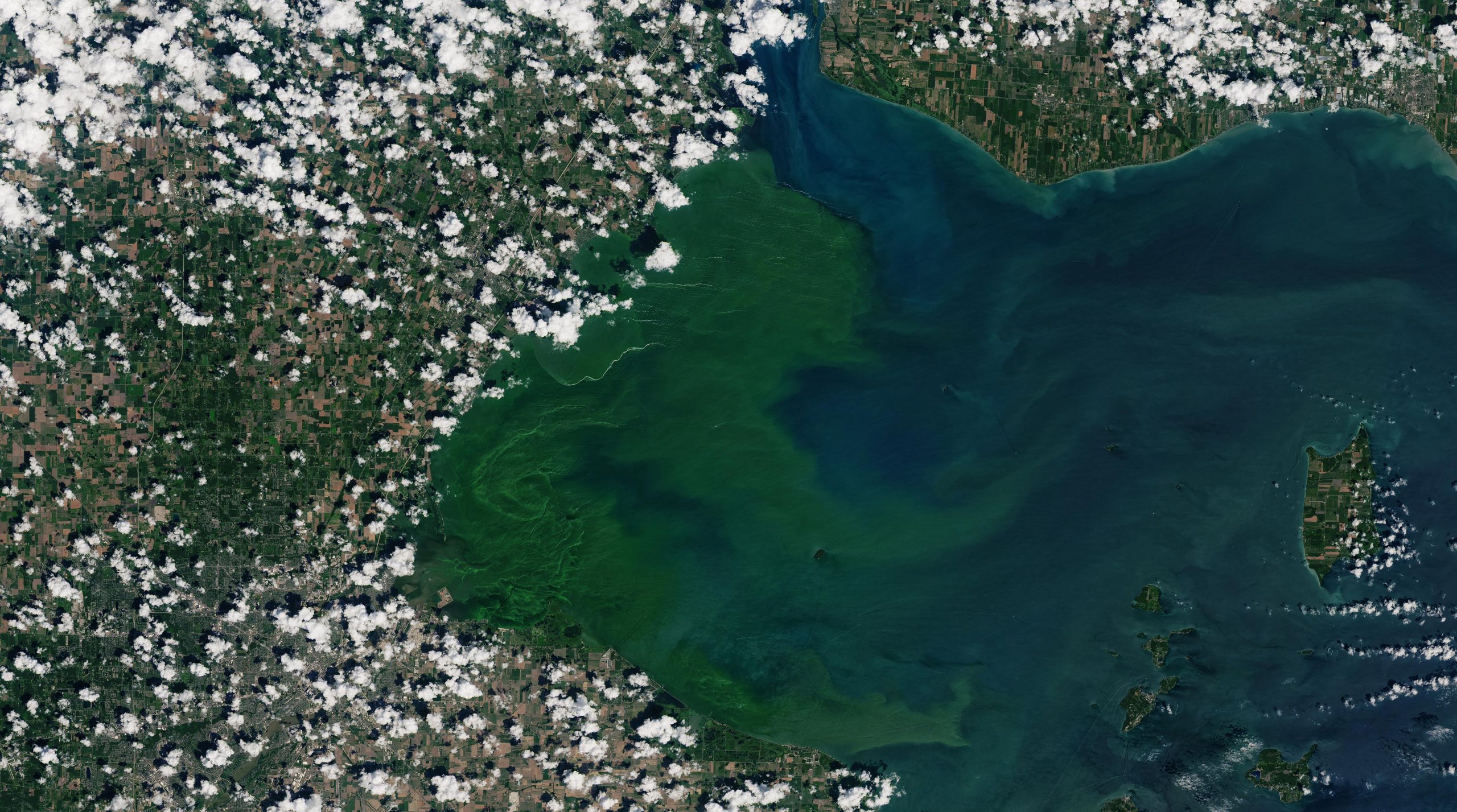
Scientists have traced Lake Erie’s deadly saxitoxin to a cyanobacterium called Dolichospermum.
During the warm summer months, Lake Erie becomes a prime environment for the rapid growth of cyanobacteria, also known as blue-green algae. When these microorganisms multiply excessively, they form algal blooms that release toxins capable of endangering both aquatic life and human health.
Researchers at the University of Michigan have now pinpointed the specific culprit behind some of these harmful toxins: a cyanobacterium known as Dolichospermum.
Harmful algal blooms (HABs) can consist of several cyanobacterial species, each capable of generating different toxins. Identifying which species produces which toxin allows scientists to better monitor, predict, and respond to the development of these dangerous blooms.
One such event in 2014 produced a toxin called microcystin, which posed a serious threat to Toledo’s drinking water supply. Earlier, in 2007, scientists detected traces of another powerful toxin known as saxitoxin in Lake Erie, though its biological source remained unknown. Saxitoxins are a family of closely related neurotoxins and are considered among the most potent naturally occurring toxins in the world.
“The main advantage of knowing which organism produces the toxin is that it helps us understand the conditions that cause toxin production—that is, what conditions make those organisms successful,” said Gregory Dick, professor of earth and environmental sciences and of environment and sustainability. “Such information can help guide policy and management, though we’re still a long way from that in this case.”
Using DNA Sequencing to Find the Source
To determine which cyanobacteria were producing the toxin, University of Michigan researchers collected samples from harmful algal blooms as they appeared in Lake Erie. Lead author Paul Den Uyl then applied a method known as “shotgun” sequencing, which involves decoding all of the DNA present in a single water sample. Using this data, he assembled a complete genome and searched it for genes linked to the production of saxitoxin.
The analysis revealed multiple strains of Dolichospermum living in the lake, but only certain ones were capable of generating the toxin. Although the reason for this difference remains unclear, the team began investigating environmental conditions that might influence when and how saxitoxin is produced.
To do this, they took samples from different locations on the lake throughout each season and quantified how much of the gene associated with saxitoxin was present in each sample. The researchers tended to find more of the gene in warm water.
“That is interesting because we do know that the lakes are changing with climate change,” said Den Uyl, a scientist at U-M’s Cooperative Institute for Great Lakes Research, or CIGLR. “With the warming of the lakes, one of the big questions is, how is that going to change the biological communities, including harmful cyanobacterial blooms?”
The researchers also found that the gene associated with saxitoxin production was less likely to be in areas that had higher concentrations of ammonium. They think this may be because Dolichospermum has an unusual adaptation: It has a gene that suggests it can use nitrogen in the form of dinitrogen, which is abundant in the atmosphere—not something many organisms can do, according to Dick.
A “Superpower” Among Microbes
“One of the neat things about having the whole genome is you can see everything the organism can do, at least theoretically,” said Dick, who is also director of CIGLR. “You have the whole blueprint for what the organism can do, and we do see the capability of obtaining fixed nitrogen from the water. It’s just that getting it in the form of dinitrogen gas is kind of a superpower. Not a lot of organisms can do that, and it makes them more competitive under those conditions.”
The researchers say they have been tracking saxitoxin in the lake for nine years, but that doesn’t provide enough data to tell whether saxitoxin production will increase as the lakes warm.
“But now that we know who’s producing it, I think we can keep a better watch on these organisms and we can also directly assess the gene abundance over time,” Dick said. “We plan to continue monitoring the abundance of this organism, but it’s too early to tell if it’s becoming more abundant. It’s just a correlation, but that correlation with temperature is concerning.”
Reference: “Genomic Identification and Characterization of Saxitoxin Producing Cyanobacteria in Western Lake Erie Harmful Algal Blooms” by Paul A. Den Uyl, E. Anders Kiledal, Reagan M. Errera, Subba Rao Chaganti, Casey M. Godwin, Heather A. Raymond and Gregory J. Dick, 10 April 2025, Environmental Science & Technology.
DOI: 10.1021/acs.est.4c10888
Never miss a breakthrough: Join the SciTechDaily newsletter.
Follow us on Google and Google News.