
Close Menu
    Facebook X (Twitter) Instagram
    SciTechDaily
    • Biology
    • Chemistry
    • Earth
    • Health
    • Physics
    • Science
    • Space
    • Technology
    Facebook X (Twitter) Pinterest YouTube RSS
    SciTechDaily
    Home»Technology»Layered Graphene Could Open Up New Ranges of Electronic Devices
    Technology

    Layered Graphene Could Open Up New Ranges of Electronic Devices

    By University of ManchesterSeptember 8, 2014No Comments3 Mins Read
    Facebook Twitter Pinterest Telegram LinkedIn WhatsApp Email Reddit
    Share
    Facebook Twitter LinkedIn Pinterest Telegram Email Reddit
    Layered Graphene Could Open Up New Ranges of Electronic Devices
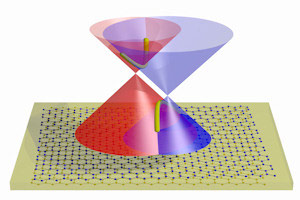
    Tunneling transistors could open up new ranges of electronic devices. Credit: University of Manchester

    Scientists at the University of Manchester have discovered that sandwiching layers of graphene with hexagonal boron nitride could produce designer materials capable of creating high-frequency electronic devices.

    Writing in Nature Nanotechnology, the researchers have demonstrated how combining the two-dimensional materials in a stack could create perfect crystals capable of being used in next-generation transistors.

    Hexagonal boron nitride (hBN), otherwise known as white graphene, is one of a family of two-dimension materials discovered in the wake of the isolation of graphene at the University in 2004. Manchester researchers have previously demonstrated how combining 2D materials, in stacks called heterostructures, could lead to materials capable of being designed to meet industrial demands.

    Now, for the first time, the team has demonstrated that the electronic behavior of the heterostructures can be changed enormously by precisely controlling the orientation of the crystalline layers within the stacks.

    The researchers, led by University of Manchester Nobel laureate Sir Kostya Novoselov, carefully aligned two graphene electrodes separated by hBN and discovered there was a conservation of electron energy and momentum.

    The findings could pave the way for devices with ultra-high frequencies, such as electronic or photovoltaic sensors.

    The research was carried out with scientists from Lancaster and Nottingham Universities in the UK, and colleagues in Russia, Seoul, and Japan.

    Professor Laurence Eaves, a joint academic from the Universities of Manchester and Nottingham, said: “This research arises from a beautiful combination of classical laws of motion and the quantum wave nature of electrons, which enables them to flow through barriers.”

    “We are optimistic that further improvements to the device design will lead to applications in high-frequency electronics.”

    Professor Vladimir Falko, from Lancaster University, added: “Our observation of tunneling and negative differential conductance in devices made of multilayers of graphene and hexagonal boron nitride demonstrates the potential that this system has for electronics applications.”

    “It is now up to material growers to find ways to produce such multilayer systems using growth techniques rather than mechanical transfer method used in this work.”

    Reference: “Twist-controlled resonant tunnelling in graphene/boron nitride/graphene heterostructures” by A. Mishchenko, J. S. Tu, Y. Cao, R. V. Gorbachev, J. R. Wallbank, M. T. Greenaway, V. E. Morozov, S. V. Morozov, M. J. Zhu, S. L. Wong, F. Withers, C. R. Woods, Y-J. Kim, K. Watanabe, T. Taniguchi, E. E. Vdovin, O. Makarovsky, T. M. Fromhold, V. I. Fal’ko, A. K. Geim, L. Eaves and K. S. Novoselov, 7 September 2014, Nature Nanotechnology.
    DOI: 10.1038/nnano.2014.187


    Never miss a breakthrough: Join the SciTechDaily newsletter.
    Follow us on Google and Google News.

    Graphene Nanotechnology University of Manchester
    Share. Facebook Twitter Pinterest LinkedIn Email Reddit

    Related Articles

    More Graphene Magic Starts When Flatness Ends: A Proton Permeability Puzzle Solved!

    Innovation Pioneers Score World First for Sustainable Construction With “Game-Changing” Graphene-Enhanced Concrete

    Findings to Help Achieve Holy Grail of 2D Materials – Superfast Electronic Devices

    Progressing Electronics Beyond Moore’s Law With Graphene and 2D Materials

    Graphene Paint Makes Impermeable and Chemically Resistant Coatings

    Researchers Develop Graphene Membrane Water Filters

    Graphene “Sandwich” Protects Microscopic Materials from Radiation

    2-D Boron has Potential Advantages over Carbon Nanotubes

    “Designer Electrons” Have Tunable Properties

    Leave A Reply Cancel Reply

    • Facebook
    • Twitter
    • Pinterest
    • YouTube

    Don't Miss a Discovery

    Subscribe for the Latest in Science & Tech!

    Trending News

    The Universe Is Expanding Too Fast and Scientists Can’t Explain Why

    “Like Liquid Metal”: Scientists Create Strange Shape-Shifting Material

    Early Warning Signals of Esophageal Cancer May Be Hiding in Plain Sight

    Common Blood Pressure Drug Shows Surprising Power Against Deadly Antibiotic-Resistant Superbug

    Scientists Uncover Dangerous Connection Between Serotonin and Heart Valve Disease

    Scientists Discover a “Protector” Protein That Could Help Reverse Hair Loss

    Bone-Strengthening Discovery Could Reverse Osteoporosis

    Scientists Uncover Hidden Trigger Behind Stem Cell Aging

    Follow SciTechDaily
    • Facebook
    • Twitter
    • YouTube
    • Pinterest
    • Newsletter
    • RSS
    SciTech News
    • Biology News
    • Chemistry News
    • Earth News
    • Health News
    • Physics News
    • Science News
    • Space News
    • Technology News
    Recent Posts
    • A Common Diabetes Drug May Hold the Key to Stopping HIV From Coming Back
    • Ancient “Syphilis-Like” Disease in Vietnam Challenges Key Scientific Assumptions
    • Drinking Alcohol To Cope in Your 20s Could Damage Your Brain for Life
    • Scientists Crack Alfalfa’s Chromosome Mystery After Decades of Debate
    • Ancient Ant-Plant Alliance Collapses As Predatory Wasps Move In
    Copyright © 1998 - 2026 SciTechDaily. All Rights Reserved.
    • Science News
    • About
    • Contact
    • Editorial Board
    • Privacy Policy
    • Terms of Use

    Type above and press Enter to search. Press Esc to cancel.