
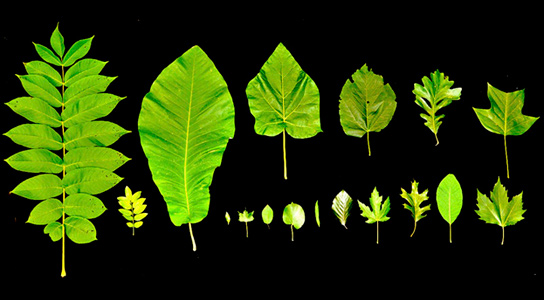
New research indicates that leaf growth may not be as complicated as it seems. When comparing species to species, shorter trees exhibit a greater variety of leaf sizes than taller ones, with the tallest trees all having leaves that measure 10 to 20 centimeters (4 to 8 inches) in length.
The scientists published their findings in the journal Physical Review Letters. The narrow size range may be simply explained in the inner workings of trees. If this is correct, this could also explain why the tallest trees can only attain about 100 meters (330 feet).
The team only considered angiosperms like maples and oaks, not gymnosperms, like pines and redwoods. They reviewed data for 1925 species and found that among angiosperms shorter than 30 meters (100 feet), leaf length varies enormously, from 3 cm (1.2 in) all the way up to 60 cm (24 in). The range narrows as the trees become taller.
The flow of sap and energy throughout the tree is what explains this. A leaf of an angiosperm produces a sugary sap that flows into a network of cells called the phloem, which transports the sap down to the tree’s trunk and through the roots. While it’s in transit, the tree metabolizes the sugar. The flow is driven by the difference in concentration in the sugars, which generates osmotic pressure.
The scientists modeled a tree as a pair of cylindrical tubes. A short, permeable tube, which represented the phloem in the leaf, was attached to a long, impermeable tube, the phloem in the trunk. Sap diffuses into the leaf phloem and travels down into the trunk phloem. The longer the permeable leaf tube is, the more the surface area it has, so the more easily sap can enter. In the trunk phloem, the longer the tube is, the more resistance it offers to flow.
The scientists then considered how the total flow of sap and energy varies with leaf length. If the leaves are big, the resistance from the trunk limits the flow and making the leaves bigger than a certain maximum length yields no additional flow or benefit. On the other hand, if the leaves are very small, their resistance limits the flow. And if the leaf is shorter than a certain minimum length, the sap would flow through the phloem more slowly than it could diffuse through the entire tree.
Trees taller than 100 meters simply could not produce leaves that obey both length limits, setting a limit for tree height. Other scientists think that the uniformity of leaf size amongst the tallest trees could come from the comparable environments and conditions that produce them.
One way to test how the flow speed varies with the height of a tree and the length of its leaves would be to directly measure it in different species of tall trees, but that might require taking an MRI machine into a rainforest canopy.
Reference: “Physical Limits to Leaf Size in Tall Trees” by Kaare H. Jensen and Maciej A. Zwieniecki, 4 January 2013, Physical Review Letters.
DOI: 10.1103/PhysRevLett.110.018104
Never miss a breakthrough: Join the SciTechDaily newsletter.
Follow us on Google and Google News.
1 Comment
It is interesting to note that length of the leaf is inversely proportional to the height of the tree, though the research confines itself to the angiosperms only at present. The leaves of the tree are the food producers namely starch and carbohydrates directly from carbon-di-oxide of the air, water from the roots or even fogs and finally the electricity from ultra-violet light of sun’s rays by photosynthetic emission of electrons from chlorophyll which tries to split water molecule and enables to free hydrogen to combine with carbon-di-oxide to form carbo-hydrates in the Calvin cycle. The produced starch or sugar is to be transported to many parts of the plant through phloem vessels for plant metabolism just as our blood vessels carry amino acids from food source to various cells of the body. For bigger leaves the journey of sugary sap through phloem is slow and could not reach far and wide thus limiting the height and overall volume of the tree. For small leaves the sap flows more easily far and wide and branches out and they can reach any physically possible height and volume. Thus the argument for smaller range of leaf size for taller plants is correct. Moreover in gymnosperms also the leaves of banian tree and neem tree are smaller in size compared with creepers with large leaves. The fruits of bigger trees are also smaller because after all it is only the leaf which modifies into a flower and then fertilizes into a fruit and nut. A good and interesting research indeed. Thank YOu.