
Animal testing will no longer be required to assess a group of deadly neurotoxins, thanks to University of Queensland-led research.
Associate Professor Bryan Fry, of UQ’s Venom Evolution Lab, said a new technique could replace conventional methods of testing paralytic neurotoxins, which previously required euthanasia of test subjects.
“The old method, while extremely efficient, is limited in that it’s slow and requires the euthanization of animals in order to obtain the necessary tissue,” Dr. Fry said.
“Our new method uses optical probes dipped into a solution containing the venoms and we measure the binding to these probes – the critical factor – by analyzing changes in the light reflected back.
“It’s going to reduce the numbers of animals used for research testing, but it also has significant biomedical implications.”
Testing and trialing paralytic neurotoxins is not only critical for research into anti-venoms, but also for the treatment of a wide array of diseases and conditions.
“The team can now – without the use of animal subjects – screen venoms for non-target activities that may be relevant for drug design and development, helping treat all types of ailments,” Dr. Fry said.
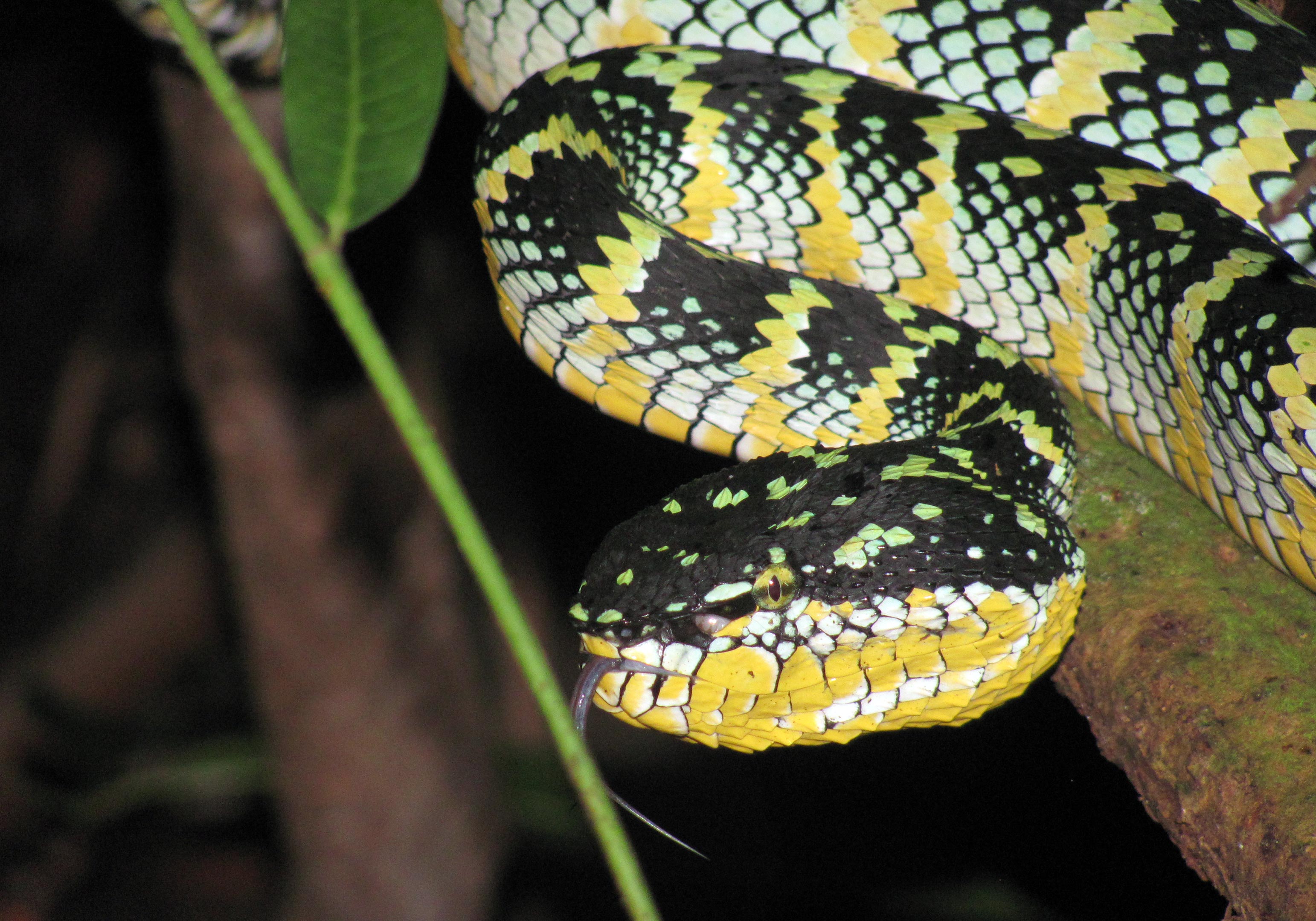
“For example, we’ve shown that temple pit viper venom has an unusual cross-reactivity for the human alpha-5 receptor, which is a major target for conditions including colitis and smoking.
“Who knows what other potential treatments the world’s venoms could lead to – we’re excited to find out.”
The technology relies on the development of synthetic peptides that correspond to nerve receptors, which tell our muscles to contract.
“Neurotoxins, found in the venom of many types of snakes, cause paralysis by attaching to nerve receptors in our muscles, preventing the normal chemical binding process that naturally occurs in our bodies when we want to move,” Dr. Fry said.
“This is what stops a mouse fleeing from a snake after it has been bitten.
“Since venoms bind to the synthetic peptides more vigorously than they do to human nerves, we’re also investigating a new treatment of snakebite, using these peptides as ‘decoys’.
“The venom would bind to them instead of their original nervous system target in the human body.
“Many species of deadly snake lack an effective anti-venom, so these sorts of applications may help meet this critical need.
“This underscores the flexibility of this novel technique and why we’re so excited about this breakthrough.”
The research has been published in the MDPI journal Toxins.
Reference: “A Taxon-Specific and High-Throughput Method for Measuring Ligand Binding to Nicotinic Acetylcholine Receptors” by Christina N. Zdenek, Richard J. Harris, Sanjaya Kuruppu, Nicholas J. Youngman, James S. Dobson, Jordan Debono, Muzaffar Khan, Ian Smith, Mike Yarski, David Harrich, Charlotte Sweeney, Nathan Dunstan, Luke Allen and Bryan G. Fry, 16 October 2019, Toxins.
DOI: 10.3390/toxins11100600
Never miss a breakthrough: Join the SciTechDaily newsletter.
Follow us on Google and Google News.
1 Comment
For years, scientists have tested the effects of nerve agents such as sarin and VX – used as chemical weapons in warfare and terror attacks – on animals. But animal experiments are limited in their ability to predict the effects on humans due to the difference in nervous systems between species. Furthermore, it was quite brutal. Reading https://www.rfdtv.com/story/44466682/sad-facts-about-animal-testing article has taught me several sad facts about animal testing. I am glad to see that a replacement for some of the most lethal neurotoxins being tested on animals has been developed by scientists in the Netherlands.