
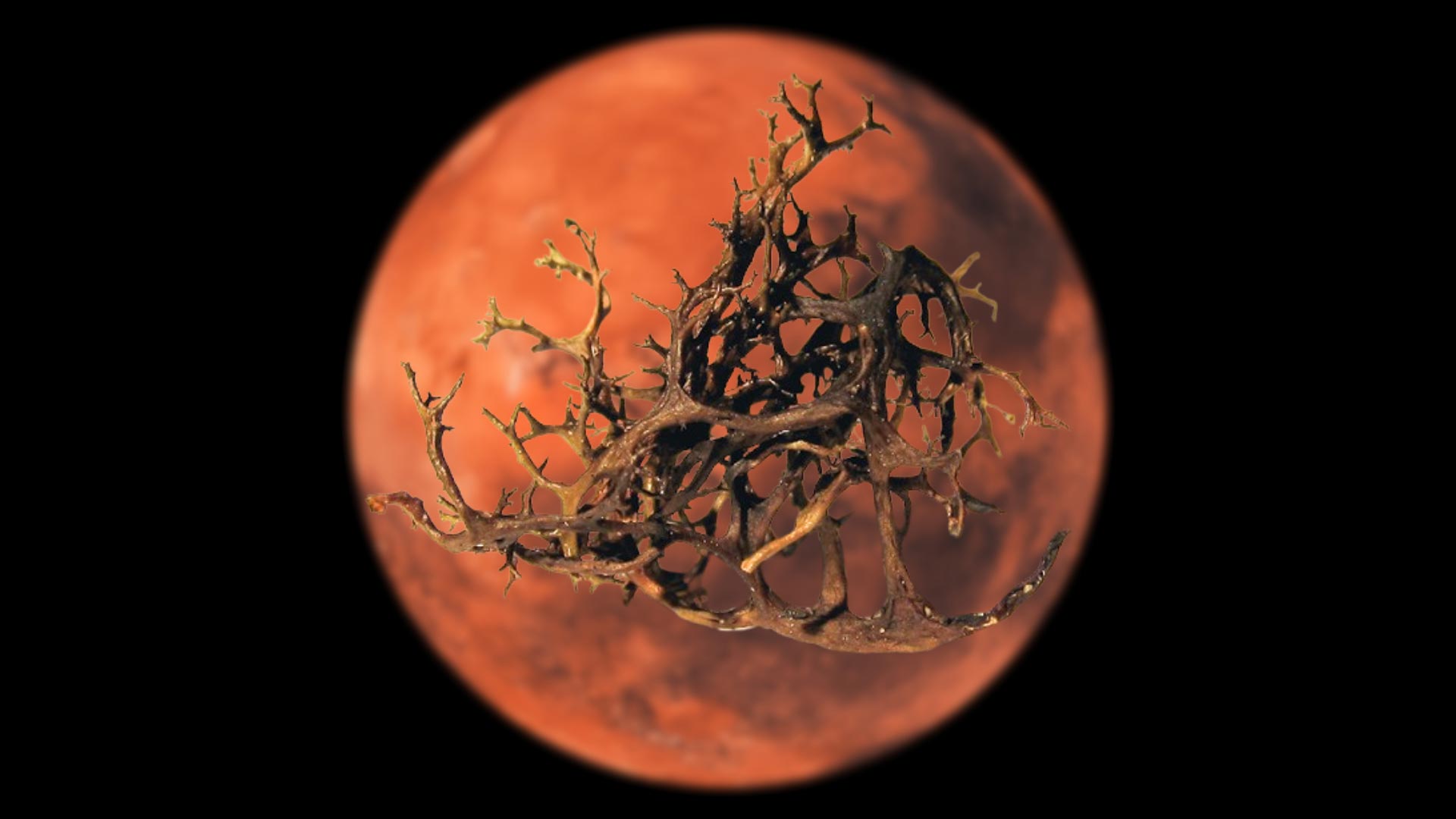
In an experiment simulating harsh Martian conditions, including X-ray radiation, scientists discovered that certain lichens can not only survive but remain metabolically active.
This breakthrough reveals that life as we know it, particularly symbiotic organisms like lichens, might be far more adaptable than previously thought, reshaping ideas about what kinds of life could exist beyond Earth.
Lichens Survive Mars-Like Conditions
For the first time, scientists have shown that certain lichen species can survive Mars-like conditions, including exposure to ionizing radiation, while remaining metabolically active.
The findings, published in the open-access journal IMA Fungus, suggest that lichens may be able to survive and function on the surface of Mars. This challenges long-standing assumptions about the planet’s uninhabitable nature and offers new insights for astrobiology and future space exploration.

Nature’s Toughest Symbiosis
Lichens are not a single organism, but a partnership between a fungus and algae or cyanobacteria. They are known for their remarkable ability to endure extreme environments, such as deserts and polar regions on Earth. In this study, researchers found that the fungal component of the lichen remained metabolically active under simulated Martian conditions, including darkness and X-ray radiation levels equivalent to one year of intense solar activity on Mars.
The study tested two species of lichen, Diploschistes muscorum and Cetraria aculeata, chosen for their contrasting traits. Both were exposed for five hours to a Mars simulation chamber that replicated the planet’s atmosphere, pressure, temperature shifts, and radiation.

Resilient Life Under Radiation
The findings suggest that lichens, particularly D. muscorum, could potentially survive on Mars despite the high doses of X-ray radiation associated with solar flares and energetic particles reaching the planet’s surface. These results challenge the assumption that ionizing radiation is an insurmountable barrier to life on Mars and set the stage for further research on the potential for extraterrestrial microbial and symbiotic survival.
Lead author of the paper, Kaja Skubała, said: “Our study is the first to demonstrate that the metabolism of the fungal partner in lichen symbiosis remained active while being in an environment resembling the surface of Mars. We found that Diploschistes muscorum was able to carry out metabolic processes and activate defense mechanisms effectively.
Adapting to Alien Worlds
“These findings expand our understanding of biological processes under simulated Martian conditions and reveal how hydrated organisms respond to ionizing radiation – one of the most critical challenges for survival and habitability on Mars. Ultimately, this research deepens our knowledge of lichen adaptation and their potential for colonizing extraterrestrial environments.”
Further long-term studies investigating the impact of chronic radiation exposure on lichens have been recommended, as well as experiments assessing their survival in real Martian environments.
Reference: “Ionizing radiation resilience: how metabolically active lichens endure exposure to the simulated Mars atmosphere” by Kaja Skubała, Karolina Chowaniec, Mirosław Kowaliński, Tomasz Mrozek, Jarosław Bąkała, Ewa Latkowska and Beata Myśliwa-Kurdziel, 31 March 2025, IMA Fungus.
DOI: 10.3897/imafungus.16.145477
The study was conducted by researchers from Jagiellonian University and the Space Research Centre of the Polish Academy of Sciences, and supported by the National Science Centre, Poland, and the “Excellence Initiative – Research University” at the Faculty of Biology, Jagiellonian University.
Never miss a breakthrough: Join the SciTechDaily newsletter.
Follow us on Google and Google News.
1 Comment
NOTE 2504130342_Source1. Analyzing
1.
Clothing Challenges Mars: Earth’s Strongest Organism, Survives Simulated Mars’ Extreme Environment.
In experiments simulating Mars’ harsh environment, including X-ray radiation, the scientists found that certain mosses not only survive but also maintain active metabolic activity.
The results of the study show that lichens live on the surface of Mars